Q.Find the potential energy of a system of four particles placed at the vertices of a square of side . Also obtain the potential at the centre of the square.
You're viewing a preview — the full solution, concept, methods & PYQ mapping are locked.
Start your 14-day free trial to unlock the full solution →The total gravitational potential energy of the system is the sum of potential energies of all unique pairs of particles, resulting in . The gravitational potential at the center of the square is the sum of potentials due to each particle, which is .
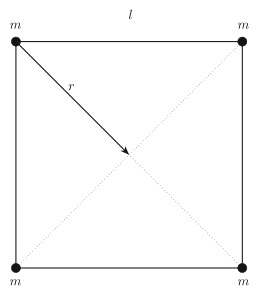
The figure shows a square of side length . At each of the four corners sits an identical point mass . The two diagonals are drawn as dotted lines, crossing at the square’s centre. One half-diagonal — the distance from the centre to a corner — is labelled , with an arrow pointing from the corner toward the centre.
This diagram is the physical setup for calculating the gravitational potential energy of a system of four equal masses at the vertices of a square. The key idea is that gravitational potential energy is a scalar sum over every distinct pair of masses. You do not add vectors; you add the potential energy for each pair, using the formula for two point masses separated by a distance :
For four identical masses , there are pairs. The figure helps you see which distances appear in the sum. The side length gives the distance between adjacent masses (four such pairs). The diagonal of the square is , so the distance between opposite corners is (two such pairs). The half-diagonal is not used directly in the pair sum — it is simply , and the textbook may use it later to relate the centre to the corners, but the potential energy sum itself depends only on .
The total gravitational potential energy of the system is therefore:
The first term covers the four sides, the second term covers the two diagonals. Simplifying:
A common mistake is to forget that the diagonal pairs are distinct from the side pairs. The figure’s dotted diagonals are a visual reminder: each diagonal connects two masses that are not neighbours, and their separation is larger than , so their contribution to the potential energy is smaller in magnitude (less negative) than that of a side pair.
The half-diagonal in the figure is . It is not used in the pair sum above, but it becomes important when you later calculate the gravitational potential at the centre of the square, or the force on a mass placed there. For the potential energy of the four-mass system, only the distances between the masses themselves matter — and those are and .
The figure thus grounds the idea that gravitational potential energy of a system is a sum over all pairs, and that geometry determines which distances appear in that sum. The square is a simple, symmetric case that lets you practise counting pairs and applying the inverse-distance formula without vector complications.
When dealing with systems of particles under gravity, we often need to calculate two key quantities: the gravitational potential energy of the system and the gravitational potential at a specific point. Both are scalar quantities, meaning they only have magnitude and no direction, which simplifies calculations as we just add them algebraically.
The gravitational potential energy of a system of particles represents the total work done by an external agent to assemble the system from an infinite separation, where the potential energy is considered zero. Alternatively, it's the negative of the work done by the gravitational forces during this assembly. For a system of multiple particles, the total potential energy is the sum of the potential energies of every unique pair of particles in the system.
The gravitational potential energy between two point masses and separated by a distance is given by:
Note the negative sign, indicating an attractive force and that work must be done against gravity to separate the masses.
The gravitational potential at a point is defined as the gravitational potential energy per unit mass at that point. It tells us how much potential energy a unit mass would have if placed at that location. For a system of particles, the total potential at a point is the algebraic sum of the potentials due to each individual particle.
The gravitational potential at a distance from a point mass is given by:
Like potential energy, gravitational potential is also always negative.
Let's apply these concepts to the given problem. We have four particles, each of mass , placed at the vertices of a square of side .
Part 1: Potential Energy of the System
-
Identify the particles and their arrangement:
Imagine the square's vertices labeled A, B, C, D in a clockwise manner. Each vertex has a particle of mass . The side length is .
-
Identify all unique pairs of particles:
For a system of particles, the number of unique pairs is . Here, , so there are unique pairs.
These pairs can be categorized by their separation distance:
- Side pairs: (A,B), (B,C), (C,D), (D,A). There are 4 such pairs.
- Diagonal pairs: (A,C), (B,D). There are 2 such pairs.
-
Calculate the distance for each type of pair:
- For side pairs, the distance is simply the side length . …
Unlock everything free for 14 days
- Full step-by-step solutions
- Concept-first explanations
- Methods, shortcuts & mistakes
- PYQ mapping + timed mock tests
Full access for 14 days. No credit card required.