Physics · Ch 12 — Kinetic Theory
Law of Equipartition of Energy
Law of Equipartition of Energy
The Core Idea: Why Energy Spreads Evenly
The kinetic theory gives us a microscopic picture of a gas: a huge number of molecules in ceaseless, random motion. Each molecule can store energy in different ways — it can move (translational kinetic energy), it can rotate (rotational kinetic energy), and its atoms can vibrate back and forth (vibrational kinetic and potential energy). The question is: if you have a gas at a certain temperature, how is the total internal energy shared among all these different forms?
The law of equipartition of energy provides the answer. It states that for a system in thermal equilibrium at temperature , the total energy is equally divided among all the independent ways a molecule can store energy. Each such independent way is called a degree of freedom, and each degree of freedom gets, on average, an energy of per molecule (or per mole).
The law of equipartition of energy: For a system in thermal equilibrium at temperature , the average energy associated with each quadratic degree of freedom is per molecule (or per mole).
This is not a theorem that can be proved from Newton's laws alone; it is a result of statistical mechanics (the Boltzmann distribution). But it is one of the most powerful tools for understanding the specific heat capacities of gases.
Degrees of Freedom of a Molecule
Before applying the law, we must count the degrees of freedom for different types of molecules.
1. Monatomic gas (e.g., He, Ar, Ne): A single atom. It can only move in three independent directions (x, y, z). It has 3 translational degrees of freedom. It cannot rotate (a point has no moment of inertia about any axis through it) and does not vibrate (no bonds). So total degrees of freedom, .
2. Diatomic gas (e.g., H₂, O₂, N₂): Two atoms joined by a bond.
- Translational: The centre of mass can move in 3 directions. So 3 translational degrees of freedom.
- Rotational: The molecule can rotate about two axes perpendicular to the bond axis. Rotation about the bond axis itself (the line joining the atoms) has a negligible moment of inertia for a diatomic molecule (the atoms are effectively points on that axis), so it does not store significant energy at ordinary temperatures. So 2 rotational degrees of freedom.
- Vibrational: The atoms can vibrate along the bond. This involves both kinetic energy (of the atoms moving towards and away from each other) and potential energy (of the stretched/compressed bond). Each of these is a quadratic term in the energy expression. So vibration contributes 2 vibrational degrees of freedom (one kinetic, one potential).
At ordinary temperatures (around room temperature), the vibrational modes are usually not excited. The energy required to start a vibration is much larger than . So for most practical purposes at room temperature, a diatomic molecule has degrees of freedom.
At very high temperatures, the vibrational modes become active, and the total degrees of freedom become . The specific heat then increases. This is why the law of equipartition is a classical result; quantum mechanics explains why some degrees of freedom are "frozen out" at low temperatures.
3. Triatomic (or polyatomic) gas:
- Linear molecule (e.g., CO₂): All atoms lie on a line.
- Translational: 3
- Rotational: 2 (about two axes perpendicular to the molecular axis) …
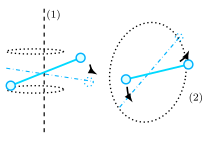
Drawn by us to help you understand the concept clearly, and verified to make sure it's accurate. For exams, practice from your textbook's own diagram.
The figure shows two separate sketches of a diatomic molecule — two spheres (the atoms) joined by a straight line (the bond). In each sketch the molecule is enclosed inside a dashed elliptical orbit, and a curved arrow runs along that ellipse to indicate rotation. The two panels are labelled (1) and (2). The key point is that the two ellipses lie in perpendicular planes, and both planes are perpendicular to the bond axis.
What the figure is teaching is that a diatomic molecule can rotate about two independent axes, each perpendicular to the line joining the atoms. Rotation about the bond axis itself is not considered because the moment of inertia about that axis is negligible — the atoms are point-like on the scale of the bond length, so rotating end-over-end about the bond would involve almost no energy. That leaves exactly two rotational degrees of freedom.
Each panel shows one of those two allowed rotations. In panel (1) the molecule rotates about an axis that goes through its centre of mass and is perpendicular to the plane of the page (or perpendicular to the bond in one direction). In panel (2) it rotates about a second axis, also through the centre of mass and perpendicular to the bond, but oriented at right angles to the first axis. The dashed ellipse in each case traces the path that the atoms follow as they rotate.
A diatomic molecule has two rotational degrees of freedom, not three. The third possible axis (the bond axis itself) contributes negligibly to the rotational kinetic energy.
The textbook uses this figure to develop the law of equipartition of energy. For a molecule in thermal equilibrium at temperature , each quadratic degree of freedom (each independent way the molecule can store energy as a square of a coordinate or momentum) gets an average energy of .
For a diatomic molecule:
- 3 translational degrees of freedom (motion of the centre of mass in , , )
- 2 rotational degrees of freedom (the two axes shown in the figure)
- At high enough temperatures, 2 vibrational degrees of freedom (kinetic and potential energy of the bond vibration)
So the total internal energy per molecule is:
at temperatures where vibration is active. At room temperature, vibration is usually frozen out, so only the translational and rotational modes contribute:
where is the total number of active quadratic degrees of freedom. For a diatomic molecule at moderate temperatures, (3 translational + 2 rotational).
Each symbol:
- = internal energy per molecule
- = Boltzmann constant () …