Q.(i) Explain Stefan's law and obtain Newton's law of cooling from Stefan's law. [4 marks]
You're viewing a preview — the full solution, concept, methods & PYQ mapping are locked.
Start your 14-day free trial to unlock the full solution →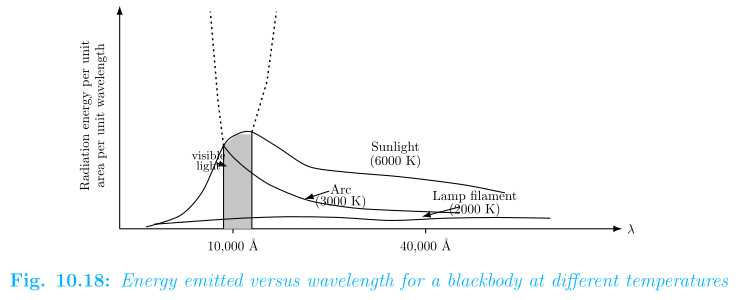
Stefan's law (E = sigma*T^4) reduces to Newton's law of cooling (rate proportional to deltaT) for small temperature differences between a body and its surroundings; the black-body spectral-energy curve peaks at a wavelength that shifts to shorter wavelengths as temperature rises.
Stefan's law: The total energy radiated per unit time, per unit surface area, by a perfectly black body is directly proportional to the fourth power of its absolute temperature:
E = sigmaT^4 where sigma is the Stefan-Boltzmann constant (sigma ~ 5.6710^-8 W/(m^2*K^4)).
For a body at temperature T placed in surroundings at temperature T0 (T0 < T), it also absorbs radiation from the surroundings at a rate sigmaT0^4 per unit area, so the net rate of loss of energy per unit area is: E_net = sigma(T^4 - T0^4)
Deriving Newton's law of cooling from Stefan's law: Suppose the temperature difference between the body and its surroundings is small, i.e. T = T0 + deltaT with deltaT much less than T0. Then:
T^4 = (T0+deltaT)^4 = T0^4 * (1 + deltaT/T0)^4
Using the binomial approximation (1+x)^4 ~ 1 + 4x for small x = deltaT/T0:
T^4 ~ T0^4 * (1 + 4deltaT/T0) = T0^4 + 4T0^3*deltaT
So:
T^4 - T0^4 ~ 4T0^3deltaT = 4T0^3(T-T0)
Hence the net rate of loss of heat per unit area becomes:
E_net ~ 4sigmaT0^3*(T-T0)
Since T0 is (nearly) constant, this shows E_net is proportional to (T-T0) - i.e. for small temperature differences, the rate of loss of heat is directly proportional to the temperature difference between the body and its surroundings. This is exactly Newton's law of cooling, now derived as a small-deltaT approximation of the more fundamental Stefan's law.
…
Unlock everything free for 14 days
- Full step-by-step solutions
- Concept-first explanations
- Methods, shortcuts & mistakes
- PYQ mapping + timed mock tests
Full access for 14 days. No credit card required.