Q.Prove that the fundamental frequency of an open organ pipe is double that of a closed organ pipe of the same length. Draw the necessary diagram.
You're viewing a preview — the full solution, concept, methods & PYQ mapping are locked.
Start your 14-day free trial to unlock the full solution →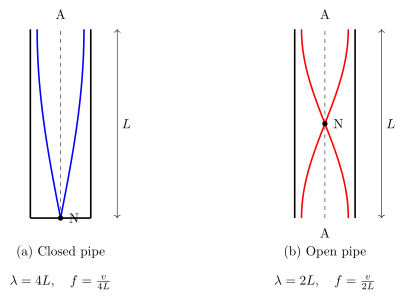
An open pipe's fundamental has λ = 2L (f = v/2L); a closed pipe's fundamental has λ = 4L (f = v/4L); so the open pipe's fundamental is exactly double the closed pipe's.
Closed organ pipe (closed at one end, open at the other): At the closed end, air cannot move, so there must be a displacement NODE there; at the open end, air is free to move maximally, so there is an ANTINODE there. In the simplest (fundamental) standing-wave pattern that fits this boundary condition, the pipe length L contains exactly one-quarter of a wavelength (node to adjacent antinode = λ/4):
L = λ_c / 4 ⟹ λ_c = 4L
Fundamental frequency: f_c = v / λ_c = v / (4L)
[Diagram: a closed pipe of length L drawn with a node (N) at the closed end and an antinode (A) at the open end, with a quarter-wavelength sine curve fitted between them.]
Open organ pipe (open at both ends): Air is free to move at BOTH ends, so there is a displacement ANTINODE at each end, with one node in between (at the middle, for the fundamental). This fundamental pattern fits exactly half a wavelength into the pipe length L (antinode to adjacent antinode = λ/2):
L = λ_o / 2 ⟹ λ_o = 2L …
Unlock everything free for 14 days
- Full step-by-step solutions
- Concept-first explanations
- Methods, shortcuts & mistakes
- PYQ mapping + timed mock tests
Full access for 14 days. No credit card required.