Business Studies · Ch 7 — Directing
Communication
Communication
Communication is the thread that holds an organisation together. A manager may have immense professional knowledge and intelligence, but without the ability to communicate effectively with subordinates, that knowledge is useless. Directing ability depends almost entirely on communication skills, which is why organisations constantly emphasise improving these skills for both managers and employees.
What is Communication?
The word 'communication' comes from the Latin word communis, meaning 'common' — implying a common understanding between people. It is generally understood as the process of exchanging ideas, views, facts, feelings, etc., between or among people to create that common understanding.
Management experts define it in slightly different ways:
- Louis Allen: "Communication is the sum of all things one person does when he wants to create understanding in the mind of another. It involves systematic and continuous process of telling, listening and understanding."
- Harold Koontz and Heinz Weihrich: "Communication is transfer of information from the sender to the receiver with the information being understood by the receiver."
- Rogers: "Communication is a process by which people create and share information with one another in order to reach common understanding."
A close examination of these definitions reveals that communication is fundamentally the process of exchange of information between two or more persons to reach common understanding.
Elements of the Communication Process
Communication is a process, and it involves eight key elements:
- Sender: The person who conveys his thoughts or ideas to the receiver. The sender is the source of communication.
- Message: The content of ideas, feelings, suggestions, orders, etc., intended to be communicated.
- Encoding: The process of converting the message into communication symbols such as words, pictures, gestures, etc.
- Media (Channel): The path through which the encoded message is transmitted to the receiver. The channel may be in written form, face-to-face, phone call, internet, etc.
- Decoding: The process of converting the encoded symbols of the sender back into a message.
- Receiver: The person who receives the communication from the sender.
- Feedback: All those actions of the receiver indicating that he has received and understood the message of the sender.
- Noise: Some obstruction or hindrance to communication. This hindrance may be caused to the sender, message, or receiver. Examples include:
- Ambiguous symbols that lead to faulty encoding.
- A poor telephone connection.
- An inattentive receiver.
- Faulty decoding (attaching wrong meanings to the message).
- Prejudices obstructing the poor understanding of the message.
- Gestures and postures that may distort the message.
Importance of Communication
Communication is one of the most central aspects of managerial activities. It has been estimated that a manager spends 90 percent of his time communicating — reading, writing, listening, guiding, instructing, approving, reprimanding, etc. An ex-president of the American Management Association once observed that the number one management problem today is communication. Bernard called it the foundation of all group activities. Communication serves as the lubricant fostering smooth operations of the management process. Its importance can be judged from the following points:
- Acts as basis of coordination: Communication provides coordination among departments, activities, and persons in the organisation by explaining organisational goals, the mode of their achievement, and inter-relationships between different individuals.
- Helps in smooth working of an enterprise: All organisational interactions depend on communication. The job of a manager is to coordinate human and physical elements into an efficient working unit. Communication is basic to an organisation's existence — right from its birth through its continuing life. When communication stops, organised activity ceases to exist.
- Acts as basis of decision making: Communication provides the needed information for decision making. Without it, managers cannot take any meaningful decision.
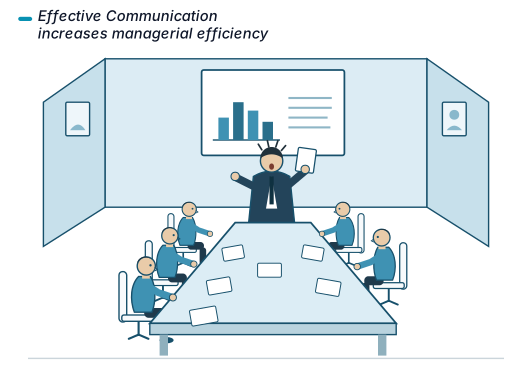
- Increases managerial efficiency: Communication is essential for quick and effective performance of all managerial functions. The management conveys goals, issues instructions, allocates jobs, and looks after performance. Communication lubricates the entire organisation and keeps it working with efficiency.
- Promotes cooperation and industrial peace: Efficient operation is possible only when there is industrial peace and mutual cooperation between management and workers. Two-way communication promotes this cooperation and mutual understanding.
- Establishes effective leadership: Communication is the basis of leadership. To influence people, a leader must possess good communication skills.
- Boosts morale and provides motivation: An efficient communication system enables management to motivate, influence, and satisfy subordinates. It assists workers in their adjustment to the physical and social aspects of work, improves human relations, and is the basis of participative and democratic management.
Formal and Informal Communication
Communication within an organisation can be broadly classified into two types.
Formal Communication
Formal communication flows through official channels designed in the organisation chart. It may take place between a superior and subordinate, a subordinate and superior, or among employees of the same cadre. It may be oral or written, but it is generally recorded and filed in the office. Formal communication is further classified as:
- Vertical Communication: Flows vertically, i.e., upwards or downwards through formal channels.
- Upward Communication: Flow from subordinate to superior. Examples: application for grant of leave, submission of progress report, request for grants.
- Downward Communication: Flow from superior to subordinate. Examples: sending notice to employees to attend a meeting, ordering subordinates to complete assigned work, passing on guidelines from top management.
- Horizontal (Lateral) Communication: Takes place between one division and another. For example, a production manager may contact a marketing manager to discuss product delivery schedules, product design, or quality.
Communication Networks in Formal Organisation: The pattern through which communication flows is indicated through a communication network. Different types include:
| Network | Description |
|---|---|
| Single Chain | Exists between a supervisor and his subordinate. Communication flows from every superior to his subordinate through a single chain, as many levels exist in the organisation structure. |
| Wheel | All subordinates under one superior communicate through him only, as he acts as the hub of the wheel. Subordinates are not allowed to talk among themselves. |
| Circular | Communication moves in a circle. Each person can communicate with his adjoining two persons. Communication flow is slow. |
| Free Flow | Each person can communicate with others freely. The flow of communication is fast. |
| Inverted V | A subordinate is allowed to communicate with his immediate superior as well as his superior's superior. However, in the latter case, only prescribed communication takes place. |
Informal Communication (Grapevine)
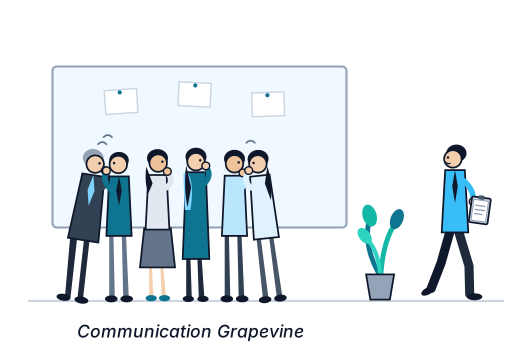
Communication that takes place without following the formal lines of communication is called informal communication. It is generally referred to as the 'grapevine' because it spreads throughout the organisation with branches going out in all directions, disregarding levels of authority. It arises out of the needs of employees to exchange views that cannot be done through formal channels. Examples include workers chit-chatting in a canteen about a superior's behaviour or discussing rumours about transfers.
The grapevine spreads rapidly and sometimes gets distorted. It is very difficult to detect the source. It can lead to rumours which are not authentic and may hamper the work environment. However, it can also be helpful as it carries information rapidly and can be used by managers to transmit information and know the reactions of subordinates. An intelligent manager should make use of the positive aspects of informal channels and minimise the negative ones.
Grapevine Networks:
- Single Strand Network: Each person communicates to the other in sequence.
- Gossip Network: Each person communicates with all on a non-selective basis.
- Probability Network: The individual communicates randomly with other individuals.
- Cluster Network: The individual communicates only with those people he trusts. This is the most popular type in organisations.
Barriers to Communication
Managers often face problems due to communication breakdowns or barriers. These barriers may prevent communication, filter part of it, or carry incorrect meaning, leading to misunderstandings. The barriers can be broadly grouped into four categories.
1. Semantic Barriers
Semantics is the branch of linguistics dealing with the meaning of words and sentences. Semantic barriers are problems in the process of encoding and decoding a message into words or impressions, usually resulting from wrong words, faulty translations, or different interpretations.
- Badly expressed message: Intended meaning may not be conveyed due to inadequate vocabulary, wrong words, or omission of needed words.
- Symbols with different meanings: A word may have several meanings. For example, the word 'value' in different contexts: "What is the value of this ring?" vs. "I value our friendship." Wrong perception leads to communication problems.
- Faulty translations: When a communication is translated from one language to another, mistakes may creep in if the translator is not proficient in both languages.
- Unclarified assumptions: Communications may have assumptions subject to different interpretations. For example, a boss instructing, "Take care of our guest," may mean arranging transport, food, and accommodation, while the subordinate may interpret it as taking the guest to a hotel.
- Technical jargon: Specialists often use technical jargon when explaining to non-specialists, who may not understand the actual meaning.
- Body language and gesture decoding: Every movement of the body communicates meaning. If there is no match between what is said and what is expressed in body movements, the communication may be wrongly perceived.
2. Psychological Barriers
Emotional or psychological factors act as barriers. For example, a worried person cannot communicate properly, and an angry receiver cannot understand the real meaning of a message.
- Premature evaluation: People sometimes evaluate the meaning of a message before the sender completes it, due to pre-conceived notions or prejudices.
- Lack of attention: A pre-occupied mind and resultant non-listening of the message acts as a major barrier. For instance, an employee explains a problem to a boss who is pre-occupied with an important file.
- Loss by transmission and poor retention: When communication passes through various levels, successive transmissions result in loss of or inaccurate information, especially in oral communication. People also cannot retain information for long if they are inattentive.
- Distrust: If the parties do not believe each other, they cannot understand each other's message in its original sense.
3. Organisational Barriers
Factors related to organisation structure, authority relationships, and rules and regulations may act as barriers.
- Organisational policy: If the policy is not supportive of free flow of communication, it hampers effectiveness. For example, in a highly centralised organisation, people may not be encouraged to have free communication.
- Rules and regulations: Rigid rules and cumbersome procedures can be a hurdle. Communication through prescribed channels may result in delays.
- Status: The status of a superior may create a psychological distance between him and his subordinates. A status-conscious manager may not allow subordinates to express their feelings freely.
- Complexity in organisation structure: Where there are many managerial levels, communication gets delayed and distorted as the number of filtering points increases.
- Organisational facilities: Lack of facilities for smooth, clear, and timely communication — such as frequent meetings, suggestion boxes, complaint boxes, and social gatherings — can create communication problems.
4. Personal Barriers
The personal factors of both sender and receiver may influence effective communication.
- Fear of challenge to authority: If a superior perceives that a particular communication may adversely affect his authority, he may withhold or suppress it.
- Lack of confidence of superior on his subordinates: If superiors do not have confidence in the competency of their subordinates, they may not seek their advice or opinions.
- Unwillingness to communicate: Subordinates may not be prepared to communicate with superiors if they perceive it may adversely affect their interests.
- Lack of proper incentives: If there is no motivation or incentive for communication (e.g., no reward or appreciation for a good suggestion), subordinates may not take the initiative to communicate.
Improving Communication Effectiveness …
Drawn by us to help you understand the concept clearly, and verified to make sure it's accurate. For exams, practice from your textbook's own diagram.
Our own simplified rendering of the real page's boardroom scene: a speaker stands beside a chart, gesturing with a pointer while presenting data to five seated listeners, each taking notes.
What it teaches: communication is not a side activity for a manager — it is the channel through which plans, instructions and feedback actually reach the people who must act on them. A manager who communicates clearly and confirms understanding (through feedback) gets work executed correctly the first time, avoiding the wasted effort and rework that follow from a garble …
Communication is the sum of all things one person does when he wants to create understanding in the mind of another. It involves systematic and continuous process of telling, listening and understanding.
— Louis Allen
Communication is transfer of information from the sender to the receiver with the information being understood by the receiver.
— Harold Koontz and Heinz Weihrich …
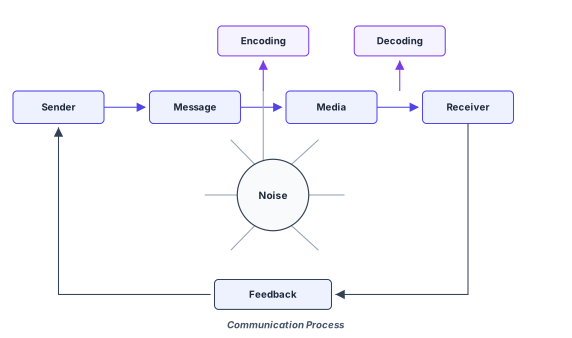
Communication unfolds as a sequence of linked steps, shown here exactly as the textbook diagrams it. The Sender originates a Message, which is put into symbols the receiver can understand — this is Encoding. The encoded message travels through Media (the channel) — a phone call, a memo, a face-to-face conversation. At the other end, the Receiver converts the symbols back into meaning — this is Decoding. …
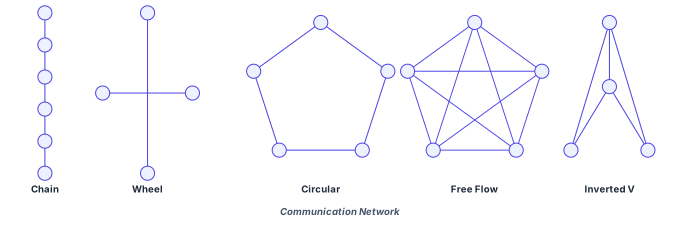
Formal communication does not always flow the same way — the pattern it follows is called a communication network, and the book illustrates five of them. In a Single Chain, messages pass down through the levels of the hierarchy one link at a time. In a Wheel, every subordinate reports only to the one superior at the centre, with no side conversations allowed between subordinates. A Circular network lets each person talk only to the two people beside them, so a message travels slowly around the ring. A Free Flow network removes those restrictions entirely — everyone can talk to everyone — so information moves fastest here. …
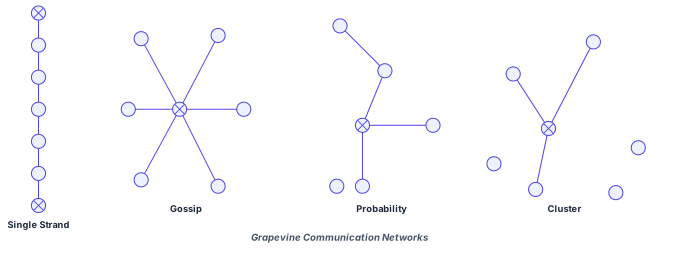
Grapevine communication — the informal, unofficial channel running alongside the formal one — does not follow just one pattern either. In a Single Strand network, each person tells the next person in a line, like passing a note down a row. In a Gossip network, one person becomes the hub and tells everyone else directly, without being selective about who hears it. A Probability network is genuinely random: the person with the information tells whoever they happen to run into, so the message reaches some people and skips others by chance. …
Drawn by us to help you understand the concept clearly, and verified to make sure it's accurate. For exams, practice from your textbook's own diagram.
Our own illustration of the grapevine — the informal, unofficial communication that runs alongside the formal channels. Employees cluster and pass news by word of mouth while a manager, kept outside the loop, walks past. It shows how rumours and casual talk spread …