Business Studies · Ch 1 — Nature and Significance of Management
Management is multidimensional
Management is multidimensional
Management is Multidimensional
Management is not a simple, one-dimensional activity. It is a complex, multidimensional process that involves handling three distinct but interconnected aspects of an organisation. These three dimensions are: Management of Work, Management of People, and Management of Operations.
1. Management of Work
Every organisation exists to perform some specific work. For example:
- A factory manufactures a product.
- A garment store satisfies a customer’s need.
- A hospital treats a patient.
Management’s role is to translate this work into clear goals and then assign the means to achieve those goals. This involves breaking down the work into concrete tasks such as:
- Problems to be solved
- Decisions to be made
- Plans to be established
- Budgets to be prepared
- Responsibilities to be assigned
- Authority to be delegated
In short, management converts the broad purpose of the organisation into actionable steps.
2. Management of People
Human resources are an organisation’s greatest asset. Despite all technological advancements, “getting work done through people” remains a core task for every manager.
Managing people has two dimensions:
- As individuals: Employees have diverse needs, behaviors, and backgrounds. A manager must deal with each person’s unique traits.
- As a group: People also work in teams. A manager must handle group dynamics and ensure collective effort.
The ultimate task is to make people work towards achieving the organisation’s goals by:
- Making their strengths effective
- Making their weaknesses irrelevant
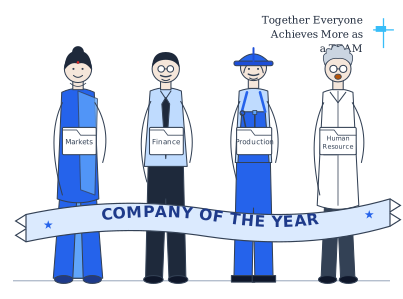
This dimension is often summarised by the acronym TEAM — Together Everyone Achieves More.
3. Management of Operations
No matter what the organisation, it must provide a basic product or service to survive. This requires a production process — a series of steps that convert inputs (raw materials, labour, etc.) into outputs (finished goods or services).
Management of operations involves:
- Designing and overseeing the production process
- Ensuring that the product or service is delivered efficiently and effectively
- Coordinating resources like materials, machines, and manpower
This dimension ensures that the organisation’s core work is carried out smoothly.
Summary Table
| Dimension | Focus | Key Idea |
|-----------|-------|----------| …
Drawn by us to help you understand the concept clearly, and verified to make sure it's accurate. For exams, practice from your textbook's own diagram.
What the Figure Shows
This is a light illustration placed beside the discussion of management of people. It shows four members of an organisation standing together and proudly holding up a banner that reads "COMPANY OF THE YEAR". Each person represents a different function of the enterprise — one from Markets (marketing), one from Finance, one from Production (drawn as a worker in a hard hat) and one from Human Resource (drawn as a professor-like figure).
What It Teaches …
Drawn by us to help you understand the concept clearly, and verified to make sure it's accurate. For exams, practice from your textbook's own diagram.
What the Figure Shows
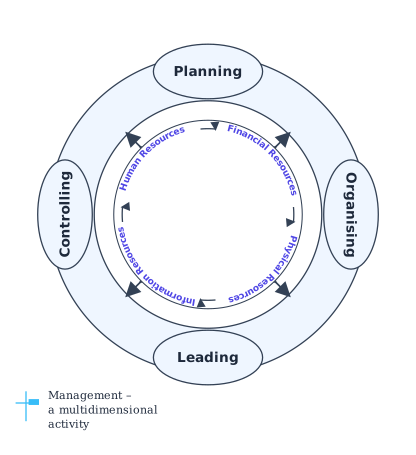
The figure is a circular ring — like a wheel — with two concentric circles. The outer ring is divided into four segments, each labelled with one of the four management functions:
- Planning (at the top)
- Organising (on the right)
- Leading (at the bottom)
- Controlling (on the left)
Each function is connected by a double-headed arrow to the inner ring, which is also divided into four segments. The inner ring carries the four resources a manager manages:
- Human Resources
- Financial Resources
- Physical Resources
- Information Resources
The arrows point both ways — from each function to each resource and back — showing that management does not act on resources one at a time. Instead, all four functions operate simultaneously on all four resources.
What It Teaches
The figure visually reinforces the textbook’s point that management is multidimensional. It is not a single, linear activity. A manager must:
- Plan how to use people, money, equipment, and data.
- Organise these resources into a working structure.
- Lead the human resources while coordinating the others.
- Control by checking actual performance against plans for all resources. …