Computer Science · Ch 12 — Security Aspects
Ransomware
Ransomware
Ransomware is malware built around one simple, cruel idea: your data is your most valuable possession, and the attacker will hold it hostage until you pay. Unlike viruses that quietly corrupt files or spyware that silently watches you, ransomware makes its presence loudly known — it announces that your files are locked, and it names its price.
The core target of ransomware is user data. The attack works in one of two broad ways. Some ransomware simply blocks your access to the data — you can see your files, but you cannot open them, move them, or use them in any way. Other, more dangerous variants encrypt the data, scrambling it with a key that only the attacker holds. Encryption makes recovery genuinely difficult, because without the decryption key, the files are effectively gibberish. In both cases, the attacker then demands a ransom payment in exchange for restoring your access.
There is a third, nastier variation worth knowing: some ransomware does not block or encrypt at all, but instead threatens to publish your personal data online unless you pay. This is a form of blackmail — the data stays intact, but the threat of public exposure is the weapon.
The textbook grounds this in a real, dramatic example. In May 2017, a ransomware called WannaCry infected nearly 200,000 computers across 150 countries. It worked by encrypting data and then demanding ransom payments in the Bitcoin cryptocurrency — a deliberate choice, since Bitcoin transactions are hard to trace, making the ransom difficult to follow. The name is a pun: it literally made its victims "cry," because they watched their files get locked and were forced to consider paying up.
Ransomware's defining feature is the demand for payment — it is not just about damaging data, but about extorting the victim. The two main technical methods are blocking access and encrypting data, with a third variant threatening to publish personal data online.
A quick summary of the key points: …
Drawn by us to help you understand the concept clearly, and verified to make sure it's accurate. For exams, practice from your textbook's own diagram.
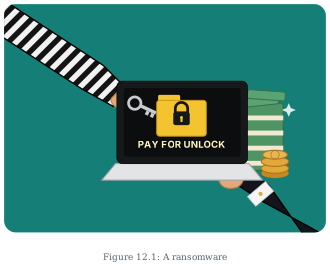
The illustration is a single, self-contained scene rather than a multi-panel diagram. The background is a flat teal colour, and the action is built around a laptop placed at the centre of the frame. On the laptop's screen sits a yellow folder icon, locked with a padlock, and directly beneath it the words PAY FOR UNLOCK appear in plain text. That folder is the victim's data — sealed away and unusable until a condition is met.
Two figures interact with the laptop from opposite sides, and their clothing tells you who they are. From the top-left, an arm in a striped sleeve — the classic visual shorthand for a burglar or thief — reaches down toward the laptop holding a small key. The key is the threat: it signals that the attacker holds the means to release the data, but will not use it freely. From the bottom-right, a second arm in a business suit extends a stack of banknotes and coins toward the laptop. That is the victim, or the victim's agent, offering payment.
The composition makes the relationship unmistakable. The thief's key and the victim's money both point at the same locked folder, and the screen's demand — PAY FOR UNLOCK — sits exactly between them. There are no arrows, panels, or labels beyond that text; the meaning is carried entirely by the arrangement of the three elements: locked data, the key held by the attacker, and the ransom offered by the victim. …