Biology · Ch 7 — Human Health and Disease
AIDS
AIDS
AIDS stands for Acquired Immuno Deficiency Syndrome. The name itself tells you what it is: a deficiency of the immune system that is acquired during a person's lifetime — it is not a congenital (inherited) disease. The word 'syndrome' means a group of symptoms that occur together.
AIDS was first reported in 1981. In the twenty-five years or so after that, it spread across the world and killed more than 25 million people.
The Cause: HIV
AIDS is caused by the Human Immunodeficiency Virus (HIV). HIV belongs to a group of viruses called retroviruses. These viruses have an envelope that surrounds an RNA genome.
How HIV is Transmitted
HIV infection spreads only through body fluids. It does not spread by mere touch or physical contact. This is a crucial point: people infected with HIV/AIDS must not be isolated from family and society — both for their physical and psychological well-being.
Transmission occurs through four main routes:
- Sexual contact with an infected person.
- Transfusion of contaminated blood and blood products.
- Sharing infected needles, especially among intravenous drug abusers.
- From an infected mother to her child through the placenta.
Who is at High Risk?
- Individuals who have multiple sexual partners.
- Drug addicts who take drugs intravenously.
- Individuals who require repeated blood transfusions.
- Children born to an HIV-infected mother.
Think about when people need repeated blood transfusions — conditions like thalassemia, haemophilia, or severe anaemia. Make a list of such conditions.
The Time Lag
There is always a time lag between the HIV infection and the appearance of AIDS symptoms. This period can vary from a few months to many years — usually 5 to 10 years.
What Happens Inside the Body (Replication of HIV)
Once HIV enters the body, it follows a specific path:
- The virus enters macrophages (a type of immune cell).
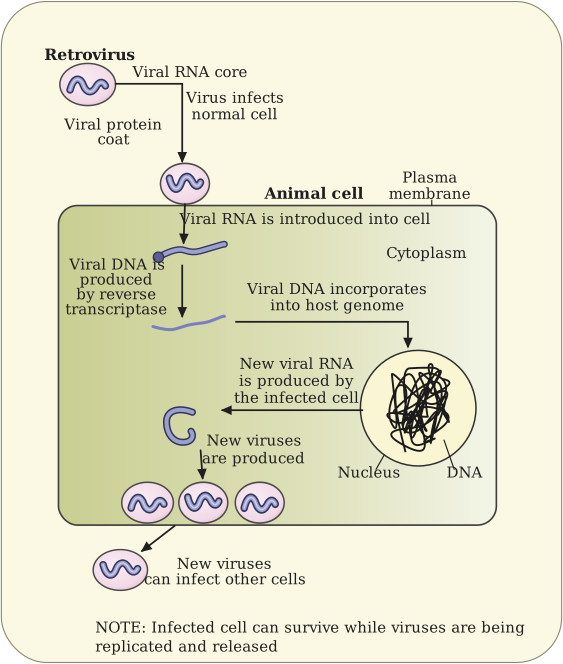
- Inside the macrophage, the viral RNA genome replicates to form viral DNA with the help of an enzyme called reverse transcriptase.
- This viral DNA gets incorporated into the host cell's DNA.
- The infected cell is then directed to produce new virus particles. The macrophage continues to produce virus, acting like an HIV factory.
Simultaneously, HIV enters helper T-lymphocytes (TH cells). Inside these cells, it replicates and produces progeny viruses. These new viruses are released into the blood and attack other helper T-lymphocytes. This cycle repeats, leading to a progressive decrease in the number of helper T-lymphocytes in the body.
Symptoms and Progression
During the period of decreasing T-cell count, the person suffers from:
- Bouts of fever
- Diarrhoea
- Weight loss
Because the number of helper T-lymphocytes falls, the person becomes vulnerable to infections that a healthy immune system would normally overcome. These include infections from:
- Bacteria (especially Mycobacterium)
- Viruses
- Fungi
- Parasites (like Toxoplasma)
The patient becomes so immuno-deficient that they cannot protect themselves against these infections.
Diagnosis
A widely used diagnostic test for AIDS is ELISA (Enzyme-Linked Immuno-Sorbent Assay).
Treatment
Treatment of AIDS uses anti-retroviral drugs. However, this treatment is only partially effective. It can prolong the life of the patient but cannot prevent death, which is inevitable.
Prevention: The Best Option
Since AIDS has no cure, prevention is the best option. HIV infection often spreads due to conscious behaviour patterns — it is not something that happens inadvertently like pneumonia or typhoid. (Infection through blood transfusion or from mother to child can happen due to poor monitoring, but the only excuse for most cases is ignorance. The saying goes: "Don't die of ignorance.")
Steps Taken for Prevention
- National AIDS Control Organisation (NACO) and other NGOs in India are educating people about AIDS.
- WHO has started programmes to prevent the spread of HIV infection.
Specific measures include: …
Drawn by us to help you understand the concept clearly, and verified to make sure it's accurate. For exams, practice from your textbook's own diagram.
Figure 7.6 is a generic diagram of how a retrovirus replicates inside an animal cell — it is not HIV-specific, and the word "HIV" never appears anywhere on the figure itself.
The diagram opens with a retrovirus particle labelled Retrovirus, showing its viral RNA core and viral protein coat. A caption "Virus infects normal cell" leads into a larger box labelled Animal cell, bounded by the plasma membrane, with the cytoplasm labelled inside it. The next caption reads "Viral RNA is introduced into cell", followed by "Viral DNA is produced by reverse transcriptase" (shown as the RNA strand being converted into a DNA strand), and then "Viral DNA incorporates into host genome", with an arrow pointing to a large circle labelled Nucleus containing tangled thread-like lines labelled DNA.
From the nucleus, a caption "New viral RNA is produced by the infected cell" leads back out to the cytoplasm, where "New viruses are produced" is captioned above three newly-formed virus-particle icons inside the cell. A final caption, "New viruses can infect other cells", points to a separate virus particle drawn outside the cell. A closing note printed at the bottom of the figure reads: "Infected cell can survive while viruses are being replicated and released." …