Q.i) Define antibiotic.
[1+1+1+1=4] OR
You're viewing a preview — the full solution, concept, methods & PYQ mapping are locked.
Start your 14-day free trial to unlock the full solution →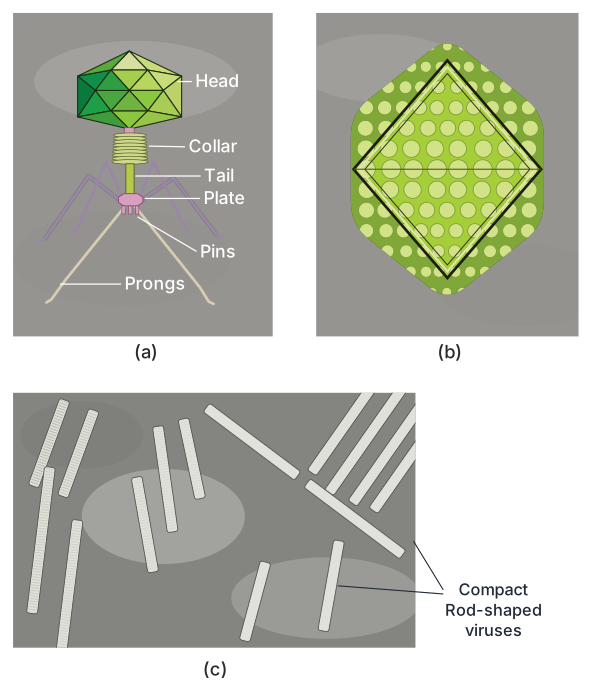
Antibiotics are microbially-produced (or semi-synthetic) chemicals that kill or inhibit other microorganisms; penicillin, one of the earliest antibiotics, is produced by the fungus Penicillium, and is used to treat bacterial diseases such as typhoid and pneumonia.
i) Antibiotic: An antibiotic is a chemical substance, produced by one microorganism (or made semi-synthetically), that can kill or inhibit the growth of other disease-causing microorganisms, generally at very low concentrations, and is used as a medicine to treat bacterial infections.
ii) Fungus producing Penicillin: The fungus Penicillium notatum (from which Alexander Fleming first observed the antibacterial effect; commercially, Penicillium chrysogenum is also used) produces the antibiotic penicillin.
iii) Two diseases treated with antibiotics: Typhoid and Pneumonia are bacterial diseases commonly treated using antibiotics. (Other accepted examples: tuberculosis, whooping cough.)
iv) Bacteriophage (labelled diagram, described): A typical (T-even) bacteriophage has:
        Head (polyhedral capsid, encloses viral DNA)
              |
           Collar
              |
         Tail sheath (contractile)
              |
          Base plate
         /    |    \
   Tail fibres (attach to the host bacterial cell wall)
The head contains the phage's genetic material (DNA); the tail sheath connects the head to the base plate, and the tail fibres help the phage attach to a specific receptor on the surface of the host bacterium before injecting its DNA.
…
Unlock everything free for 14 days
- Full step-by-step solutions
- Concept-first explanations
- Methods, shortcuts & mistakes
- PYQ mapping + timed mock tests
Full access for 14 days. No credit card required.