Biology · Ch 5 — Molecular Basis of Inheritance
DNA Fingerprinting
DNA Fingerprinting
As stated earlier, 99.9 per cent of the base sequence among humans is the same. If the human genome is roughly 3 × 10⁹ base pairs, then differences exist in about 0.1 per cent of that — that is, in roughly 3 million base pairs. It is these differences in DNA sequence that make every individual unique in their phenotypic appearance.
If we wanted to find genetic differences between two individuals or among individuals of a population, sequencing the entire DNA every time would be a daunting and expensive task. Imagine trying to compare two sets of 3 million base pairs. DNA fingerprinting is a very quick way to compare the DNA sequences of any two individuals.
Repetitive DNA and Satellite DNA
DNA fingerprinting involves identifying differences in specific regions of DNA called repetitive DNA. In these sequences, a small stretch of DNA is repeated many times. These repetitive DNA sequences can be separated from the bulk genomic DNA by density gradient centrifugation. The bulk DNA forms a major peak, while the other small peaks are referred to as satellite DNA.
Satellite DNA is classified into many categories — such as micro-satellites and mini-satellites — depending on:
- base composition (A:T rich or G:C rich),
- length of the segment,
- and number of repetitive units.
These sequences normally do not code for any proteins, but they form a large portion of the human genome. They show a high degree of polymorphism and form the basis of DNA fingerprinting.
Why DNA Fingerprinting Works
Since DNA from every tissue of an individual (blood, hair follicle, skin, bone, saliva, sperm, etc.) shows the same degree of polymorphism, it becomes a very useful identification tool in forensic applications. Furthermore, because these polymorphisms are inheritable from parents to children, DNA fingerprinting is the basis of paternity testing in cases of dispute.
What is DNA Polymorphism?
Polymorphism (variation at the genetic level) arises due to mutations. New mutations may arise in an individual either in somatic cells or in germ cells (cells that generate gametes in sexually reproducing organisms). If a germ cell mutation does not seriously impair an individual's ability to have offspring who can transmit the mutation, it can spread to other members of the population through sexual reproduction.
Allelic sequence variation is traditionally described as a DNA polymorphism if more than one variant (allele) at a locus occurs in the human population with a frequency greater than 0.01. In simple terms, if an inheritable mutation is observed in a population at high frequency, it is referred to as DNA polymorphism.
The probability of such variation being observed in non-coding DNA sequences is higher, because mutations in these sequences may not have any immediate effect on an individual's reproductive ability. These mutations keep accumulating generation after generation and form one of the bases of variability and polymorphism.
There is a variety of different types of polymorphisms — ranging from a single nucleotide change to very large-scale changes. Such polymorphisms play a very important role in evolution and speciation.
The Technique of DNA Fingerprinting
The technique of DNA fingerprinting was initially developed by Alec Jeffreys. He used a satellite DNA as a probe that shows a very high degree of polymorphism. This probe was called Variable Number of Tandem Repeats (VNTR).
The technique, as used earlier, involved Southern blot hybridisation using radiolabelled VNTR as a probe. The steps were:
- Isolation of DNA.
- Digestion of DNA by restriction endonucleases.
- Separation of DNA fragments by electrophoresis.
- Transferring (blotting) of separated DNA fragments to a synthetic membrane, such as nitrocellulose or nylon.
- Hybridisation using labelled VNTR probe.
- Detection of hybridised DNA fragments by autoradiography.
VNTR and the DNA Fingerprint Pattern
The VNTR belongs to a class of satellite DNA referred to as mini-satellite. A small DNA sequence is arranged tandemly in many copy numbers. The copy number varies from chromosome to chromosome in an individual. The numbers of repeats show a very high degree of polymorphism. As a result, the size of a VNTR varies from 0.1 to 20 kb. …
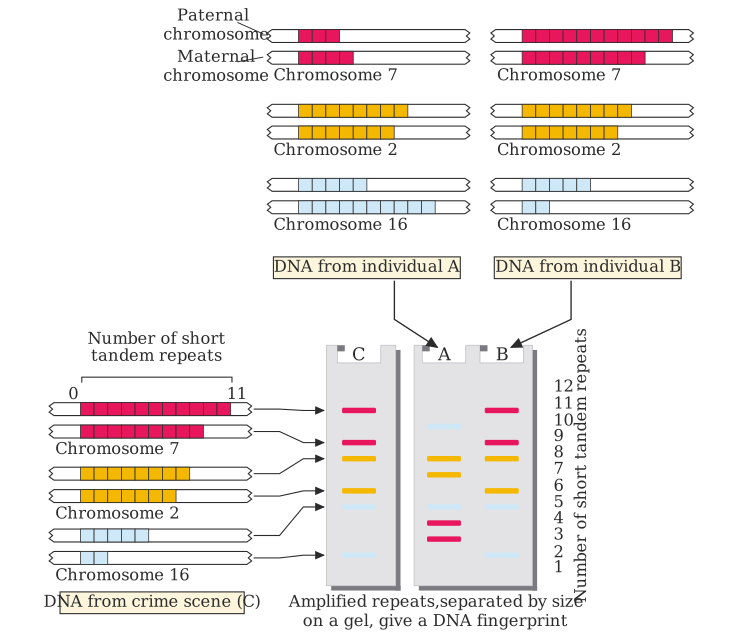
Drawn by us to help you understand the concept clearly, and verified to make sure it's accurate. For exams, practice from your textbook's own diagram.
This figure walks through how DNA fingerprinting can identify a person from a biological sample, using a worked example: comparing DNA from a crime scene (C) against two individuals, A and B, to see which one it matches.
Top: the source chromosomes. Each person's DNA is shown at three representative chromosomes — 7, 2 and 16 — that each carry a VNTR (variable number of tandem repeats) region. The same VNTR locus can carry a different number of repeat units in different people (and even between the two copies, paternal and maternal, in the same person), so the length of that stretch of DNA differs from person to person. The crime-scene sample (C) is compared the same way, at the same three loci, against individual A and individual B.
Bottom: separating the fragments by size. Once the VNTR regions are cut out and amplified, they are loaded into a gel and run under an electric field. Shorter fragments (fewer repeats) move further through the gel; longer fragments (more repeats) stay closer to the top. Each person's sample produces its own ladder of bands — one band per marker, positioned according to how many repeats that marker has in their DNA. This ladder of bands, read across all the markers together, is a DNA fingerprint.
Reading the result. The crime-scene lane's three bands sit at exactly the same heights as individual B's bands at every marker, but do not line up with individual A's bands. Because it is extremely unlikely for two unrelated people to share the same repeat count by chance at multiple independent markers, this match identifies individual B as the source of the crime-scene DNA. …