Chemistry · Ch 7 — Alcohols, Phenols and Ethers
Nomenclature
Nomenclature
Naming Alcohols: The Common (Trivial) System
The everyday name of an alcohol is built by taking the common name of the alkyl group joined to the carbon and simply adding the word "alcohol" after it. So , built on a methyl group, is called methyl alcohol. The same logic gives n-propyl alcohol for a straight-chain three-carbon alcohol, isopropyl alcohol when the sits on the middle carbon of that chain, and sec-butyl or tert-butyl alcohol depending on whether the hydroxyl-bearing carbon has one or two other carbon branches attached to it. This system is quick to use for small, familiar alcohols but becomes clumsy once the chain is long or branched, which is exactly why the IUPAC system exists.
| Compound | Common name | IUPAC name |
|---|---|---|
| Methyl alcohol | Methanol | |
| n-Propyl alcohol | Propan-1-ol | |
| Isopropyl alcohol | Propan-2-ol | |
| n-Butyl alcohol | Butan-1-ol | |
| sec-Butyl alcohol | Butan-2-ol | |
| Isobutyl alcohol | 2-Methylpropan-1-ol | |
| tert-Butyl alcohol | 2-Methylpropan-2-ol |
Naming Alcohols: The IUPAC System
The IUPAC name of an alcohol is generated from the name of the parent alkane by dropping the final "e" and replacing it with the suffix "-ol". Three rules govern how this is applied:
- Identify the parent chain. Find the longest continuous carbon chain that includes the carbon carrying the group. This chain fixes the base alkane name that will be converted to the "-ol" form.
- Number for the lowest locant to . The parent chain is numbered from whichever end gives the smaller locant to the carbon bearing the hydroxyl group. That locant is inserted before the "-ol" suffix, and the locants of any other substituents follow from the same numbering.
- Name substituents as prefixes. Any branches or other groups on the parent chain are cited as numbered prefixes ahead of the parent name, exactly as in alkane nomenclature.
So a straight-chain three-carbon alcohol with on the terminal carbon becomes propan-1-ol, while the same skeleton with on the middle carbon becomes propan-2-ol. A four-carbon chain with on carbon 2 is butan-2-ol, and a branched four-carbon alcohol with the hydroxyl on a chain-end carbon and a methyl branch becomes 2-methylpropan-1-ol; putting a methyl-bearing quaternary-type carbon at the hydroxyl position instead gives 2-methylpropan-2-ol. In every case the numbering has already been chosen to keep the locant as small as possible, so it always wins priority over where a substituent happens to fall.
Polyhydric alcohols (those carrying more than one group) are named a little differently: here the terminal "e" of the parent alkane name is retained, and the ending "-ol" is simply added after it, preceded by a multiplying prefix — "di" for two hydroxyl groups, "tri" for three, and so on — to show how many groups are present. The position of each group is given by locants placed immediately before this multiplied "-ol" ending. For example, the compound , commonly called ethylene glycol, is named ethane-1,2-diol by this rule: the parent is ethane (its "e" is kept), "diol" shows two hydroxyl groups, and the locants 1,2 mark where they sit. A three-carbon chain carrying three hydroxyl groups, one on each carbon — commonly known as glycerol — becomes propane-1,2,3-triol on the same pattern.
Naming Cyclic Alcohols
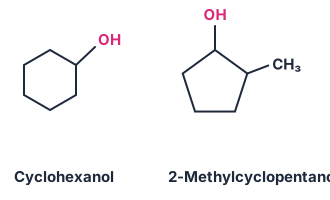
When the group is attached to a ring rather than an open chain, the compound is named using the prefix "cyclo" before the parent name, and the ring carbon bearing the group is always numbered as carbon 1 — since that locant is fixed, it does not need to be written out for the parent hydroxyl itself. A six-membered saturated ring with a hydroxyl group is therefore simply cyclohexanol. If a substituent such as a methyl group is also present on the ring, the ring is numbered from the hydroxyl-bearing carbon outward in the direction that gives the substituent the lowest possible locant; a five-membered ring carrying on carbon 1 and a methyl group on the adjacent carbon is named 2-methylcyclopentanol.
Drawn by us to help you understand the concept clearly, and verified to make sure it's accurate. For exams, practice from your textbook's own diagram.
Redrawn from the NCERT page with the structures, printed labels (OH, CH3) and reagent placement exactly as the t …
Naming Phenols
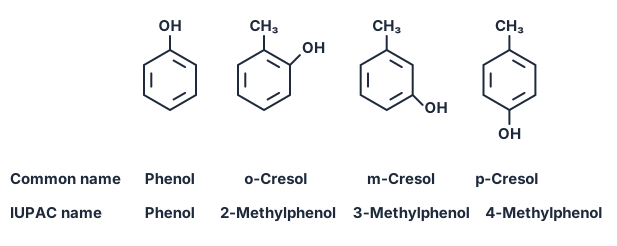
Phenol — the hydroxy derivative of benzene in which is bonded directly to the aromatic ring — is unusual in that its common name, "phenol", is also its accepted IUPAC name; there is no separate systematic parent word for it the way "methanol" is systematic for methyl alcohol. Substituted phenols are then named using locants around this "phenol" parent, counting the ring carbon bearing as position 1.
For a monosubstituted phenol, chemists commonly still lean on the older ortho/meta/para language rather than numerals: ortho describes a 1,2- relationship between the substituent and the hydroxyl group, meta a 1,3- relationship, and para a 1,4- relationship. Applying this to a methyl-substituted phenol gives the three cresol isomers — o-cresol, m-cresol and p-cresol are the respective common names, while their IUPAC names simply state the locant and substituent directly on the phenol parent: 2-methylphenol, 3-methylphenol and 4-methylphenol.
Drawn by us to help you understand the concept clearly, and verified to make sure it's accurate. For exams, practice from your textbook's own diagram.
Redrawn from the NCERT page with the structures, printed labels (OH, CH3) and reagent placement exactly as the t …
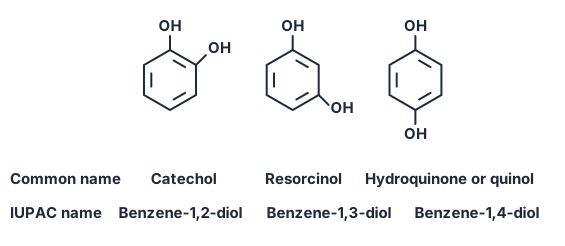
Dihydroxy derivatives of benzene — phenols carrying two groups on the ring — are described by the same ortho/meta/para-style pattern but named systematically as "benzenediols". The 1,2-dihydroxy isomer is called benzene-1,2-diol, the 1,3-isomer benzene-1,3-diol, and the 1,4-isomer benzene-1,4-diol. Each of these also carries a well-established common name still in everyday chemical use: the 1,2-diol is catechol, the 1,3-diol is resorcinol, and the 1,4-diol is known as hydroquinone (also called quinol).
Drawn by us to help you understand the concept clearly, and verified to make sure it's accurate. For exams, practice from your textbook's own diagram.
Redrawn from the NCERT page with the structures, printed labels (OH) and reagent placement exactly as the t …
Naming Ethers: The Common (Trivial) System
An ether has the general connectivity , and its common name is formed by naming the two alkyl or aryl groups attached to the oxygen as separate words, written in alphabetical order, followed by the word "ether". So — where a methyl group and an ethyl group flank the oxygen — is named ethyl methyl ether, with "ethyl" preceding "methyl" because it comes first alphabetically. When the two groups attached to oxygen are identical, the prefix "di" is placed before the single alkyl name instead of writing it twice: , where both groups are ethyl, is named diethyl ether rather than "ethyl ethyl ether". An ether in which one of the two groups is an aryl group also picks up a distinctive common name of its own in some cases — the methyl phenyl ether is widely known as anisole, and the ethyl phenyl ether as phenetole, alongside their systematic-style common names.
| Compound | Common name | IUPAC name |
|---|---|---|
| Dimethyl ether | Methoxymethane | |
| Diethyl ether | Ethoxyethane | |
| Methyl n-propyl ether | 1-Methoxypropane | |
| Methyl phenyl ether (Anisole) | Methoxybenzene | |
| Ethyl phenyl ether (Phenetole) | Ethoxybenzene | |
| Heptyl phenyl ether | 1-Phenoxyheptane | |
| Methyl isopropyl ether | 2-Methoxypropane |
Naming Ethers: The IUPAC System
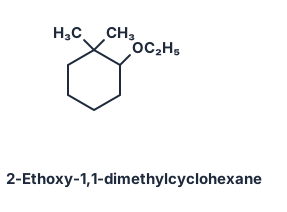
The IUPAC approach treats an ether not as a compound built from two separate hydrocarbon groups joined by oxygen, but as a substituted hydrocarbon: one hydrogen atom of a parent hydrocarbon is thought of as replaced by an or group (an "alkoxy" or "aryloxy" group, where R and Ar stand respectively for the alkyl and aryl portions). Between the two groups attached to the ether oxygen, the larger one is chosen as the parent hydrocarbon chain, and the smaller one, together with the oxygen, is expressed as an alkoxy (or aryloxy) substituent prefix on that parent, complete with a locant showing where on the parent chain it sits. …
Drawn by us to help you understand the concept clearly, and verified to make sure it's accurate. For exams, practice from your textbook's own diagram.
Redrawn from the NCERT page with the structures, printed labels (H3C, CH3, OC2H5) and reagent placement exactly as the …