Q.Give the structure of the following compounds:
You're viewing a preview — the full solution, concept, methods & PYQ mapping are locked.
Start your 14-day free trial to unlock the full solution →The key to drawing structures from IUPAC names is to identify the parent chain (the root name), then locate and attach substituents according to their locants. For (a) 4-Nitropropiophenone, the parent is propiophenone (a ketone with a phenyl ring on a 3-carbon chain) with a nitro group at carbon 4. For (b) 2-Hydroxycyclopentanecarbaldehyde, the parent is cyclopentanecarbaldehyde (a formyl group attached to a cyclopentane ring) with a hydroxyl at carbon 2. For (c) Phenyl acetaldehyde, the parent is acetaldehyde (ethanal) with a phenyl substituent.
Let’s build each structure step by step, focusing on the logic behind the name.
The Core Idea: Decoding IUPAC Names
IUPAC nomenclature is a systematic way to translate a compound’s structure into a name, and vice versa. The name tells you three things in order:
- The parent chain or ring (the longest carbon chain or the principal ring system).
- The principal functional group (the one with highest priority, which gives the suffix like -one, -al, -oic acid).
- Substituents (other groups attached, with their positions indicated by locant numbers).
The trick is to read the name from the end backwards: the suffix tells you the functional group, the root tells you the carbon count, and the prefix tells you what’s attached where.
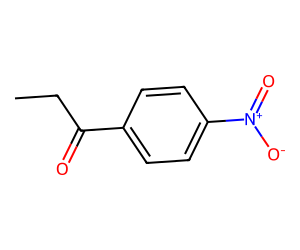
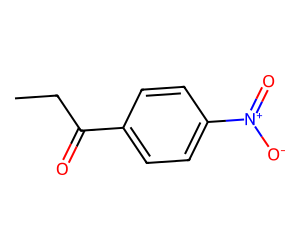
(a) 4-Nitropropiophenone
1. Identify the parent compound. The name ends in “-phenone”. This suffix indicates a ketone where one of the alkyl groups attached to the carbonyl () is a phenyl ring (). The root “propi-” tells us the other alkyl group is a propyl group (). So, propiophenone is simply 1-phenylpropan-1-one. The carbonyl carbon is always carbon 1 in such ketones, and the phenyl ring is attached to it.
2. Locate the substituent. The propyl chain in propiophenone has only 3 carbons total (the carbonyl carbon plus one and one ), so it has no “carbon 4” at all. The locant “4” in “4-nitro” must therefore name a position on the phenyl ring instead: counting the ring carbon attached to the carbonyl as ring-C1, “4-nitro” places the group at the ring’s para position.
A common mistake is to look for a “carbon 4” on the propyl chain — but propiophenone’s own chain only reaches C3. Whenever a locant in an “-ophenone” name has no matching position on the alkyl chain, it is naming a position on the attached phenyl ring instead.
3. Assemble the structure. Draw a benzene ring with a (propanoyl) group at ring-C1 and a group at the para (ring-C4) position.
The structure is:
4. Final structure in condensed form: (para-nitrophenyl ethyl ketone)
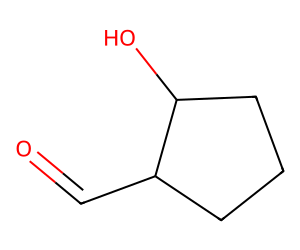
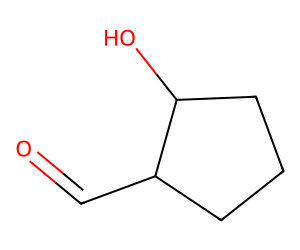
(b) 2-Hydroxycyclopentanecarbaldehyde
1. Identify the parent compound. The name ends in “-carbaldehyde”. This suffix means the principal functional group is an aldehyde () attached directly to a ring. The root “cyclopentane” tells us the ring is a five-membered carbon ring. So, cyclopentanecarbaldehyde is a cyclopentane ring with a formyl group () attached to one of its carbons. The carbon of the formyl group is not part of the ring; it’s a substituent. The ring carbon to which it is attached is considered carbon 1 for numbering the ring.
2. Locate the substituent. The prefix “2-hydroxy” tells us a hydroxyl group () is attached to carbon number 2 of the cyclopentane ring. Since the aldehyde carbon is not part of the ring, the ring carbons are numbered starting from the carbon bearing the aldehyde group as carbon 1.
3. Assemble the structure. Draw a cyclopentane ring. Attach a group to one carbon (call it C1). Then attach an group to the adjacent carbon (C2). The stereochemistry (cis or trans) is not specified, so any relative orientation is acceptable.
The structure is a cyclopentane ring with at position 1 and at position 2 (adjacent ring carbons).
4. Final structure in condensed form: A cyclopentane ring with and on adjacent carbons. …
Unlock everything free for 14 days
- Full step-by-step solutions
- Concept-first explanations
- Methods, shortcuts & mistakes
- PYQ mapping + timed mock tests
Full access for 14 days. No credit card required.