Chemistry · Ch 8 — Aldehydes, Ketones and Carboxylic Acids
Structure of Carboxyl Group
Structure of Carboxyl Group
Geometry at the Carboxyl Carbon
The carboxyl carbon is planar: the three groups attached to it — the alkyl/aryl group, the doubly-bonded oxygen, and the oxygen — all lie in a single plane, arranged around the carbon at bond angles of roughly . This is the geometry expected of an -hybridised carbon, the same hybridisation state seen at the carbonyl carbon of aldehydes and ketones.
Why the Carboxyl Carbon Is Less Electrophilic
Despite that structural resemblance to a simple carbonyl, the carboxyl carbon behaves quite differently — it is noticeably less electrophilic than the carbonyl carbon of an aldehyde or ketone. The reason is resonance delocalisation involving the extra oxygen of the group.
A lone pair on the hydroxyl oxygen can push into the carbon–oxygen framework, generating a set of resonance structures for the carboxyl group:
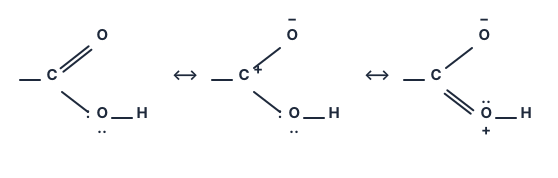
Drawn by us to help you understand the concept clearly, and verified to make sure it's accurate. For exams, practice from your textbook's own diagram.
Redrawn from the NCERT page with the structures, printed labels () and reagent placement exactly as the textbook prints them. Every element of this display was checked against the printed page during the sweep's blind-judge verification pass, so what …
Reading across these contributing structures: the lone pair on the oxygen can shift in to form a second bond to carbon, which in turn pushes electron density out onto the carbonyl oxygen. The net effect is that the positive character that would otherwise sit squarely on the carbonyl carbon (making it attractive to nucleophiles) gets spread out over the group, with the carbonyl oxygen picking up a share of the negative character instead. …