Chemistry · Ch 9 — Amines
Structure of Amines
Structure of Amines
Amines as Derivatives of Ammonia
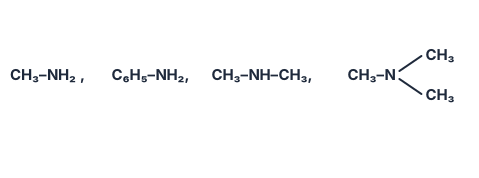
Amines are a major class of organic compounds obtained when one, two, or all three of the hydrogen atoms of an ammonia molecule () are replaced by alkyl and/or aryl groups. Depending on how many hydrogens are substituted, and by which kind of group, a wide range of amines is possible, for example:
Drawn by us to help you understand the concept clearly, and verified to make sure it's accurate. For exams, practice from your textbook's own diagram.
Redrawn from the NCERT page with the structures, printed labels (CH3–NH2 ,, C6H5–NH2,, CH3–NH–CH3,, CH3–N, CH3) and reagent placement exactly as the textbook prints them. Every element of this display was checked against the printed page during the sweep's blind-judge verification pass, s …
These four structures illustrate the range covered by the amine family: a simple alkyl amine, an aryl amine, an amine with two alkyl groups on nitrogen, and one with three alkyl groups on nitrogen.
Amines are widespread in nature — they occur in proteins, vitamins, alkaloids, and hormones — and are equally important as synthetic compounds, turning up in polymers, dyestuffs, and drugs. This unit builds up both the aliphatic and the aromatic amines, and closes with diazonium salts, which serve as key intermediates for making a whole series of aromatic compounds, including azo dyes.
Hybridisation and Geometry at Nitrogen
Because an amine is built on the same nitrogen atom as ammonia, the nitrogen in an amine keeps the same essential bonding picture: it is trivalent, and it retains one unshared (lone) pair of electrons even after its hydrogens are replaced by carbon-containing groups.
To accommodate three bonding pairs and one lone pair, the nitrogen orbitals in an amine are hybridised. Three of the four hybrid orbitals overlap with orbitals on hydrogen or carbon — whichever the particular amine is built from — while the fourth hybrid orbital simply holds the unshared electron pair rather than forming a bond.
A useful way to picture this: nitrogen sits at the centre of a tetrahedral-like set of four orbitals, but only three of those orbitals are used to bond to substituents. The lone pair occupies the fourth position, and it is this lone pair — occupying space without forming a visible bond to another atom — that gives the molecule its characteristic shape rather than a simple flat or tetrahedral one.
Pyramidal Shape and the C–N–E Bond Angle
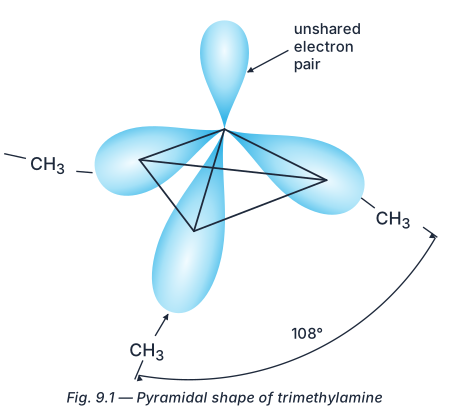
With three bonding orbitals directed toward the substituents and the fourth holding the lone pair, the overall geometry of an amine is pyramidal, in the same way ammonia itself is pyramidal. …
Drawn by us to help you understand the concept clearly, and verified to make sure it's accurate. For exams, practice from your textbook's own diagram.
The figure shows a three-dimensional ball-and-stick model of a trimethylamine molecule, . The central nitrogen atom is placed at the apex of a shallow pyramid. Three methyl groups () form the triangular base of the pyramid: one points to the lower-left, one to the lower-right, and one comes toward the viewer. A large, teardrop-shaped lobe rises from the nitrogen atom, labelled as the unshared (lone) electron pair.
The key physical idea is that the nitrogen atom in trimethylamine is hybridised. In an ideal hybrid, the four orbitals (three bonding, one lone pair) would point to the corners of a regular tetrahedron, giving bond angles of . However, the lone pair occupies more space than a bonding pair. It repels the three bonds more strongly than the bonds repel each other. This lone-pair repulsion compresses the bond angles from the ideal down to , as marked on the figure. The molecule is therefore pyramidal, not flat — the nitrogen and the three carbons do not lie in the same plane.
The textbook uses this figure to introduce the structure of amines and to explain why the bond angle in trimethylamine () is less than the tetrahedral angle (). The general principle is that for any -hybridised nitrogen in an amine, the (or ) bond angle is always less than due to lone-pair–bond-pair repulsion. The exact angle depends on the size and number of alkyl groups attached.
The key formula is not a mathematical equation but a structural relationship: …