Q. is paramagnetic while is diamagnetic though both are tetrahedral. Why?
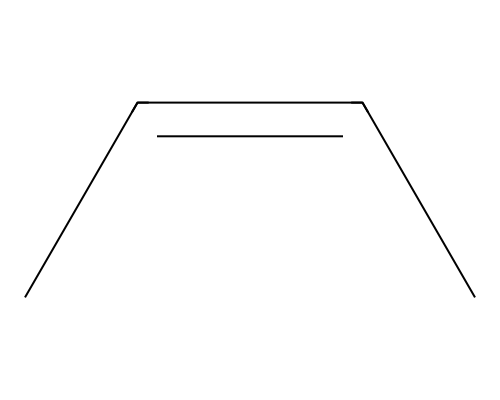
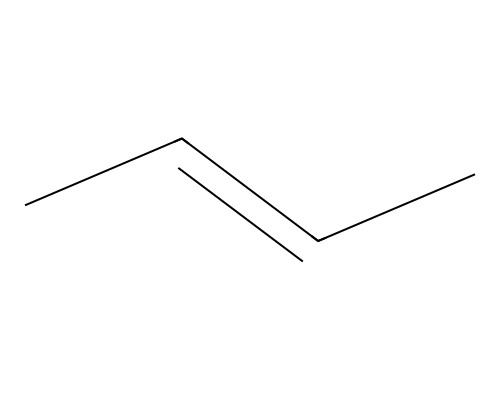
The difference in magnetic behaviour arises from the crystal field splitting and the nature of the ligand. In , Cl⁻ is a weak field ligand, leaving Ni²⁺ with two unpaired electrons (paramagnetic). In , CO is a strong field ligand, causing pairing of electrons (diamagnetic). Both complexes are tetrahedral, but the electron configuration differs.
Why the geometry is the same but magnetism differs
Both complexes are tetrahedral — that much is true. But magnetism depends on unpaired electrons, not just shape. The key lies in how the ligands interact with the nickel ion’s d-orbitals.
Nickel in is in the +2 oxidation state: Ni²⁺ has the electron configuration . In , nickel is in the 0 oxidation state: Ni⁰ has , but in the complex, the 4s electrons are also involved in bonding — effectively, the d-electron count is 10 after accounting for ligand donation. Let’s walk through each.
1. Oxidation state and d-electron count
-
: Each Cl⁻ has a –1 charge. Four Cl⁻ give –4. The overall charge is –2, so Ni must be +2.
Ni²⁺: — eight d-electrons.
-
: CO is a neutral ligand. Four CO molecules contribute 0 charge. The complex is neutral, so Ni is in 0 oxidation state.
Ni⁰: — CO is such a strong field ligand that its large crystal-field splitting favours pairing all electrons into the 3d subshell rather than leaving any unpaired. The two 4s electrons are promoted/paired into the 3d subshell, giving an effective 3d10 4s0 arrangement; the now-empty 4s and 4p orbitals are free to take part in hybridisation.
A common mistake is to assume Ni⁰ has 10 d-electrons directly. Actually, Ni⁰’s ground state is (only 8 d-electrons). It is the strong ligand field of CO that makes it energetically favourable for the two 4s electrons to pair up inside the 3d subshell, giving an effective arrangement and leaving the 4s/4p orbitals empty for hybridisation. This is a subtle but crucial point — it is electron pairing under a strong field, not π back-donation, that explains the count used here.
2. Crystal field splitting in tetrahedral geometry
In a tetrahedral field, the d-orbitals split into two sets — inverted relative to octahedral:
- Lower energy: (the set)
- Higher energy: (the set)
The splitting energy is smaller than in octahedral complexes (about of ). This means:
- Weak field ligands (like Cl⁻) produce a small , so electrons do not pair — they occupy orbitals singly (Hund’s rule).
- Strong field ligands (like CO) produce a larger , enough to force pairing.
For tetrahedral complexes:
Pairing occurs only if pairing energy.
3. Electron configuration in (weak field)
Ni²⁺ has 8 d-electrons. In a tetrahedral weak field:
- The set (2 orbitals) is lower in energy, so it fills first: (both orbitals doubly occupied, no unpaired electrons there).
- The remaining 4 electrons go into the higher-energy set (3 orbitals). Since the field is weak, Hund’s rule applies: 3 electrons occupy the 3 orbitals singly first, and the 4th pairs up with one of them: (2 orbitals singly occupied, 1 doubly occupied).
So there are two unpaired electrons (in the set) → paramagnetic.
Think of it this way: In tetrahedral geometry, the set is higher in energy. With a weak field, the electrons beyond the filled set would rather occupy the orbitals singly than pay the pairing-energy cost. That leaves two unpaired electrons in .
4. Electron configuration in (strong field)
Here, Ni is in the 0 oxidation state, but the complex is formed by hybridisation. The 4s and 4p orbitals hybridise to form four equivalent orbitals, each accepting a lone pair from CO. The d-electrons remain in the 3d orbitals.
CO is a very strong field ligand — it causes a large . With an effective configuration (10 d-electrons), in tetrahedral geometry:
- All 10 d-electrons fill the and sets completely: .
- Every electron is paired → no unpaired electrons → diamagnetic.
It is the strong ligand field of CO — not π back-donation — that forces this full pairing. Back-donation (Ni → CO π-acceptor bonding) is a real effect in metal carbonyls, but it explains bond strength/IR stretching frequencies, not the electron count used here. This is why is diamagnetic despite being tetrahedral.
5. Summary of the difference
| Complex | Ni oxidation state | d-electrons | Ligand field strength | Electron configuration | Unpaired electrons | Magnetism |
|---|---|---|---|---|---|---|
| +2 | 8 | Weak (Cl⁻) | 2 | Paramagnetic | ||
| 0 | 10 (effective) | Strong (CO) | 0 | Diamagnetic |
The geometry is tetrahedral in both, but the ligand strength and oxidation state change the electron distribution.
is paramagnetic because Cl⁻ is a weak field ligand, leaving two unpaired electrons in Ni²⁺ (), while is diamagnetic because CO is a strong field ligand that forces all electrons to pair in Ni⁰ ( effective configuration).
Unlock everything free for 14 days
- Full step-by-step solutions
- Concept-first explanations
- Methods, shortcuts & mistakes
- PYQ mapping + timed mock tests
Full access for 14 days. No credit card required.