Chemistry · Ch 2 — Electrochemistry
Primary Batteries
Primary Batteries
In a primary battery, the cell reaction occurs only once — after the reactants are used up over time, the battery is dead and cannot be revived. Two familiar examples are the dry cell and the mercury cell.
The Dry Cell
The dry cell — also called the Leclanché cell, after the person who first devised it — is the everyday battery found in transistor radios, torches, and clocks. Despite the name, it is not truly dry; it uses a moist paste rather than a free liquid electrolyte.
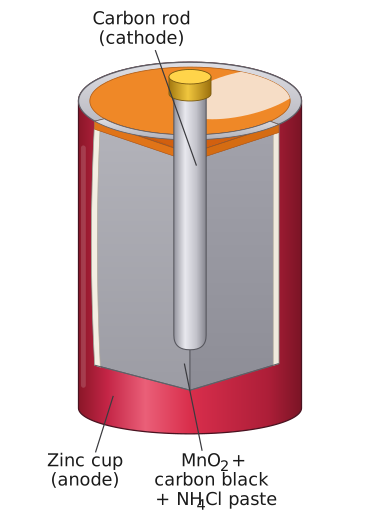
Its construction (shown alongside) is built around a zinc container that does double duty as the outer casing and the anode. Inside it sits a carbon (graphite) rod that acts as the cathode, packed around with a mixture of powdered manganese dioxide and carbon. The space between the zinc wall and this central assembly is filled with a moist paste of ammonium chloride () and zinc chloride (), which serves as the electrolyte.
Drawn by us to help you understand the concept clearly, and verified to make sure it's accurate. For exams, practice from your textbook's own diagram.
The figure is a cutaway diagram of a commercial dry cell (a Leclanché cell). It shows a cylindrical zinc container that forms the outer casing and is labelled as the anode (negative terminal). Inside, a central carbon (graphite) rod is labelled as the cathode (positive terminal), topped with a metal cap for external connection. The space between the zinc anode and the carbon cathode is filled with a moist paste containing manganese dioxide (), carbon black (to improve conductivity), and ammonium chloride () as the electrolyte.
Physical idea: The dry cell is a primary battery — it converts chemical energy into electrical energy through spontaneous redox reactions and cannot be recharged. The zinc anode is oxidised, releasing electrons that flow through the external circuit to the carbon cathode, where reduction of occurs. The moist paste provides the ions needed to maintain charge balance.
Key half-reactions (as developed in the textbook for this cell):
- Anode (oxidation):
- Cathode (reduction):
The overall cell reaction is:
…
The true electrode chemistry is fairly complicated, but it is usually written in an approximate form:
Anode:
Cathode:
At the cathode, manganese is reduced from the +4 oxidation state to the +3 state. The ammonia released in this step does not simply float free — it combines with the ions produced at the anode to form the complex ion .
A fresh dry cell delivers a potential of roughly 1.5 V, but this value is not steady — it drifts downward as the cell is used, since the concentrations of the species involved in the reaction keep changing.
The Mercury Cell
The mercury cell is designed for devices that draw only a small, steady current, such as hearing aids and watches.
Drawn by us to help you understand the concept clearly, and verified to make sure it's accurate. For exams, practice from your textbook's own diagram.
What the Figure Shows
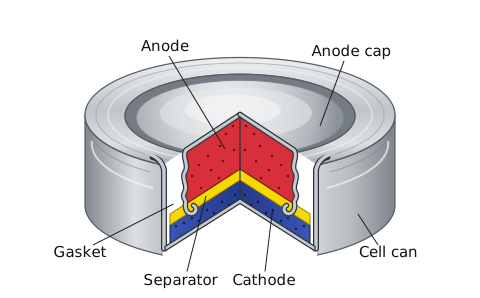
The figure is a cross-sectional diagram of a button-type mercury cell. The outer casing is a steel can that forms the body of the cell. On top is an anode cap (negative terminal), beneath which lies a ring-shaped zinc-amalgam anode (a mixture of zinc and mercury). A gasket ring seals the anode cap to the cell body, preventing leakage. Below the anode, a separator layer (often porous paper or felt soaked in electrolyte) physically divides the anode from the central cathode paste, which is a mixture of mercury(II) oxide () and a small amount of graphite (to improve conductivity). The entire assembly is compact and button-shaped.
The Physical Idea
The mercury cell is a primary battery — it cannot be recharged. Its key advantage is a constant voltage throughout its life. This constancy arises because the overall cell reaction involves no ions in solution whose concentration can change. The reaction is:
Here, the reducing agent is zinc (it loses electrons) and the oxidising agent is mercury(II) oxide (it gains electrons). The cell potential is approximately 1.35 V and remains steady until the reactants are exhausted.
Key Formula and Explanation
The cell reaction can be split into two half-reactions:
-
Anode (oxidation):
-
Cathode (reduction):
The overall reaction (adding the two half-reactions) is:
The cell potential is given by the Nernst equation. For this reaction, since no dissolved ions appear in the overall equation, the concentrations of reactants and products remain constant (solids and pure liquids have activity = 1). Hence, is constant at 1.35 V throughout discharge. …
Here the anode is an amalgam of zinc with mercury, and the cathode is a paste of mercury(II) oxide (HgO) mixed with carbon. The electrolyte is a paste containing KOH and ZnO.
The electrode reactions are:
Anode:
Cathode:
Combining the two half-reactions gives the overall cell reaction: …