Chemistry · Ch 4 — The d- and f-Block Elements
Oxides and Oxoanions of Metals
Oxides and Oxoanions of Metals
Oxides of the Transition Metals
Transition-metal oxides are generally formed when the metal reacts with oxygen at high temperature. Every metal of the first transition series except scandium forms an oxide of formula , and these monoxides are essentially ionic.
The highest oxidation number a metal shows in its oxide coincides with its group number, and this trend holds as far as group 7, where manganese reaches . Beyond group 7, no oxide of iron higher than is known — iron does not form a stable or similar species. In addition to neutral oxides, some very high oxidation states are stabilised as oxocations rather than as simple oxides: vanadium(V) as , vanadium(IV) as , and titanium(IV) as .
As the oxidation number of the metal rises, the ionic character of its oxide falls and covalent bonding becomes more important. Manganese(VII) oxide, , is a covalent green oil rather than a solid ionic compound, and both and have unusually low melting points for metal oxides. In these higher oxides the acidic character dominates:
Vanadium(V) oxide, , is amphoteric, though its acidic behaviour dominates: it gives both orthovanadate, , and salts. Across the vanadium oxides there is a gradual change from basic to acidic character as the oxidation state rises: is basic, is less basic, and is amphoteric. dissolves in acids to give salts, while reacts with both alkalies and acids, giving and respectively. Among the chromium oxides, the well-characterised is basic, but is amphoteric.
Potassium Dichromate — Preparation
Potassium dichromate, , is an industrially important chemical, used in the leather industry and as an oxidant in the preparation of many azo compounds.
Dichromates are manufactured starting from chromite ore, . The ore is fused with sodium or potassium carbonate in the presence of free access of air, converting the chromium in it to soluble chromate:
The resulting yellow solution of sodium chromate is filtered and then acidified with sulphuric acid. This shifts the equilibrium toward the orange dichromate, which crystallises out as :
Sodium dichromate is considerably more soluble in water than potassium dichromate. Because of this difference in solubility, potassium dichromate is obtained by treating a solution of sodium dichromate with potassium chloride; the less soluble potassium salt crystallises out as orange crystals while sodium chloride stays in solution:
The Chromate–Dichromate Equilibrium and Ion Structures
Chromates and dichromates are interconvertible in aqueous solution, and which form predominates depends on the pH of the solution — not on any change in the oxidation state of chromium, which stays the same in both ions:
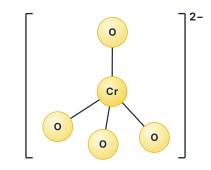
Structurally, the chromate ion, , is tetrahedral, with chromium at the centre of four oxygen atoms.
Drawn by us to help you understand the concept clearly, and verified to make sure it's accurate. For exams, practice from your textbook's own diagram.
Redrawn from the NCERT page with the structures, printed labels (2−, Cr) and reagent placement exactly as the textbook prints them. Every element of this display was checked against the printed page during the sweep's blind-judge verification pass, so what …
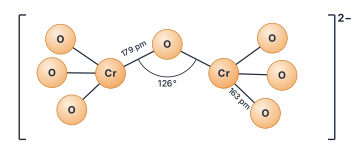
The dichromate ion, , is built from two such tetrahedra sharing one corner through a bridging oxygen atom, with a bond angle of about ; the bridging bonds are somewhat longer than the terminal bonds within each tetrahedron.
Drawn by us to help you understand the concept clearly, and verified to make sure it's accurate. For exams, practice from your textbook's own diagram.
Redrawn from the NCERT page with the structures, printed labels (2−, Cr, 179 pm, 126°, 163 pm) and reagent placement exactly as the textbook prints them. Every element of this display was checked against the printed page during the sweep's blind-judge verification pass, so w …
Dichromate as an Oxidising Agent
Both sodium and potassium dichromate are strong oxidising agents. The sodium salt, being more soluble in water, is the one extensively used as an oxidising agent in organic chemistry, while potassium dichromate — because it can be obtained in a very pure, stable form — is used as a primary standard in volumetric analysis.
In acidic solution, the oxidising action of the dichromate ion is represented by the half-reaction:
Acidified potassium dichromate will accordingly oxidise iodide ions to iodine, sulphide ions to sulphur, tin(II) to tin(IV), and iron(II) salts to iron(III). The relevant half-reactions of these reducing agents are:
The complete ionic equation for any of these reactions is obtained by adding the dichromate half-reaction to the half-reaction of the reducing agent. For example, with iron(II):
Potassium Permanganate — Preparation
Potassium permanganate, , is prepared industrially by fusing manganese dioxide with an alkali metal hydroxide together with an oxidising agent such as . This fusion produces dark green potassium manganate, :
Manganate is unstable relative to permanganate and manganese dioxide in a neutral or acidic medium, so it disproportionates on standing in such conditions:
Commercially, potassium permanganate is prepared by this alkaline oxidative fusion of followed by the electrolytic oxidation of the resulting manganate(VI) ion, in alkaline solution, to permanganate:
In the laboratory, permanganate is instead obtained by oxidising a manganese(II) salt directly with peroxodisulphate:
Structure and Physical Properties
Potassium permanganate crystallises as dark purple, almost black crystals that are isostructural with potassium perchlorate, . The salt is only moderately soluble in water (about 6.4 g per 100 g of water at 293 K), and on heating it decomposes at 513 K:
Two physical properties of permanganate are of particular interest: its intense colour, and its diamagnetism accompanied by a weak, temperature-dependent paramagnetism. Both are best explained using molecular orbital theory.
Drawn by us to help you understand the concept clearly, and verified to make sure it's accurate. For exams, practice from your textbook's own diagram.
Redrawn from the NCERT page with the structures, printed labels (Mn, O⁻) and reagent placement exactly as the textbook prints them. Every element of this display was checked against the printed page during the sweep's blind-judge verification pass, so what …
Drawn by us to help you understand the concept clearly, and verified to make sure it's accurate. For exams, practice from your textbook's own diagram.
Redrawn from the NCERT page with the structures, printed labels (Mn, O⁻) and reagent placement exactly as the textbook prints them. Every element of this display was checked against the printed page during the sweep's blind-judge verification pass, so what …
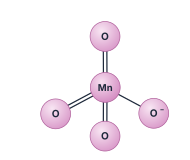
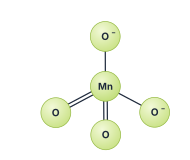
Both the manganate and permanganate ions are tetrahedral, and in each case -bonding arises from the overlap of filled orbitals on oxygen with empty orbitals on manganese. The green manganate ion, , is paramagnetic because it has one unpaired electron, whereas the purple permanganate ion, , is diamagnetic because it has no unpaired electrons.
Acidified permanganate solution oxidises oxalates to carbon dioxide, iron(II) to iron(III), nitrites to nitrates and iodides to free iodine. The half-reactions of the reductants are:
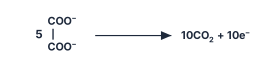
Drawn by us to help you understand the concept clearly, and verified to make sure it's accurate. For exams, practice from your textbook's own diagram.
Redrawn from the NCERT page with the structures, printed labels (COO⁻, 10CO₂ + 10e⁻) and reagent placement exactly as the textbook prints them. Every element of this display was checked against the printed page during the sweep's blind-judge verification pass, so wh …
The full reaction can be written by adding the half-reaction for to the half-reaction of the reducing agent, balancing wherever necessary.
Permanganate as an Oxidising Agent
The hydrogen-ion concentration of the solution strongly influences what permanganate is reduced to, and this is reflected in three quite different standard reduction potentials:
Although redox potential explains much of this behaviour, the kinetics of the reaction also matters: even where makes oxidation of water by permanganate thermodynamically favourable, the reaction in practice is extremely slow unless manganese(II) ions are already present or the solution is heated.
Oxidising Reactions in Acidic Solution
Acidified permanganate oxidises a range of common reducing agents:
- iodide to iodine:
- iron(II), green, to iron(III), yellow:
- oxalate ion or oxalic acid, at 333 K, to carbon dioxide: …