Absolute Maxima and Minima on a Closed Interval
The absolute maximum (or greatest) value of a function f on a set is the single
largest value f actually attains anywhere in that set; the absolute minimum
(least value) is the smallest. This is different from a local max/min, which only
needs to be the largest/smallest value in some small neighbourhood, not over the whole
domain.
The key theorem — a closed interval guarantees it
If f is continuous on a closed interval [a,b], then f is guaranteed to attain
both an absolute maximum and an absolute minimum somewhere in [a,b] (this is the
Extreme Value Theorem). Crucially, that "somewhere" is always one of:
- A critical point inside (a,b) — where f′(x)=0 or f′(x) does not exist, or
- One of the two endpoints, x=a or x=b.
The procedure (works for ANY continuous function on [a,b], whatever its shape)
Step 1. Find every critical point of f inside (a,b): solve f′(x)=0, and also
check any point where f′(x) fails to exist (e.g. a corner, from a term like ∣x−k∣ or
a fractional power like x2/3).
Step 2. Evaluate f at every critical point found in Step 1, and at both
endpoints x=a, x=b.
Step 3. Compare all these values. The largest is the absolute maximum; the
smallest is the absolute minimum. No sign-of-derivative test is needed here — a
direct value comparison is enough, because the closed interval already guarantees the
extrema exist among exactly this finite list of candidates.
Worked example
Find the absolute maximum and minimum of f(x)=x3−3x+1 on [−2,3].
f′(x)=3x2−3=3(x−1)(x+1), so critical points are x=1,−1 (both inside
(−2,3)).
Evaluate at all four candidates:
f(−2)=−8+6+1=−1,f(−1)=−1+3+1=3,f(1)=1−3+1=−1,f(3)=27−9+1=19.
Comparing {−1,3,−1,19}: the absolute maximum is 19 at x=3 (an endpoint), and
the absolute minimum is −1, attained at BOTH x=−2 and x=1 (an endpoint and a
critical point can tie).
Why the interval must be CLOSED — the open-interval caveat
If the domain is an open interval like (0,1), or all of R, the guarantee
above breaks down completely — the function may have no absolute maximum or minimum at
all, even if it is perfectly continuous and well-behaved.
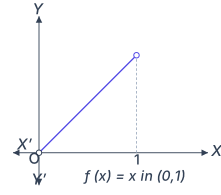
Example: f(x)=x on the open interval (0,1). This function is strictly
increasing, but it never actually attains a highest or lowest value: for any point you
pick close to 1, a point even closer to 1 gives a larger value, yet x=1 itself is
never reached (it's excluded from the domain). The same happens at the lower end near
x=0. So f has neither an absolute maximum nor an absolute minimum on (0,1) —
not because the function is unusual, but purely because the endpoints, which is where
the extreme values would have occurred, aren't included in the domain.
Don't assume every continuous function must have an absolute max/min "somewhere" — that
guarantee specifically requires a closed, bounded interval. Drop either condition
(make the interval open, or let it stretch to infinity) and the guarantee is gone.
Local vs. absolute — not the same thing
A function can have several local maxima/minima inside [a,b], but the absolute
extrema are found by comparing ALL of them together with the two endpoint values — the
absolute maximum is not necessarily at a local-maximum point at all; it is very often at
an endpoint instead, exactly as 19 at x=3 was in the worked example above (an
endpoint value that a local-max/min test would never flag, yet turned out to be the
overall winner).