Q.Show that the function , defined as , is neither one-one nor onto.
You're viewing a preview — the full solution, concept, methods & PYQ mapping are locked.
Start your 14-day free trial to unlock the full solution →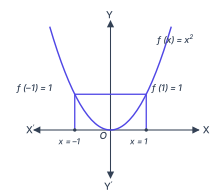
The function fails to be one-one because two different inputs (like and ) give the same output, and it fails to be onto because negative numbers in the codomain have no preimage in the domain.
Why this approach works
The question asks us to check two properties: injectivity (one-one) and surjectivity (onto). For a function to be one-one, each output must come from exactly one input. For it to be onto, every possible output in the codomain must actually be produced by some input. The square function is the classic counterexample for both — it's symmetric (so not one-one) and never negative (so not onto). Let's verify each property step by step.
1. Checking one-one (injectivity)
A function is one-one if implies for all in the domain.
Take and . Then:
So but . This directly violates the definition.
A common mistake is to think that implies . It actually implies , so the function is not one-one unless the domain is restricted to non-negative numbers.
Thus is not one-one.
2. Checking onto (surjectivity)
A function is onto if for every , there exists some such that .
Here the codomain is , the set of all real numbers. But is always non-negative:
So any negative number, say , has no preimage. There is no real such that . …
Unlock everything free for 14 days
- Full step-by-step solutions
- Concept-first explanations
- Methods, shortcuts & mistakes
- PYQ mapping + timed mock tests
Full access for 14 days. No credit card required.