Physics · Ch 1 — Electric Charges and Fields
Electric Charge
Electric Charge
The Fundamental Property: Electric Charge
Electric charge is an intrinsic property of matter, just like mass. It is the source of the electric force. The word "electricity" comes from the Greek word elektron, meaning amber, because the ancient Greeks (Thales of Miletus, ~600 BC) discovered that rubbing amber with wool made it attract light objects like straw.
Two Kinds of Charge
Through careful experiments, scientists found that there are exactly two kinds of electric charge. This is not a choice; it is a fact of nature.
- Like charges repel each other.
- Unlike charges attract each other.
This is the fundamental rule of electric interaction.
Polarity and the Franklin Convention
The property that distinguishes the two kinds of charge is called polarity. The American scientist Benjamin Franklin named them:
- Positive charge (+) : By convention, the charge on a glass rod rubbed with silk is called positive. (Also, the charge on cat's fur is positive.)
- Negative charge (−) : By convention, the charge on a plastic rod rubbed with fur, or on the silk used to rub the glass rod, is called negative.
Neutralization
When a positively charged glass rod is brought into contact with the negatively charged silk that was used to rub it, they neutralize each other. They lose their ability to attract or repel other objects. This shows that opposite charges cancel each other's effects.
Detecting Charge: The Gold-Leaf Electroscope
A simple device to detect charge is the gold-leaf electroscope. It has a metal rod with a knob at the top and two thin gold leaves at the bottom. When a charged object touches the knob, charge flows to the leaves. Since both leaves get the same charge (like charges), they repel each other and diverge. The amount of divergence indicates the amount of charge.
The Microscopic Origin of Charge
All matter is made of atoms, which contain charged particles (protons and electrons). Normally, matter is electrically neutral because the total positive charge equals the total negative charge.
- Charging a body means creating an excess or deficit of one kind of charge.
- In solids, the charges that move are electrons (which are loosely bound in atoms).
- Positive charge is acquired by losing electrons.
- Negative charge is acquired by gaining electrons. …
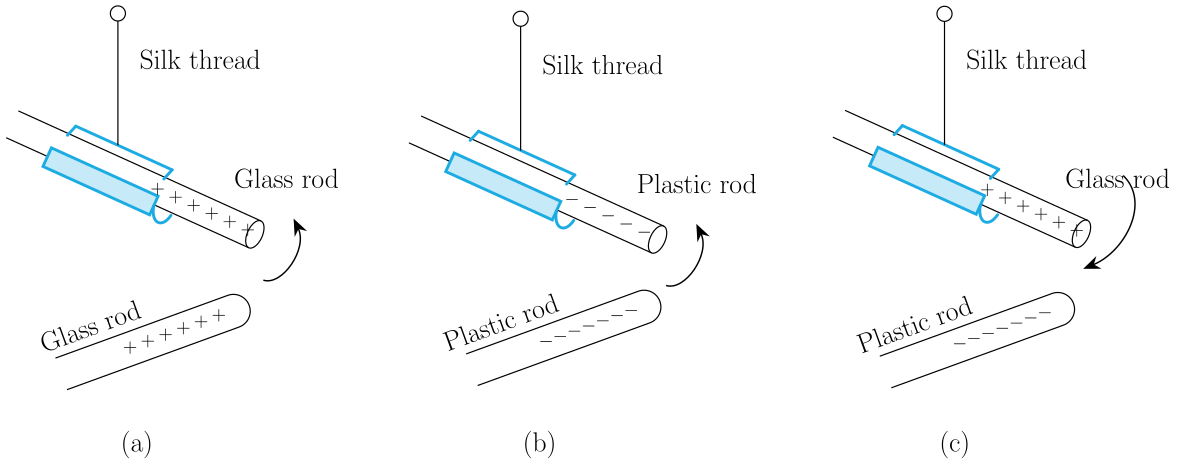
Drawn by us to help you understand the concept clearly, and verified to make sure it's accurate. For exams, practice from your textbook's own diagram.
What the Figure Shows
The figure presents three side-by-side panels, labeled (a), (b), and (c). In each panel, a rod is suspended from a pivot by a silk thread, with a sleeve tying the thread to the rod. A second rod is brought up diagonally from the lower left toward the suspended rod. A curved arrow at the free end of the suspended rod indicates its direction of swing.
- Panel (a): Two glass rods, both positively charged. The suspended rod swings away from the approaching rod — this is repulsion.
- Panel (b): Two plastic rods, both negatively charged. Again, the suspended rod swings away — repulsion.
- Panel (c): A positively charged glass rod is suspended, and a negatively charged plastic rod is brought near. The suspended rod swings toward the approaching rod — this is attraction.
The Physical Idea
The figure demonstrates the fundamental rule of electrostatics: like charges repel, unlike charges attract. This is the first experimental observation that leads to the concept of two types of electric charge. The direction of the swing (away or toward) directly shows the nature of the force between the two charged objects. The silk thread isolates the suspended rod so that only the electric force (and gravity) acts on it, making the effect clear.
Key Formula Developed from This Figure
The textbook uses this figure to introduce Coulomb's law, which quantifies the electric force between two point charges. The law is stated as:
where:
- is the magnitude of the electric force between the two charges (in newtons, N).
- and are the magnitudes of the two charges (in coulombs, C).
- is the distance between the centers of the two charges (in meters, m).
- is Coulomb's constant, . …