Physics · Ch 2 — Electrostatic Potential and Capacitance
Electrostatic Potential
Electrostatic Potential
Why Potential? The Idea of a "Per-Unit-Charge" Quantity
When we place a test charge in an electric field , the electrostatic force on it is . The work done to move this charge is proportional to . To get a quantity that depends only on the field (and not on the test charge), we divide the work by . This gives us the electrostatic potential — the work done per unit positive charge.
Defining Electrostatic Potential
Consider two points and in an electrostatic field. Let and be the potential energies of a test charge at these points. The work done by an external force (equal and opposite to the electrostatic force, so the charge moves without acceleration) in moving the charge from to is:
Dividing by gives the work done per unit charge:
We define the electrostatic potential at a point as:
Thus, the work done per unit positive charge in moving from to is:
This is the potential difference between and . Only differences in potential are physically meaningful — the absolute value of at a single point is not fixed.
Choosing a Reference: Potential at Infinity
To assign a definite value to at a point, we choose a reference point where . By convention, we take infinity as the zero of potential (). Then, setting in the equation above:
Since (no interaction at infinite separation), we get:
Final Definition
Electrostatic potential () at any point in an electrostatic field is the work done by an external force in bringing a unit positive charge (without acceleration) from infinity to that point.
Key Points to Remember …
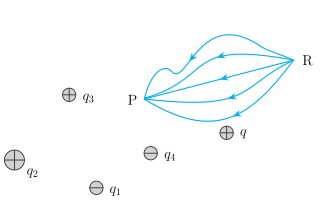
Drawn by us to help you understand the concept clearly, and verified to make sure it's accurate. For exams, practice from your textbook's own diagram.
The figure shows a source charge configuration on the left, consisting of four point charges: two positive ( and ) and two negative ( and ). On the right, two points are marked: P (lower left) and R (upper right). A small test charge (labelled with a ⊕) sits just below and to the right of P.
Between P and R, several curved arcs are drawn, each with arrowheads. These arcs represent different possible paths that the test charge could take while moving from P to R. The arcs form a bundle that looks like an almond or a leaf — they all start at P and end at R, but each follows a different route through the space around the source charges.
What the figure teaches:
The key physical idea is that the work done by the electrostatic field on the test charge is independent of the path taken between two fixed points. No matter which curved arc the charge follows from P to R, the net work done by the electric field is the same. This is a direct consequence of the electrostatic force being conservative — it depends only on the initial and final positions, not on the path.
The formula developed from this idea:
The textbook defines electrostatic potential difference between two points P and R as the work done per unit positive test charge by an external force (equal and opposite to the electrostatic force) in moving the charge from R to P without acceleration:
where:
- and are the electrostatic potentials at points P and R, respectively.
- and are the potential energies of the test charge at P and R.
- The negative sign indicates that the external force does work against the electric field. …