Q.Define electric potential. Obtain an expression of electric potential due to an electric dipole at any point (r, theta). Draw necessary diagram. OR What is capacitor? Derive an expression of capacitance of the spherical capacitor. Draw necessary diagram.
You're viewing a preview — the full solution, concept, methods & PYQ mapping are locked.
Start your 14-day free trial to unlock the full solution →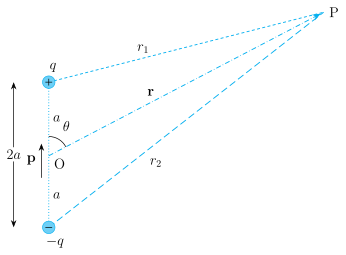
Electric potential is the work done per unit charge to bring a test charge from infinity to a point; for a dipole this potential falls off as and depends on the angle from the dipole axis.
Definition of electric potential:
The electric potential at a point in an electric field is defined as the amount of work done in bringing a unit positive test charge from infinity to that point, without any acceleration (i.e. quasi-statically, against the electric force):
Electric potential due to a dipole at point (r, θ):
Consider an electric dipole consisting of charges and separated by a distance , with dipole moment directed from to . Let P be a point at distance from the centre O of the dipole, making angle with the dipole axis.
Let = distance of P from , and = distance of P from .
The potential at P due to the two point charges (superposition):
For a point far from the dipole (, the "short dipole" approximation), using the geometry (dropping perpendiculars from ±q onto the line OP):
So: , and .
Substituting:
…
Unlock everything free for 14 days
- Full step-by-step solutions
- Concept-first explanations
- Methods, shortcuts & mistakes
- PYQ mapping + timed mock tests
Full access for 14 days. No credit card required.