Applied Mathematics · Ch 1 — Numbers and Quantification
Prime Numbers
Prime Numbers
Prime numbers are the fundamental building blocks of all natural numbers — every integer greater than 1 can be broken down into a unique product of primes. Understanding them is not just about memorising a list; it is about seeing the elegant structure that underpins arithmetic itself. In this section, we will explore what makes a number prime, how to test for primality, and why these indivisible numbers matter so much in mathematics and its applications.
[amb-begin]: # (applied-maths backfill — do not edit between these markers) …
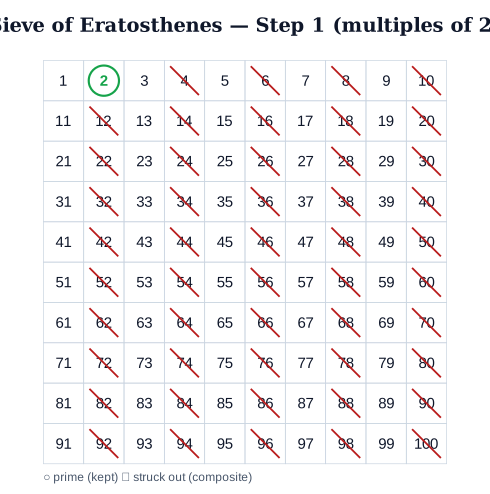
Drawn by us to help you understand the concept clearly, and verified to make sure it's accurate. For exams, practice from your NCERT textbook's own diagram.
Step 1 of the sieve: keep 2, then strike out every larger mul …
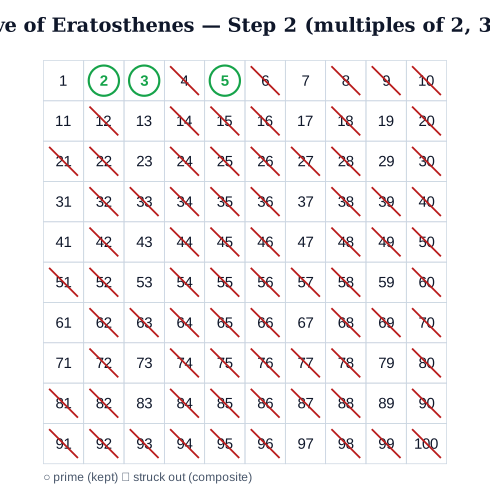
Drawn by us to help you understand the concept clearly, and verified to make sure it's accurate. For exams, practice from your NCERT textbook's own diagram.
Step 2: after striking the multiples of 2, 3 and 5, the numbers left uncrossed …