Business Studies · Ch 10 — Internal Trade
Goods and Services Tax (GST)
Goods and Services Tax (GST)
Following the principle of "One Nation, One Tax" and the aim of building a single unified national market, the Government of India rolled out the Goods and Services Tax (GST) with effect from 1 July 2017. It is widely regarded as one of the most far-reaching tax reforms in India's history, meant to smoothen the flow of goods across the country and make life simpler for manufacturers, producers, investors and consumers alike. Understanding how GST unifies India's indirect-tax system is an important part of the CBSE Class 11 Business Studies syllabus on internal trade.
GST is a destination-based single tax on the supply of goods and services, charged all the way from the manufacturer to the final consumer. It has replaced the many separate indirect taxes that the Central and State governments earlier levied — in all, 17 indirect taxes (8 at the Central level and 9 at the State level) and 23 cesses — converting the country into one common market. By removing this maze of overlapping levies, GST is expected to ease tax compliance, reduce the tax burden by ending tax-on-tax, improve tax administration, curb tax evasion, broaden the organised segment of the economy and boost tax revenues.
On an intra-state supply, GST has two components — Central GST (CGST), which absorbs the levies the Centre used to charge, and State GST (SGST), which absorbs the levies the States used to charge. GST is applied at each stage of value addition, and at every stage the supplier sets off the tax already paid on inputs in the earlier stages through the input tax credit mechanism. Because credit for the tax paid earlier is available at each link of the chain, the cascading effect (tax on tax) is avoided, which is expected to lower the prices of commodities and benefit consumers. The last dealer in the supply chain passes the accumulated GST on to the buyer, which is exactly why GST is called a destination-based consumption tax.
Some Facts about GST
- GST folds a large number of separate taxes into one single tax across the country, so that goods are priced more uniformly across India — though, as a result, some goods become costlier and some become cheaper.
- After GST, luxury goods have generally become costlier, while items of mass consumption have become cheaper.
- GST is not a tax collected at the source of production; it is a destination or consumption tax. For instance, a product manufactured in Tamil Nadu that travels across the country and is finally bought in Delhi is taxed where the consumer buys it, with both the Centre and the State sharing in that tax.
- Indian GST works through a mechanism of matching of invoices — input tax credit on goods and services purchased is allowed only when the details of the taxable supplies match. The Goods and Services Tax Network is a self-regulating system that not only checks tax fraud and evasion but also draws more and more businesses into the formal economy.
- Anti-profiteering is one of the key features of the GST law. A National Anti-profiteering Authority (NAA) has been provided for, to ensure that the benefit of reduced costs (from lower tax together with input tax credit) is actually passed on to consumers, and to check firms that raise prices unjustifiably in the name of GST.
How GST Benefits and Empowers Citizens
- A reduction in the overall tax burden.
- No hidden taxes.
- The development of a harmonised national market for goods and services.
- Higher disposable income in the hands of citizens for education and essential needs.
- Wider choice for customers.
- Increased economic activity.
- More employment opportunities.
Key Features of GST
- The territorial spread of GST is the whole country.
- GST is levied on the supply of goods or services, in place of the earlier ideas of taxing the manufacture or sale of goods or the provision of services.
- It is based on the principle of destination-based consumption tax, as against the earlier origin-based taxation.
- Import of goods and services is treated as an inter-state supply and attracts IGST in addition to the applicable customs duties.
- CGST, SGST and IGST are levied at rates mutually agreed upon by the Centre and the States under the aegis of the GST Council.
- There are four tax slabs — 5 per cent, 12 per cent, 18 per cent and 28 per cent — for all goods or services.
- Exports and supplies to Special Economic Zones (SEZ) are zero-rated. …
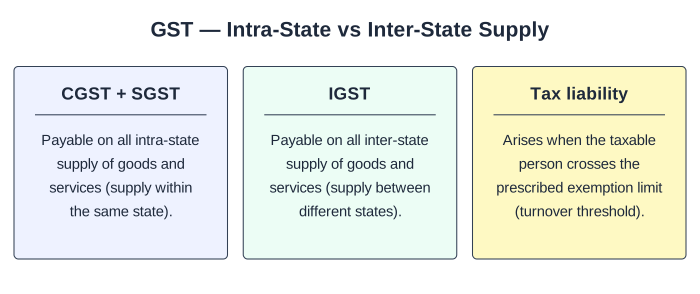
Drawn by us to help you understand the concept clearly, and verified to make sure it's accurate. For exams, practice from your NCERT textbook's own diagram.
What the Figure Shows
Our own schematic of how GST applies — CGST + SGST on supply within a state, IGST on supply between states, and the point at which a taxable person's liability begin …