Economics · Ch 13 — Rural Development
Agricultural Market System
Agricultural Market System
The agricultural market system is the mechanism that moves food grains, vegetables and fruits from where they are grown to consumers across the country.
Agricultural marketing is a process that covers the assembling, storage, processing, transportation, packaging, grading and distribution of farm commodities.
Prior to independence, when selling to traders, farmers suffered from faulty weighing and manipulated accounts. Lacking price information, they were often forced to sell cheaply, and without proper storage they could not hold produce back for a better price later. Even today, more than 10 per cent of farm output is wasted for want of storage. These problems made government intervention necessary to regulate the activities of private traders.
Four measures to improve marketing
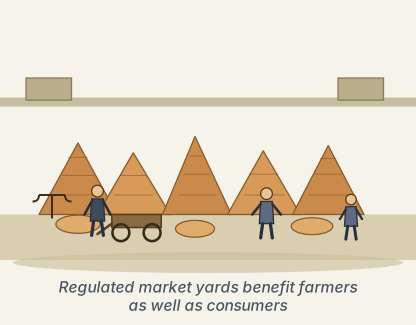
- Regulation of markets to create orderly, transparent conditions — this broadly benefited both farmers and consumers, though about 27,000 rural periodic markets still need to be developed into regulated marketplaces to realise the full potential of rural markets.
- Physical infrastructure — roads, railways, warehouses, godowns, cold storages and processing units, which remain inadequate for growing demand.
- Cooperative marketing to secure fair prices, shown by the success of milk cooperatives in transforming the social and economic landscape of Gujarat and other parts of the country; cooperatives have, however, suffered setbacks in recent years from inadequate coverage of farmer members, weak links between marketing and processing cooperatives, and inefficient financial management.
- Policy instruments — assured minimum support prices (MSP) for farm products, buffer stocks of wheat and rice maintained by the Food Corporation of India, and distribution of foodgrains and sugar through the public distribution system (PDS), together aimed at protecting farmers' incomes and supplying subsidised food to the poor.
Drawn by us to help you understand the concept clearly, and verified to make sure it's accurate. For exams, practice from your NCERT textbook's own diagram.
Own-drawn recreation of NCERT Fig 5.1 (p.80) — a regulated market yard scene: sack mounds, workers, a cart and a weighing point, evoking an orderly regulated mandi. O …
Work These Out
- Visit a nearby vegetable and fruit market. Observe and identify different characteristics of the market. Identify the place of origin of at least ten different fruits and vegetables and the distance travelled to reach the market, and note the modes of transport used and their effect on prices.
- Most small towns have regulated market yards, where farmers can sell their produce and also store their goods. Visit one regulated market yard, collect details of its functioning, the kind of goods coming to the yard and how prices are fixed, and prepare a detailed report to discuss in class.
Despite these measures, private trade — by moneylenders, rural political elites, big merchants and rich farmers — still dominates agricultural markets, and the need for government intervention remains urgent, particularly because a large share of agricultural products is handled by the private sector.
Agricultural marketing has come a long way with the intervention of the government in various forms. Some scholars argue that commercialising agriculture offers tremendous scope for farmers to earn higher incomes, provided government intervention is restricted — a view the book leaves open for debate.
Emerging Alternate Marketing Channels: It has been realised that if farmers sell their produce directly to consumers, their incomes rise, because the many intermediaries who each take a margin are cut out. Several states have organised markets where cultivators bring their own produce straight to buyers. Well-known examples include:
| Channel | Where it operates |
|---|---|
| Apni Mandi | Punjab, Haryana and Rajasthan |
| Hadaspar Mandi | Pune (Maharashtra) |
| Rythu Bazars (vegetable and fruit markets) | Andhra Pradesh and Telangana |
| Uzhavar Sandies (farmers' markets) | Tamil Nadu |