Computer Science · Ch 11 — Societal Impact
Net Etiquettes
Net Etiquettes
Just as we observe manners in face-to-face social interactions, we are expected to show proper manners while online. Net etiquettes (illustrated in Figure 11.2) rest on three pillars: while surfing the Internet, one should be ethical, respectful and responsible.
(A) Be Ethical
- No copyright violation. Do not use copyrighted material without the permission of its creator or owner. An ethical digital citizen is careful even in everyday acts like streaming audio or video, or downloading images and files from the Internet — these can involve copyrighted works. (Copyright is treated in depth in Section 11.4.)
- Share the expertise. Sharing information and knowledge on the Internet is a good thing — it lets others benefit from what you know. But sharing carries duties:
- be sure you have sufficient knowledge of the topic before posting about it;
- the information you share should be true and unambiguous; and
- to avoid cluttering the Internet with redundant information, check first that the same information is not already available online.
(B) Be Respectful
- Respect privacy. As digital citizens we enjoy a right to privacy and the freedom of personal expression — and every other digital citizen enjoys exactly the same rights and freedoms. Personal communication between two people may include images, documents and files that are private to both. Respect that privacy: never share such private material with anyone else without the consent of both parties.
- Respect diversity. In a group or public forum, participants differ in knowledge, experience, culture and other respects. A respectful netizen honours that diversity rather than mocking or dismissing it.
(C) Be Responsible
-
Avoid cyber bullying. Cyber bullying is any insulting, degrading or intimidating behaviour online — for example:
- repeatedly posting rumours about someone,
- issuing threats online,
- posting a victim's personal information,
- sexual harassment, or
- comments designed to publicly ridicule a victim.
The defining feature is repeatedly targeting someone with the intention to hurt or embarrass. New or occasional Internet users sometimes imagine that what happens online has no effect in the real world — it does. Online bullying can have very serious consequences for the victim. And a warning to would-be bullies: our actions online can be traced back through our digital footprints. …
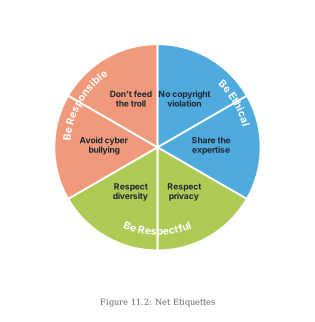
Drawn by us to help you understand the concept clearly, and verified to make sure it's accurate. For exams, practice from your NCERT textbook's own diagram.
This figure summarises the whole of Section 11.3.1 in a single circular wheel diagram. The circle is divided into three coloured thirds — one for each pillar of net etiquette — and each third has two layers: an outer rim arc carrying the group name, and two inner pie sectors carrying the individual etiquettes belonging to that group. Thin white radial lines separate the six inner sectors, and each sector's label sits as dark text centred in its wedge.
Reading the wheel:
- Top-right third (blue) — "Be Ethical" on the curved rim, with its two inner sectors: "No copyright violation" and "Share the expertise". These are the ethical duties: never use copyrighted material without permission, and share knowledge online only when it is accurate, unambiguous and not redundant.
- Bottom-right third (green) — "Be Respectful" (the rim text curves reading bottom-up), with inner sectors "Respect privacy" and "Respect diversity": honour other netizens' private images, documents and files, and respect the differences in knowledge, experience and culture within any group or forum. …