Physical Education · Ch 4 — Physical Education & Sports for CWSN (Children With Special Needs)
Learning Disabilities
Learning Disabilities
A person with a learning disability (also called a cognitive disability) has trouble remembering, learning new things, concentrating, or making decisions that affect everyday life. A cognitive disability ranges from mild to severe: a person with a mild cognitive disability may manage most everyday activities, while severe levels can take away the ability to understand the meaning or importance of things, or to talk or write, making independent living difficult.
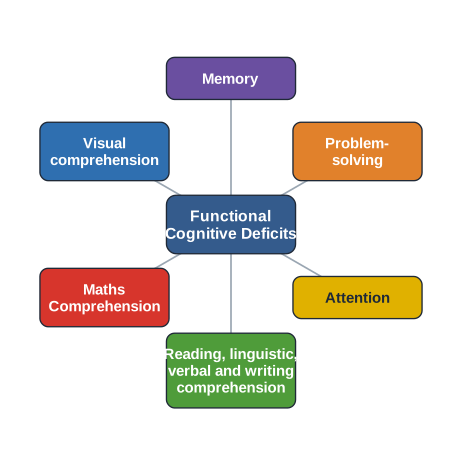
Drawn by us to help you understand the concept clearly, and verified to make sure it's accurate. For exams, practice from your NCERT textbook's own diagram.
A radial hub-and-spoke chart: a central node reads 'Functional Cognitive Deficits', with six labelled nodes branching out — Memory, Problem-solving, Attention, Reading/linguistic/verbal and writing comprehension, Maths Comprehension and Visual comprehension. It shows the main areas in w …
The main categories of functional cognitive difficulty are:
A. Memory
Memory is the ability to recall what has been learned over time. A common model distinguishes working (immediate) memory, short-term memory and long-term memory. Some individuals with cognitive disabilities have difficulty with one, two or all three.
B. Problem Solving
Some individuals find it hard to solve problems as they arise. Their resilience can be low, and the resulting frustration may be such that they choose to give up rather than persist.
C. Attention
Many individuals struggle to focus their attention on the task at hand; distractions — a particular sound, colour or design — frequently shift it. On the positive side, some people with attention deficits are highly creative and very productive in short bursts, with abundant energy and enthusiasm; on the less positive side, people with ADHD can find it hard to stick to a task for long.
D. Reading, Linguistic, Verbal and Writing Comprehension
Difficulties with reading, speaking, understanding and writing are another challenge. A reading disorder — also known as Dyslexia — is marked by trouble with reading despite normal intelligence. These difficulties may be mild or severe, and can include trouble with spelling, reading quickly, writing words, "sounding out" words in the head, pronouncing words when reading aloud, and understanding what one reads. Notably, many of the brightest minds of recent generations — such as Albert Einstein, Thomas Edison and Henry Ford — are said to have had some form of language or text-comprehension difficulty.
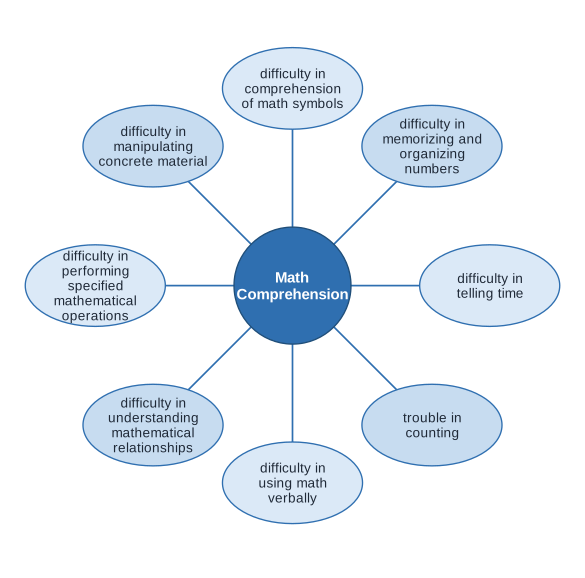
Drawn by us to help you understand the concept clearly, and verified to make sure it's accurate. For exams, practice from your NCERT textbook's own diagram.
A radial/flower chart: a central node reads 'Math Comprehension', surrounded by eight petals naming the common difficulties of dyscalculia — difficulty comprehending math symbols; difficulty memorizing and organizing numbers; difficulty telling time; trouble counting; difficulty using math verbally; difficulty understanding mathematical relationships; difficulty performing specified ma …
…