Physical Education · Ch 3 — Yoga
Kapalabhati
Kapalabhati
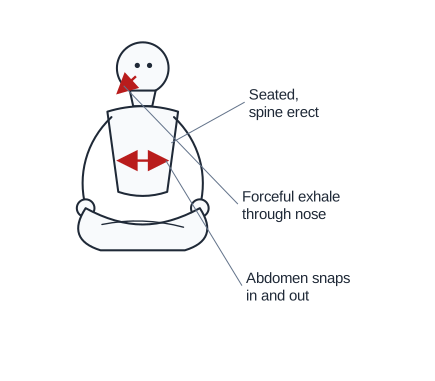
Kapalabhati, as one of the six cleansing kriyas, is a purification practice of forceful and fast diaphragmatic breathing. In a comfortable sitting position, the practitioner exhales forcefully by contracting the abdomen and then inhales; the exhalations and inhalations are accompanied by quick abdominal movements, repeated in rapid succession a number of times according to one's capacity. The key feature is that the exhalation is active (a sharp inward pull of the abdomen) while the inhalation follows naturally.
Drawn by us to help you understand the concept clearly, and verified to make sure it's accurate. For exams, practice from your NCERT textbook's own diagram.
A bare-torso person sits cross-legged on the floor with a straight spine and the hands resting on the knees. A small arrow at the nose shows air being pushed out through the nostrils, and a horizontal double-headed arrow across the abdomen shows the forceful inward contraction and release of the …
Step-by-step procedure
- Sit in a comfortable meditative posture such as Padmasana, Siddhasana or Sukhasana, with the spine erect and the hands resting on the knees.
- Take a normal breath in, then begin a cycle of sharp, forceful exhalations through the nose, each produced by a quick inward contraction of the abdominal muscles.
- Let the inhalation that follows each exhalation happen passively — the abdomen simply releases and relaxes, drawing air back in on its own, without any active effort.
- Continue this cycle of active exhalation and passive inhalation at a steady, comfortable rhythm, starting with around 20 strokes and building up gradually over weeks of practice.
- Finish a round by taking one slow, deep breath in and out, then rest before beginning the next round if practising more than one.
Physiological rationale
Because the exhalation is forced and the inhalation passive, Kapalabhati actively pumps the diaphragm and abdominal muscles far more than normal breathing does. This vigorous pumping action increases the rate of carbon dioxide expulsion from the lungs, draws fresh air deep into the alveoli, and massages the abdominal organs with each contraction — which is why it is classed as a cleansing kriya for the frontal region (the sinuses and lungs) rather than only a breathing exercise.
Benefits
- It is a great cleanser for the respiratory passages, including the sinuses.
- It improves respiratory function and promotes circulation.
- It improves balance.
- It removes acidity and gas-related problems.
- It helps cure sinus trouble, asthma and hair loss.