Biology · Ch 14 — Breathing and Exchange of Gases
Exchange of Gases
Exchange of Gases
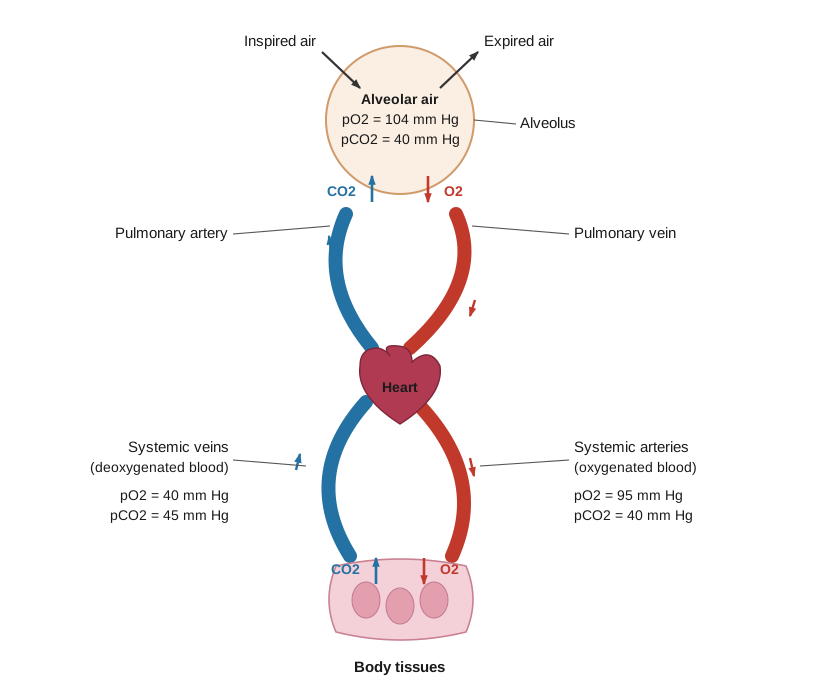
Once air reaches the alveoli, the gases must move between air and blood, and later between blood and the body's tissues. The alveoli are the main sites of gas exchange, and a similar exchange also takes place between the blood and the tissues.
Diffusion drives the exchange
Oxygen and carbon dioxide are exchanged at these sites by simple diffusion, driven mainly by differences in pressure or concentration. The rate at which a gas diffuses depends on:
- the pressure/concentration gradient across the surface,
- the solubility of the gas, and
- the thickness of the membranes the gas must cross.
Partial pressure
In a mixture of gases, the pressure contributed by any one gas on its own is called its partial pressure. It is written as the partial pressure of oxygen and the partial pressure of carbon dioxide. Comparing these partial pressures at different points shows the direction in which each gas will move.
| Respiratory gas | Atmospheric air | Alveoli | Deoxygenated blood | Oxygenated blood | Tissues |
|---|---|---|---|---|---|
| Oxygen (in mm Hg) | 159 | 104 | 40 | 95 | 40 |
| Carbon dioxide (in mm Hg) | 0.3 | 40 | 45 | 40 | 45 |
(All values are partial pressures in millimetres of mercury.)
Which way each gas moves
- For oxygen, the values show a downhill gradient from the alveoli into the blood, and again from the blood into the tissues — so oxygen moves alveoli → blood → tissues.
- For carbon dioxide, the gradient runs the opposite way: from the tissues into the blood, and from the blood into the alveoli.
Why carbon dioxide diffuses so readily
The solubility of carbon dioxide is 20 to 25 times higher than that of oxygen. Because of this, for the same difference in partial pressure, far more carbon dioxide can pass through the diffusion membrane than oxygen.
The diffusion membrane
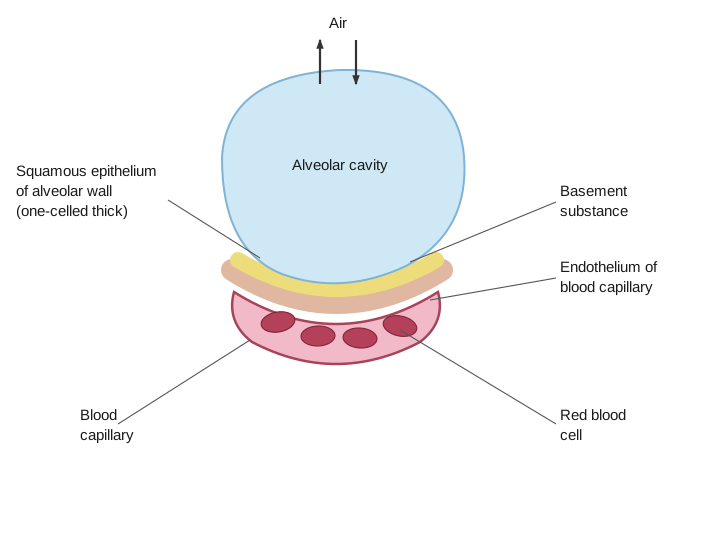
The barrier that gases cross is made of three main layers:
- the thin squamous epithelium of the alveoli,
- the endothelium of the alveolar capillaries, and …
Drawn by us to help you understand the concept clearly, and verified to make sure it's accurate. For exams, practice from your NCERT textbook's own diagram.
This figure illustrates how oxygen and carbon dioxide are swapped by simple diffusion, both at the alveoli and again between blood and tissues. Read the arrows as gases sliding from where their partial pressure is high to where it is low. Using the values in the table, follow oxygen downhill: it is highest in the alveoli, so it moves into the deoxygenated blood, and once that blood reaches the tissues, where oxygen is low again, it passes out to the cells. Carbon dioxide travels the opposite way — its partial pressure is higher in the tissues than in the blood, so it enters the blood there, and higher in that blood than in the alveoli, so it leaves at the lungs. The figure makes clear t …
Drawn by us to help you understand the concept clearly, and verified to make sure it's accurate. For exams, practice from your NCERT textbook's own diagram.
This figure shows the diffusion membrane a gas molecule crosses to move between the air in an alveolus and the blood in its neighbouring pulmonary capillary. Three layers make up this membrane: the thin squamous epithelium lining the alveolar cavity (only one cell thick), the basement substance in between, and the endothelium of the blood capillary carrying red blood cells. Even stacked together, the three layers add up to well under a millimetre — a barrier thin enough that oxygen and carbon dioxide can diffuse across it …