Biology · Ch 16 — Excretory Products and their Elimination
Function of the Tubules
Function of the Tubules
Each segment of the renal tubule has its own particular job in shaping the filtrate into urine, handling reabsorption and secretion in characteristic ways.
Proximal Convoluted Tubule (PCT)
The PCT is lined by simple cuboidal cells with a brush border, a fringe that greatly increases the surface area available for reabsorption. This is the segment where most recovery happens:
- Nearly all of the essential nutrients are reabsorbed here.
- About 70 to 80 per cent of the electrolytes and water are reclaimed in this stretch.
The PCT also helps keep the pH and ionic balance of the body fluids steady. It does this by selectively secreting hydrogen ions and ammonia into the filtrate and by absorbing bicarbonate from it.
Henle's Loop
Reabsorption in the loop is at a minimum in its ascending limb. Even so, this region is important for building and maintaining the high osmolarity of the medullary interstitial fluid. The two limbs behave very differently:
- The descending limb is permeable to water but almost impermeable to electrolytes, so the filtrate becomes concentrated as it moves down.
- The ascending limb is impermeable to water but allows electrolytes to move out, actively or passively. As the concentrated filtrate travels up, it therefore becomes diluted because electrolytes pass out into the medullary fluid.
Distal Convoluted Tubule (DCT)
The DCT carries out conditional reabsorption of sodium ions and water — that is, reabsorption that is adjusted according to the body's needs. It can also reabsorb bicarbonate and selectively secrete hydrogen and potassium ions and ammonia. Through these actions it helps maintain both the pH and the sodium-potassium balance of the blood.
Collecting Duct …
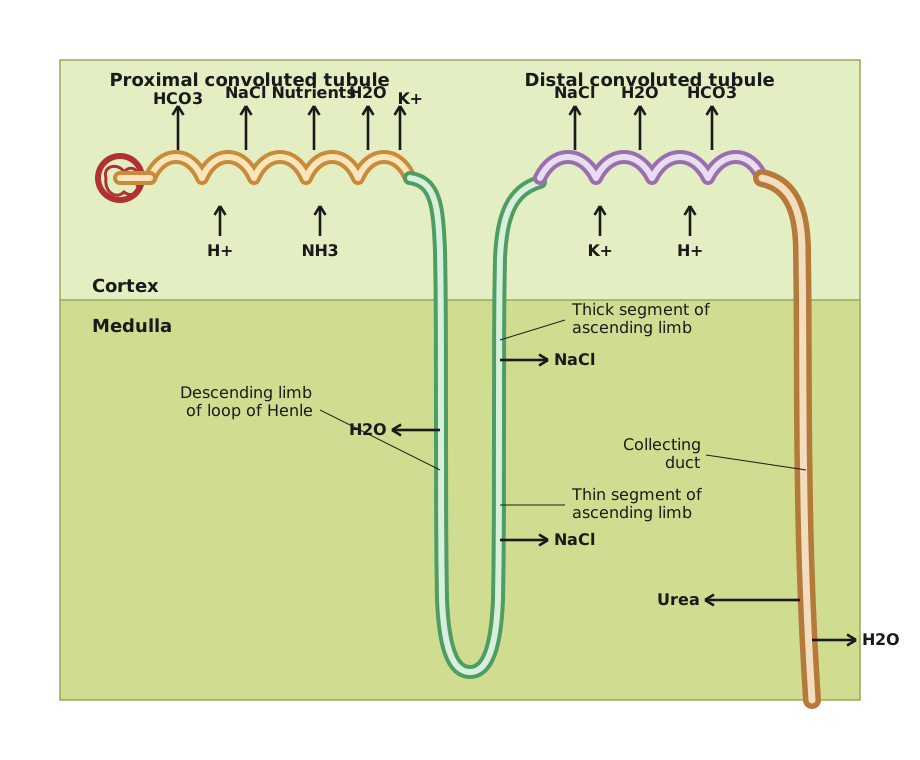
Drawn by us to help you understand the concept clearly, and verified to make sure it's accurate. For exams, practice from your NCERT textbook's own diagram.
This figure follows the filtrate along the renal tubule so you can match each region to the particular job it does. Trace it from the proximal convoluted tubule, whose lining cells carry a brush border that greatly increases the surface for reclaiming most of the water, salts and nutrients. Follow the fluid into the U-shaped Henle's loop and note the contrast between its two limbs: the descending limb lets water leave so the fluid grows more concentrated, while the ascending limb lets salts move out so the fluid becomes dilute again. The figure then leads into the distal convoluted tubule. Seen together, these labelled s …