Chemistry · Ch 6 — Equilibrium
Arrhenius Concept of Acids and Bases
Arrhenius Concept of Acids and Bases
The Arrhenius Concept of Acids and Bases
The Arrhenius theory was the first successful attempt to define acids and bases in terms of their behaviour in water. Svante Arrhenius proposed this theory as part of his work on electrolytic dissociation, for which he won the Nobel Prize in Chemistry in 1903.
According to Arrhenius, an acid is a substance that dissociates in water to produce hydrogen ions . A base is a substance that dissociates in water to produce hydroxyl ions .
For a general acid , the ionization in water is:
But this is a simplification. A bare proton is extremely small (radius ~ m) and carries an intense electric field. It cannot exist freely in aqueous solution. Instead, it immediately bonds to the oxygen atom of a water molecule, using one of the two lone pairs on oxygen, to form the hydronium ion . This species has a trigonal pyramidal geometry and has been detected in solid compounds like . The more accurate representation of acid ionization is therefore:
In this chapter, and are used interchangeably to mean the same thing — a hydrated proton.
The hydronium ion itself undergoes further hydration in solution, forming species like , , and even .
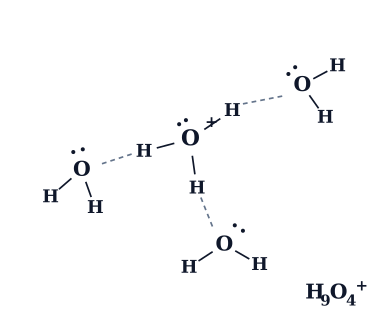
A bare proton, , is far too small and too reactive to exist freely in water. It immediately attaches to a lone pair on the oxygen of a water molecule to form the hydronium ion, — but even does not sit in solution on its own. It is itself further hydrogen-bonded to additional water molecules, and is the most commonly cited example of this further hydration: one central ion, hydrogen-bonded through each of its three O–H bonds to a separate surrounding water molecule (hence "" waters and "" hydrogens in the formula: 3 from the central plus 2 from each of the 3 attached water molecules, ). …
Similarly, the hydroxyl ion is hydrated to give , , and . These higher hydrates are important in understanding the structure of aqueous solutions, but for most chemical purposes, and are sufficient.
For a base like , the ionization in water is:
The hydroxyl ion also exists in hydrated form in aqueous solution.
Limitations of the Arrhenius Concept
The Arrhenius theory has two major shortcomings.
First, it is restricted to aqueous solutions only. It cannot explain acid-base behaviour in other solvents (like liquid ammonia or glacial acetic acid) or in the gas phase.
Second, it cannot account for the basicity of substances that do not contain a hydroxyl group. Ammonia is a classic example. Ammonia clearly behaves as a base in water — it turns litmus blue, neutralizes acids, and produces ions in solution — yet it has no group to dissociate. The Arrhenius theory simply cannot explain this.
Do not confuse the Arrhenius definition with the fact that ammonia produces in water. The theory says bases are substances that produce , but it cannot explain how ammonia does this. The Brønsted-Lowry theory (covered next) resolves this by focusing on proton transfer rather than dissociation. …