Mathematics · Ch 10 — Conic Sections
Standard Equations of Parabola
Standard Equations of Parabola
The Standard Equations of a Parabola
The simplest and most useful form of a parabola's equation occurs when its vertex is placed at the origin and its axis of symmetry lies along either the x-axis or the y-axis. There are four possible orientations for such a parabola, depending on which direction it opens: right, left, upward, or downward. We will derive the equation for each orientation, starting with the parabola that opens to the right.
Deriving the Equation: Parabola Opening to the Right
Consider a parabola with its focus at where , and its directrix as the vertical line . The vertex is at the origin .
Let be the focus and the directrix. Draw a perpendicular from to . The midpoint of lies on the parabola by definition (it is equidistant from and ) and is called the vertex. We set as the origin, as the x-axis (along ), and as the y-axis (perpendicular to ). The distance from the directrix to the focus is , so the focus is at and the directrix is the line .
Now, let be any point on the parabola. By the definition of a parabola, the distance from to the focus equals the distance from to the directrix. The perpendicular distance from to the directrix is the distance to the point on the directrix directly above or below .
Therefore, the condition is:
Using the distance formula:
Setting them equal:
Squaring both sides:
Expanding:
Cancelling and from both sides:
Rearranging gives the equation of the parabola:
›Proof
Proving the Converse
We must also show that any point satisfying lies on the parabola. Calculate :
Since for this parabola (as we will see), , so . Hence , and lies on the parabola.
Thus, the equation is the standard equation of a parabola with vertex at the origin, focus at , and directrix .
Discussion of the Equation
Since , the term is non-negative only when . This means can be any positive number or zero, but never negative. The curve therefore lies entirely in the first and fourth quadrants, extending infinitely to the right. The axis of symmetry is the positive x-axis.
The Four Standard Equations
By similar derivations, we obtain the equations for the other three orientations. The results are:
| Orientation | Focus | Directrix | Standard Equation |
|---|---|---|---|
| Opens to the right | |||
| Opens to the left | |||
| Opens upward | |||
| Opens downward |
In all cases, . These four equations are known as the standard equations of parabolas.
Key Feature of Standard Equations
In every standard equation, the focus lies on one coordinate axis, the vertex is at the origin, and the directrix is parallel to the other coordinate axis.
Observations from the Standard Equations
From the standard equations, we can make three important observations about the parabola's geometry.
1. Symmetry
A parabola is symmetric with respect to its own axis.
- If the equation contains a term (like or ), the axis of symmetry is the x-axis.
- If the equation contains an term (like or ), the axis of symmetry is the y-axis.
2. Direction of Opening (Axis along x-axis)
When the axis of symmetry is the x-axis: …
Drawn by us to help you understand the concept clearly, and verified to make sure it's accurate. For exams, practice from your NCERT textbook's own diagram.
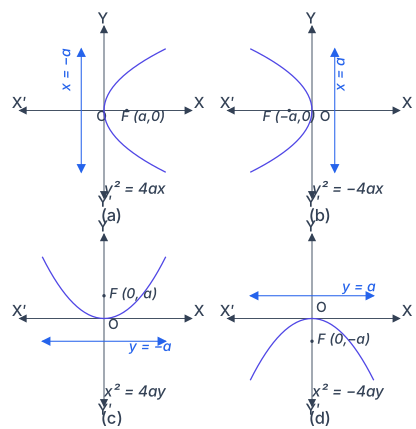
The figure shows four separate X-Y coordinate grids, labelled (a) through (d). Each grid has the origin at the centre, with the x-axis horizontal and the y-axis vertical. In every panel, the vertex of the parabola is at the origin, and the axis of symmetry lies along one of the coordinate axes. A blue vertical or horizontal line marks the directrix, and a single point (the focus) is placed on the axis of symmetry at a distance from the vertex.
Panel (a) shows the parabola . The focus is at on the positive x-axis, and the directrix is the vertical line (shown in blue). The curve opens to the right, lying entirely in the first and fourth quadrants (x is never negative). The axis of symmetry is the x-axis itself.
Panel (b) shows . The focus is at on the negative x-axis, and the directrix is . The parabola opens to the left, with x never positive. The axis is still the x-axis.
Panel (c) shows . The focus is at on the positive y-axis, and the directrix is the horizontal line . The parabola opens upward, with y never negative. The axis of symmetry is the y-axis.
Panel (d) shows . The focus is at on the negative y-axis, and the directrix is . The parabola opens downward, with y never positive.
The physical idea the figure teaches is that a parabola is the set of all points equidistant from a fixed point (the focus) and a fixed line (the directrix). By placing the vertex at the origin and aligning the axis with a coordinate axis, the equation becomes simple. The sign of the coefficient tells you which direction the parabola opens: positive coefficient of in means right; negative means left. For , positive coefficient of means up; negative means down.
Focus: , directrix: , opens right.
The other three standard forms follow by replacing with or swapping and :
In every case, is the distance from the vertex to the focus (and also from the vertex to the directrix). The number is called the latus rectum — the length of the chord through the focus perpendicular to the axis. …
Drawn by us to help you understand the concept clearly, and verified to make sure it's accurate. For exams, practice from your NCERT textbook's own diagram.
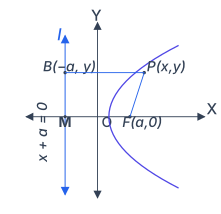
The figure is a coordinate-plane diagram built around the definition of a parabola. The x‑axis and y‑axis are drawn, with the origin labelled O — this is the vertex of the parabola. The curve opens to the right, symmetric about the x‑axis. A point F is marked on the positive x‑axis at coordinates ; this is the focus. A vertical line labelled is drawn to the left of the origin, with equation (equivalently ); this is the directrix. The distance from the directrix to the focus is , so the vertex O lies exactly midway between them.
A general point on the parabola is shown. From P, a perpendicular segment is dropped to the directrix, meeting it at point . The foot of the perpendicular from the focus to the directrix is labelled . Two line segments are drawn: (from P to the focus) and (from P to the directrix). The entire diagram is the geometric statement of the parabola’s definition: for every point P on the curve, the distance to the focus equals the distance to the directrix.
The physical idea is that a parabola is the set of all points equidistant from a fixed point (the focus) and a fixed line (the directrix). The figure makes this equality visible: and are the two distances being compared. By placing the vertex at the origin and the axis along the x‑axis, the algebra becomes clean.
The textbook uses this figure to derive the standard equation. Starting from the definition , and using the coordinates , , and , the distance formula gives:
Setting them equal and squaring:
Expanding both sides:
Cancelling and leaves:
…