Mathematics · Ch 1 — Sets
Union of Sets
Union of Sets
The Union of Two Sets
The union is the first operation we meet in set theory, and its idea is simple: take everything from both sets and put it together, but never write the same element twice.
If you have a set and a set , their union is the set that contains every element that belongs to or belongs to (or both). The word "or" here is the inclusive or — it includes elements that are in either set, including those that are in both.
The symbol for union is . We write and read it as "A union B".
This definition is the formal way of saying: an object is in if and only if it is in at least one of the two sets.
Venn Diagram Representation
A Venn diagram shows the union visually. Draw a rectangle for the universal set , and inside it two overlapping circles for and . The region representing is the entire area covered by both circles together — every part of , every part of , and the shared region where they overlap. Nothing inside either circle is left out, and nothing outside both circles counts.
Properties of the Union Operation
The textbook lists five fundamental properties. Each one is proved directly from the definition of union.
›Proof
Property (i): Commutative Law —
By definition, .
The statement " or " is logically equivalent to " or " — the order of the two conditions does not change the truth of the statement.
Therefore .
So .
›Proof
Property (ii): Associative Law —
Take any element in . By definition, or .
If , then or . So overall, or or .
Conversely, if , then or . If , then or . So again or or .
Both sides contain exactly those elements that belong to at least one of , , or . Hence the two sets are equal.
›Proof
Property (iii): Identity Law —
The empty set has no elements. So .
Since is never true, the condition " or " reduces to just "".
Therefore .
This is why is called the identity element for the union operation — it leaves any set unchanged when united with it.
›Proof
Property (iv): Idempotent Law —
.
The condition " or " is logically equivalent to just "" (repeating the same condition adds nothing).
So . …
The union of two sets and , written as , is the set of all elements that belong to or to (or to both).
Intuitively, it is like taking everything from both sets and putting them together, without repeating any element. …
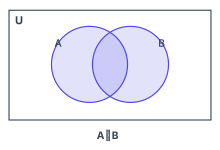
Drawn by us to help you understand the concept clearly, and verified to make sure it's accurate. For exams, practice from your NCERT textbook's own diagram.
Fig 1.4 is a Venn diagram inside a rectangle labelled (the universal set). Two overlapping circles sit inside the rectangle: the left circle is , the right circle is . The entire region covered by either circle — the left circle alone, the right circle alone, and the overlapping lens where both circles meet — is shaded. The shaded area is labelled .
The rectangle represents everything we are considering — the universal set. The two circles and are subsets of . The shading shows the union: every element that belongs to or to (or to both). The key visual point is that the overlapping part is shaded only once, even though it belongs to both sets. This matches the textbook's definition: common elements are taken only once.
A common mistake is to think the union means "add the elements of and separately." The Venn diagram makes it clear: the overlap is not counted twice. If and , the union is — the and appear once, not twice.
The physical idea the figure teaches is that the union of two sets collects everything from both, without duplication. It is the set of all elements that are in at least one of the two sets.
The central formula the textbook develops with this figure is the definition of union:
Here, means " is an element of ", and means " is an element of ". The symbol is read as "union". The condition " or " includes elements that belong to both sets — the "or" is inclusive. …