Q.Figure 12.8 shows plot of versus for kg of oxygen gas at two different temperatures.
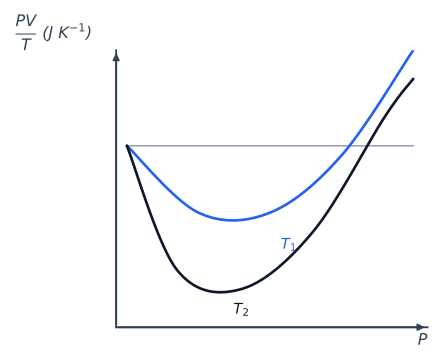
The horizontal dotted line is the ideal-gas prediction , a constant that does not change with pressure. Real oxygen departs from it, and the curve that stays closer to the ideal line is the one at the higher temperature, so . Where the curves touch the axis (the limit) both equal for of . Because this value depends only on the number of moles, matching it with hydrogen needs a much smaller mass, .
Concept — why is the natural quantity to plot
The ideal-gas equation is , so
where is the number of moles and . For a fixed mass of gas is fixed, so an ideal gas would give a value of that is completely independent of and of — a horizontal straight line. A real gas obeys only approximately (best at low pressure and high temperature), so its deviates from the constant, dipping and rising as grows.
(a) Meaning of the dotted straight line
The dotted horizontal line has constant for all . That is exactly ideal-gas behaviour:
So the dotted line represents the ideal-gas value ; the solid curves show how real oxygen departs from it.
(b) Ordering of and
A real gas behaves more like an ideal gas at higher temperature, i.e. its stays closer to the constant line. The curve lies closer to the dotted line than the curve, so
(The curve dips further below , showing stronger non-ideality, which happens at the lower temperature.)
(c) Value of where the curves meet the axis
At the axis the pressure is vanishingly small; there every gas is ideal, so both curves converge to . For of oxygen with molar mass :
(d) The same experiment with hydrogen
The intercept value is , which depends only on the number of moles, not on the identity of the gas. Taking of hydrogen () would give
many more moles than , so would be much larger — not the same value.
To reproduce the oxygen value we need the same number of moles, . The required mass of hydrogen is
- The dotted line is the ideal-gas result constant (independent of ).
- — the curve closer to the ideal line is at the higher temperature.
- .
- No — the intercept depends on the number of moles, so of gives a larger value. Equal requires equal moles, i.e. a hydrogen mass of .
Unlock everything free for 14 days
- Full step-by-step solutions
- Concept-first explanations
- Methods, shortcuts & mistakes
- PYQ mapping + timed mock tests
Full access for 14 days. No credit card required.