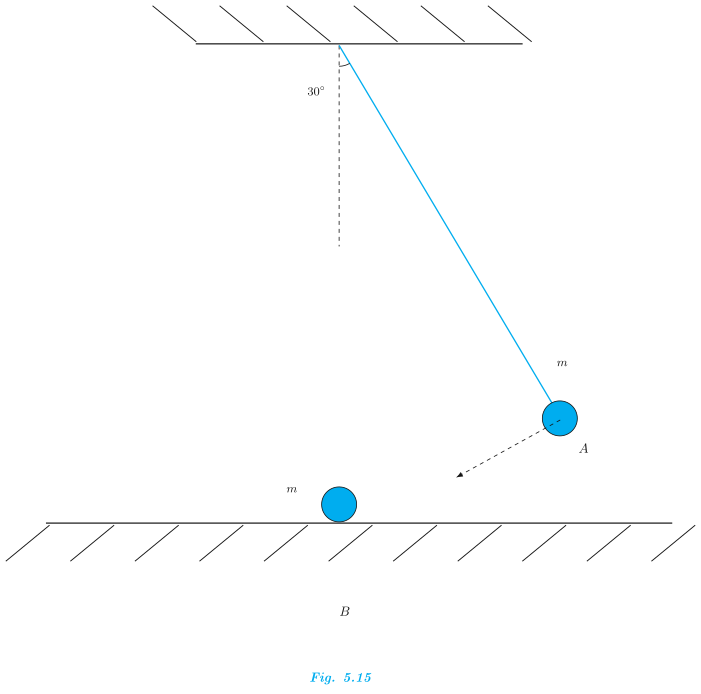
Q.The bob A of a pendulum released from to the vertical hits another bob B of the same mass at rest on a table as shown in Fig. 5.15.
You're viewing a preview — the full solution, concept, methods & PYQ mapping are locked.
Start your 14-day free trial to unlock the full solution →Using conservation of mechanical energy for the pendulum swing and conservation of momentum + kinetic energy for the elastic collision, bob A comes to rest after hitting bob B, so it rises to zero height — it simply stops.
The key insight here is that the collision is elastic and both bobs have equal mass. When a moving object of mass collides elastically with a stationary object of the same mass, the moving object transfers all its velocity to the stationary one and itself comes to rest. That's a standard result from elastic collision theory, and it's the heart of this problem.
Let's walk through it carefully.
-
Find the speed of bob A just before collision
Bob A is released from rest at an angle of to the vertical. As it swings down, gravitational potential energy converts to kinetic energy. The height from which it falls is the vertical drop from its release point to the lowest point.
If the pendulum string has length , then at the bob is at a height above the lowest point.
Using conservation of mechanical energy:
Since , we get . But we don't actually need the numeric value — the exact speed isn't required for the final answer.
-
The elastic collision between equal masses
Bob A (mass , velocity just before impact) hits stationary bob B (mass ). The collision is elastic, so both momentum and kinetic energy are conserved.
Let and be velocities after collision. Conservation of momentum:
Conservation of kinetic energy:
Solving these two equations: substitute into the energy equation:
So either or . The solution would mean (no collision happened), which is physically impossible here. Therefore: …
Unlock everything free for 14 days
- Full step-by-step solutions
- Concept-first explanations
- Methods, shortcuts & mistakes
- PYQ mapping + timed mock tests
Full access for 14 days. No credit card required.