Q.Solve the following Linear Programming Problem graphically.
Maximize Z=5x+3y
Subject to constraints:
3x+5y≤15
5x+2y≤10
x≥0, and y≥0
Concept understanding — Linear Programming Formulation
Linear Programming Formulation: From Intuition to Precision
Imagine you run a small factory that makes two products: chairs and tables. Each chair gives you ₹200 profit, each table gives you ₹300 profit. You have limited wood (240 units) and limited labour hours (100 hours). A chair needs 2 units of wood and 1 hour of labour; a table needs 4 units of wood and 3 hours of labour. You can't make negative chairs or tables. How many of each should you produce to maximise your profit?
This is the kind of problem Linear Programming (LP) is built to solve. The word "programming" here doesn't mean computer programming — it's an old term for "planning". So linear programming is about planning with linear relationships.
The Core Intuition
Every LP problem has three ingredients:
- Decision variables — the quantities you control (how many chairs, how many tables)
- An objective — what you want to maximise (profit) or minimise (cost)
- Constraints — the limits you must respect (wood, labour, non-negativity)
The "linear" part means everything — the profit, the resource usage — adds up in straight-line proportions. Double the chairs, double the wood needed. No fancy curves, no discounts for bulk.
The Precise Statement
A Linear Programming problem is an optimisation problem of the following form:
Maximise (or Minimise) Z=c1x1+c2x2+⋯+cnxn
subject to:
a11x1+a12x2+⋯+a1nxn≤b1
a21x1+a22x2+⋯+a2nxn≤b2
⋮
am1x1+am2x2+⋯+amnxn≤bm
x1,x2,…,xn≥0
Let's decode this piece by piece.
Decision Variables
x1,x2,…,xn are the variables you control. In our factory: let x1 = number of chairs, x2 = number of tables.
Objective Function
Z=c1x1+c2x2+⋯+cnxn is what you want to optimise. The cj are coefficients — profit per unit or cost per unit. For our factory: Z=200x1+300x2 (profit to maximise).
Constraints
Each constraint is a linear inequality (or equality) that limits the variables. The aij are the resource usage per unit of product j for resource i. The bi are the available amounts of each resource.
For our factory:
- Wood: 2x1+4x2≤240
- Labour: 1x1+3x2≤100
Non-negativity
xj≥0 for all j. You can't produce negative chairs. This is almost always present in real problems.
A common mistake is forgetting the non-negativity constraints. Without them, the solver might "produce" negative quantities — which is nonsense in the real world.
The Complete Formulation for Our Example
Maximise Z=200x1+300x2
subject to:
2x1+4x2≤240
x1+3x2≤100
x1,x2≥0
That's it. This is a complete LP formulation. Every LP problem, no matter how complex, follows this same skeleton.
Why "Linear"?
The objective and every constraint are linear functions — they involve only first powers of variables, no x2, no sinx, no x1x2. This linearity is what makes LP problems solvable efficiently (using the Simplex method or interior-point methods). If you have products of variables or powers, it's not linear programming anymore — it becomes nonlinear programming, which is much harder.
A Quick Checklist for Formulating Any LP
When you see a word problem, ask yourself in order:
- What are the decisions? → Define variables with units.
- What is the goal? → Maximise or minimise? Write the objective.
- What are the limits? → Each limit becomes a constraint. Check units match.
- Are there hidden constraints? → Non-negativity is standard. Sometimes you need integer constraints (but that's Integer Programming, not LP).
Always write the units in your head. If a constraint says 2x1+4x2≤240, and x1 is chairs, then 2 must be "units of wood per chair" and 240 must be "total units of wood available". Unit consistency catches most formulation errors.
What LP Cannot Do
LP assumes everything is continuous — you can produce 3.7 chairs. If you need whole numbers (you can't sell half a chair), you need Integer Programming. LP also assumes certainty — if wood supply is random, you need stochastic programming. But for a first meeting, LP is the foundation that all these advanced topics build upon.
Linear Programming Formulation is the opening skill taught in the NCERT Class 12 Mathematics chapter on Linear Programming, matching searches like "linear programming problem formulation examples" or "LPP important questions class 12 maths". Correctly translating a word problem into an objective function and constraints is a heavily weighted, scoring-friendly topic in CBSE Class 12 board exams.
Concept: Linear Programming – Graphical Method
The feasible region is the intersection of all constraint half-planes. The maximum of a linear objective function on a bounded feasible region occurs at a corner point.
Step 1: Plot the constraint lines.
- 3x+5y=15 passes through (5,0) and (0,3).
- 5x+2y=10 passes through (2,0) and (0,5).
- The feasible region lies in the first quadrant below both lines.
Step 2: Find corner points of the feasible region.
- Origin: (0,0)
- x-intercept of 5x+2y=10: (2,0)
- y-intercept of 3x+5y=15: (0,3)
- Intersection of 3x+5y=15 and 5x+2y=10:
Multiply the first by 5 and the second by 3:
15x+25y=75
15x+6y=30
Subtracting: 19y=45⟹y=1945, then x=1920.
Corner point: (1920,1945)
Step 3: Evaluate Z=5x+3y at each corner.
- At (0,0): Z=0
- At (2,0): Z=10
- At (0,3): Z=9
- At (1920,1945): Z=5⋅1920+3⋅1945=19100+135=19235
Since 19235≈12.37>10, the maximum occurs at (1920,1945).
The maximum value is 19235 at (1920,1945).
The maximum of Z=5x+3y over the feasible region is 19235≈12.37, attained at (1920,1945).
Corner points of the feasible region
With 3x+5y≤15, 5x+2y≤10, x,y≥0 (testing the origin in both, the region lies toward the origin), the feasible region has vertices:
- (0,0)
- (2,0) — where 5x+2y=10 meets the x-axis
- (0,3) — where 3x+5y=15 meets the y-axis
- Intersection of 3x+5y=15 and 5x+2y=10:
15x+25y=75,15x+6y=30⇒19y=45,y=1945
5x=10−1990=19100⇒x=1920
giving (1920,1945).
Evaluate Z=5x+3y
| Corner | Z |
|---|---|
| (0,0) | 0 |
| (0,3) | 9 |
| (2,0) | 10 |
| (1920,1945) | 19100+135=19235≈12.37 |
The largest value is 19235.
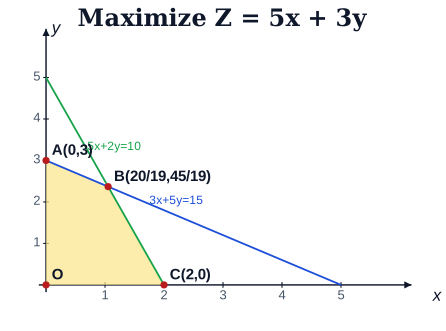
The bounded feasible region OABC; the maximum of Z occurs at corner B(20/19, 45/19).
The maximum value is Z=19235≈12.37, occurring at (1920,1945).
🎓Unlock everything free for 14 days
- ✓Full step-by-step solutions
- ✓Concept-first explanations
- ✓Methods, shortcuts & mistakes
- ✓PYQ mapping + timed mock tests
Full access for 14 days. No credit card required.