Business Studies · Ch 3 — Business Environment
Dimensions of Business Environment
Dimensions of Business Environment
The business environment is not a single, uniform force. It is made up of several distinct dimensions — economic, social, technological, political, and legal conditions — that together form the general environment of an enterprise. Unlike the specific environment (which affects only one firm or industry), these dimensions influence many enterprises at the same time. A manager who ignores them does so at the firm’s peril; one who studies them can spot opportunities and avoid threats.
The textbook illustrates this with a concrete example: when scientific research produced a technology for an energy-efficient light bulb that lasts at least twenty times longer than a standard bulb, senior managers at General Electric and Philips recognised the potential impact on their unit growth and profitability. They carefully followed the research and profitably used its findings. This is the practical value of understanding the dimensions of the business environment.
(i) Economic Environment
The economic environment consists of factors that affect the purchasing power and spending patterns of consumers, as well as the cost structure of businesses. Key factors include:
- Interest rates (short-term and long-term)
- Inflation rates
- Changes in disposable income of people
- Stock market indices
- Value of the rupee
How these factors affect business:
- Interest rates: Short and long-term interest rates significantly affect demand for products and services. For example, low long-term rates benefit construction companies and automobile manufacturers because consumers are more willing to borrow money to buy homes and cars.
- Disposable income: A rise in disposable income (often due to an increase in GDP) creates increasing demand for products.
- Inflation: High inflation rates generally constrain business enterprises because they increase costs — the purchase of raw materials, machinery, and the payment of wages and salaries.
The textbook also lists the components of the economic environment in a structured way:
Existing structure of the economy (relative role of private and public sectors)
Rates of growth of GNP and per capita income (at current and constant prices)
Rates of saving and investment
Volume of imports and exports of different items
Balance of payments and changes in foreign exchange reserves
Agricultural and industrial production trends
Expansion of transportation and communication facilities
Money supply in the economy
Public debt (internal and external)
Planned outlay in private and public sectors
(ii) Social Environment
The social environment includes the social forces that shape people's beliefs, behaviours, and expectations. These forces are:
- Customs and traditions: Social practices that have lasted for decades or even centuries. For example, the celebration of Diwali, Eid, Christmas, and Guru Parv in India provides significant financial opportunities for greeting card companies, sweets manufacturers, tailoring outlets, and many other related businesses.
- Values: Concepts that a society holds in high esteem. In India, individual freedom, social justice, equality of opportunity, and national integration are major values. In business terms, these values translate into freedom of choice in the market, business responsibility towards society, and non-discriminatory employment practices.
- Social trends: These present various opportunities and threats. For example, the health-and-fitness trend among urban dwellers has created demand for organic food, gyms, bottled (mineral) water, and food supplements.
The textbook lists the major elements of the social environment:
Attitudes towards product innovations, lifestyles, occupational distribution, and consumer preferences
Concern with quality of life
Life expectancy
Expectations from the workforce
Shifts in the presence of women in the workforce
Birth and death rates
Population shifts
Educational system and literacy rates
Consumption habits
Composition of family
The textbook also includes an activity (Activity II) asking students to contact ten families and find out changes in their consumption habits over the last five years, and to analyse the impact of these changes on business enterprises. It specifically notes the impact of shifts with the presence of women in the workforce on the fashion industry (shifts towards formal wear), food habits (shift towards packed food), electronic gadgets (increase in demand), and the cosmetic industry (increase in demand).
(iii) Technological Environment
The technological environment includes forces relating to scientific improvements and innovations which provide new ways of producing goods and services, and new methods and techniques of operating a business.
Examples from the textbook:
- Recent technological advances in computers and electronics have modified the ways companies advertise their products. It is now common to see computerised information kiosks and World Wide Web multimedia pages highlighting the virtues of products.
- Retailers have direct links with suppliers who replenish stocks when needed.
- Manufacturers have flexible manufacturing systems.
- Airline companies have Internet and World Wide Web pages where customers can look for flight times, destinations, and fares, and book their tickets online.
- Continuing innovations in lasers, robotics, biotechnology, food preservatives, medicine, telecommunication, and synthetic fuels have provided numerous opportunities and threats for many different enterprises.
Shifts in demand that have created new businesses:
- From vacuum tubes to transistors
- From steam locomotives to diesel and electric engines
- From fountain pens to ballpoint pens
- From propeller airplanes to jets
- From typewriters to computer-based word processors
The textbook also notes that because of technological advancement, it has become possible to book railway tickets through the Internet from home or office.
(iv) Political Environment
The political environment includes:
- Political conditions such as general stability and peace in the country
- Specific attitudes that elected government representatives hold towards business
Significance of political conditions:
- Political stability builds confidence among business people to invest in long-term projects for the growth of the economy. It leads to predictability of business activities.
- Political instability (unrest, threats to law and order) can shake that confidence and create uncertainty for business activities.
- The attitudes of government officials towards business may have either a positive or negative impact upon business.
(v) Legal Environment
The legal environment includes:
- Various legislations passed by the Government
- Administrative orders issued by government authorities
- Court judgments
- Decisions rendered by various commissions and agencies at every level of government — centre, state, or local …
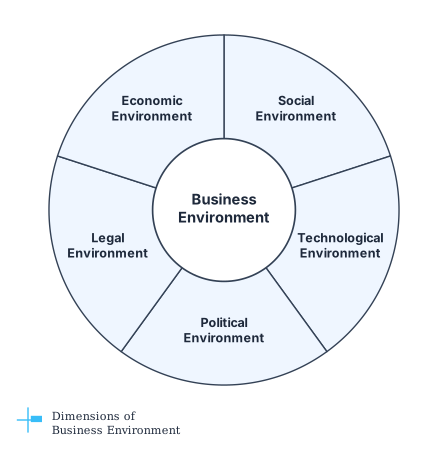
What the Diagram Shows
Our own wheel diagram shows five equal sectors arranged around a white hub labelled Business Environment: Economic, Social, Technological, Political and Legal Environment, arranged around the central hub.
What It Teaches
These are the five dimensions — the factors constituting the business environment — that the textbook identifies as relevant for decision-making and improving performance. In contrast to the specific environment (investors, customers, competitors, suppliers), these dimensions explain the general environment, which influences many enterprises at the same time rather than a single firm. A manager who studies them can be first to spot an opportunity — as when General Electric and Phi …
- Existing structure of the economy in terms of relative role of private and public sectors.
- The rates of growth of GNP and per capita income at current and constant prices.
- Rates of saving and investment.
- Volume of imports and exports of different items.
- Balance of payments and changes in foreign exchange reserves.
- Agricultural and industrial production trends.
- Expansion of transportation and communication facilities.
- Money supply in the economy. …
- Attitudes towards product innovations, lifestyles, occupational distribution and consumer preferences.
- Concern with quality of life.
- Life expectancy.
- Expectations from the workforce.
- Shifts in the presence of women in the workforce.
- Birth and death rates.
- Population shifts. …
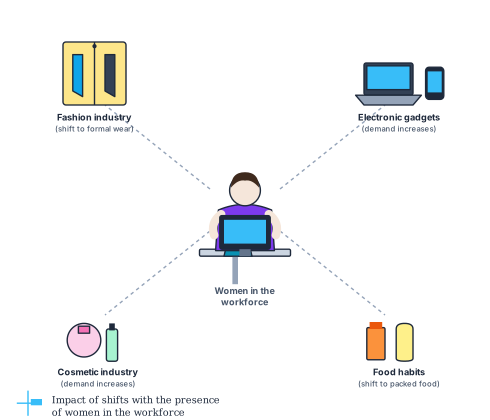
Drawn by us to help you understand the concept clearly, and verified to make sure it's accurate. For exams, practice from your NCERT textbook's own diagram.
Activity II — Social Environment. Contact any ten families known to you. Find out the changes in their consumption habits over the last five years. Analyse the impact of these changes on the working of business enterprises.
What the Figure Shows
Our own illustration shows a woman at work on a computer, with four labelled examples of how a shift in the social environment — more women joining the workforce — ripples outward into business demand: the fashion industry shifting towards formal wear, rising demand for electronic gadgets, rising demand in the cosmetic industry, and food habits shifting towards packed food.
What It Teaches …
- Prevailing political system.
- The degree of politicisation of business and economic issues.
- Dominant ideologies and values of major political parties.
- The nature and profile of political leadership and thinking of political personalities.
- The level of political morality.
- Political institutions like the government and allied agencies.
- Political ideology and practices of the ruling party. …