Business Studies · Ch 11 — Consumer Protection
Importance of Consumer Protection
Importance of Consumer Protection
Why Consumer Protection Matters
Consumer protection is the set of laws and practices designed to safeguard buyers from unfair business behaviour. It gives consumers a way to get their complaints resolved quickly when they are cheated or harmed. The textbook lists ten specific grievances that consumer protection addresses:
- Adulterated goods — adding inferior substances to the product being sold.
- Counterfeit goods — selling a product of lesser value than the real one.
- Sub-standard goods — products that do not meet the prescribed quality standards.
- Duplicate goods — unauthorised copies of branded items.
- Faulty weights and measures — rigged scales that cause underweight products.
- Black marketing and hoarding — creating artificial scarcity and driving up prices.
- Overcharging — charging more than the Maximum Retail Price (MRP).
- Defective goods — products that are damaged or do not work.
- Misleading advertisements — false claims about a product’s quality, grade, or standard.
- Inferior services — service quality lower than what was agreed upon.
The scope of consumer protection is wide. It is not just about punishing wrongdoers; it also involves educating consumers about their rights and responsibilities, helping them get their grievances redressed, and encouraging them to form consumer associations for collective strength.
The Need for Consumer Protection
The need arises from the basic goal of protecting consumers from loss, injury, or exploitation. Specifically, consumer protection aims to ensure:
- Physical safety of the consumer.
- Access to information about products and services.
- Corporate Social Responsibility — businesses must provide quality and quantity at fair prices.
- Consumer satisfaction.
- Social justice and trusteeship — the idea that business resources are held in trust for society.
- Survival and growth of businesses — because satisfied customers are the foundation of a successful enterprise.
Importance from the Consumer’s Point of View
Three major reasons explain why consumers themselves need protection:
- Consumer Ignorance Most consumers are unaware of their rights and the relief available to them. They do not know whom to approach or how to complain. Consumer protection educates them and creates awareness.
- Unorganised Consumers Individual consumers are scattered and weak. They need to be organised into consumer associations that can collectively fight for their interests. While such organisations exist in India, they are not yet powerful enough everywhere, so formal legal protection remains essential.
- Widespread Exploitation of Consumers Unscrupulous sellers use unfair trade practices — defective products, adulteration, false advertising, hoarding, black-marketing — to exploit buyers. Consumers need protection against these malpractices.
Importance from the Point of View of Business
A business has its own strong reasons to protect consumers. These are not just ethical; they are practical and strategic.
- Long-term Interest of Business Enlightened businesses know that customer satisfaction leads to repeat sales and positive word-of-mouth. A satisfied customer brings in new customers. The goal should be long-term profit maximisation through genuine customer satisfaction, not short-term gains through cheating.
- Business Uses Society’s Resources Every business uses resources that belong to society — land, raw materials, labour, infrastructure. In return, it has a responsibility to supply products and services that are in the public interest and do not damage public trust.
- Social Responsibility …
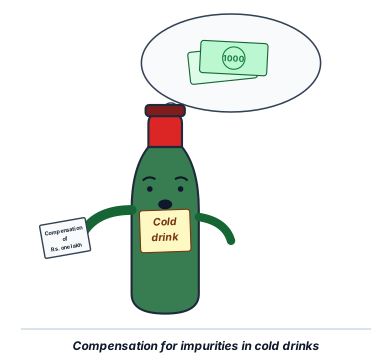
Drawn by us to help you understand the concept clearly, and verified to make sure it's accurate. For exams, practice from your NCERT textbook's own diagram.
Our own simplified rendering of the real page's illustration: a personified cold-drink bottle (labelled "Cold drink") holds out a note reading "Compensation of Rs. one lakh" in one hand, with a thought bubble above showing a stack of currency notes. …