Economics · Ch 7 — Introduction to Microeconomics
Central Problems of an Economy
Central Problems of an Economy
The entire study of economics begins with a single, unavoidable fact: resources are scarce, but human wants are unlimited. Because of this scarcity, no society can produce everything its members desire. Every economy, whether it is a village, a nation, or the whole world, is forced to make choices. These choices are not random; they fall into three fundamental questions that together form the central problems of an economy.
The Three Central Questions
Every society must answer the following:
-
What is produced and in what quantities?
This is the problem of allocation of resources among different goods. Since resources are limited, a society cannot produce everything at once. It must decide on the mix of goods and services. Should it produce more food, clothing, and housing, or more luxury goods? Should it prioritise agricultural goods or industrial products? Should more resources go to education and health, or to building military services? Should the focus be on basic education or higher education? A particularly important choice is between consumption goods (things we use today, like food and clothes) and investment goods (like machines and factories, which boost production and consumption in the future). Every decision to produce more of one thing means producing less of another.
-
How are these goods produced?
This is the problem of choice of technique or technology. For any given good, there are usually several ways to produce it. The central question is: what combination of resources should be used? Should production use more labour (labour-intensive technique) or more machines (capital-intensive technique)? The society must choose the method that makes the best use of its available resources, given their relative scarcity and cost.
-
For whom are these goods produced?
This is the problem of distribution of the final output. Once goods and services are produced, how should they be shared among the members of the economy? Who gets more and who gets less? This involves difficult decisions about equity and fairness. Should the economy ensure a minimum amount of consumption for everyone? Should elementary education and basic health services be available freely to all? The answer to this question determines the pattern of consumption in the society.
The central problems of an economy are therefore two-fold: (i) the allocation of scarce resources to the production of different possible goods and services, and (ii) the distribution of the final goods and services among the individuals in the economy.
Production Possibility Frontier
To understand the problem of choice more clearly, economists use a simple model called the Production Possibility Frontier (PPF). It shows the different combinations of two goods that an economy can produce when all its resources are fully and efficiently utilised, given the current state of technology.
Example 1. Consider an economy that can only produce two goods: corn and cotton. The table below shows some of the possible combinations it can produce when all its resources are fully used.
Table 1.1: Production Possibilities
| Possibilities | Corn (units) | Cotton (units) |
|---|---|---|
| A | 0 | 10 |
| B | 1 | 9 |
| C | 2 | 7 |
| D | 3 | 4 |
| E | 4 | 0 |
If all resources go to corn, the maximum is 4 units (point E). If all go to cotton, the maximum is 10 units (point A). The economy can also produce any combination in between, such as 2 units of corn and 7 units of cotton (point C).
When these points are plotted on a graph (with corn on one axis and cotton on the other) and joined, the resulting curve is the Production Possibility Frontier (PPF).
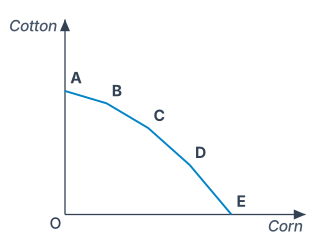
Drawn by us to help you understand the concept clearly, and verified to make sure it's accurate. For exams, practice from your NCERT textbook's own diagram.
When the production possibilities of Table 1.1 are plotted with corn on the horizontal axis and cotton on the vertical axis and the points are joined, the resulting curve is the production possibility frontier of the economy. Every combination on or below the curve can be produced with the economy's resources; points strictly below it leave some resources under-employed or wasted. The curve is concave to the origin: moving from A towards E it steepens, because each extra …
The PPF represents the boundary between what is attainable and what is not. Any point on the curve (like B, C, or D) is attainable and efficient — all resources are fully used. Any point inside the curve (below it) is also attainable, but it represents inefficiency: some resources are either unemployed or used wastefully. Any point outside the curve is unattainable with the current resources and technology.