Economics · Ch 11 — Market Equilibrium
Price Ceiling
Price Ceiling
What Is a Price Ceiling?
A price ceiling is a legal maximum price that the government allows sellers to charge for a particular good or service. It is an upper limit imposed by law, and no seller may legally sell the good above this price.
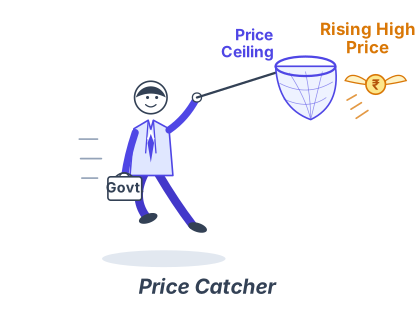
Drawn by us to help you understand the concept clearly, and verified to make sure it's accurate. For exams, practice from your NCERT textbook's own diagram.
The cartoon captures the intuition behind a price ceiling. When the market price of an essential good such as wheat, rice, kerosene or sugar climbs too high, the government steps in and imposes a legal maximum price to 'catch' and hold it down — just as the official chases the escaping Rising High Price with a net labelled Price Ceiling. As the wheat-market analysis that follows shows, however, capping the price below the market equilibrium does not make the problem vanish: it creates a new one — a sh …
The government typically imposes a price ceiling on essential goods — items that are considered necessities for a large section of the population. Common examples from the Indian context include wheat, rice, kerosene, and sugar. The reasoning is straightforward: at the market-determined equilibrium price, some low-income households cannot afford these basic goods. By capping the price below the equilibrium, the government aims to make these necessities accessible to the poor.
A price ceiling is always set below the market-determined equilibrium price. If it were set above the equilibrium, it would have no effect — the market price would simply stay at the equilibrium level, since no seller would voluntarily charge less than what buyers are willing to pay.
The Effect of a Price Ceiling on Market Equilibrium
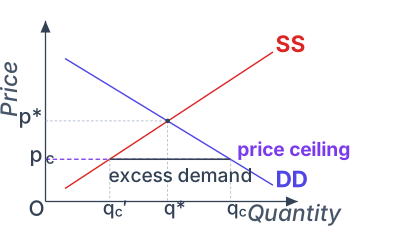
To understand what actually happens when a price ceiling is imposed, consider the market for wheat. The diagram (Figure 5.7 in the textbook) shows the usual market demand curve DD and market supply curve SS for wheat. The free-market equilibrium occurs at price and quantity , where the two curves intersect.
Now the government imposes a price ceiling at , which is lower than . At this artificially low price, the quantity demanded by consumers jumps to — because wheat is now cheaper, more people want to buy it. But the quantity that firms are willing to supply falls to , since producers find it less profitable to sell at the lower price.
The result is a shortage — an excess demand — equal to at the ceiling price. The very policy intended to help consumers ends up creating a situation where there is not enough wheat to go around.
Drawn by us to help you understand the concept clearly, and verified to make sure it's accurate. For exams, practice from your NCERT textbook's own diagram.
The figure shows a standard supply-and-demand diagram for the wheat market. The vertical axis is labelled Price and the horizontal axis is labelled Quantity. Two curves are drawn: an upward-sloping supply curve SS (shown in red) and a downward-sloping demand curve DD (shown in indigo). These curves intersect at the market equilibrium point, which is marked with coordinates (q*, p*) — the equilibrium quantity and price.
A horizontal dashed line in purple is drawn across the diagram at a price level labelled p_c. This line is the price ceiling, and it lies clearly below the equilibrium price p*. At this ceiling price, the diagram shows two key points on the curves. On the supply curve SS, directly above the quantity axis, a point marks the quantity that firms are willing to supply at price p_c; this quantity is labelled q_c' (read as "q-c-prime"). On the demand curve DD, at the same price level, a point marks the quantity that consumers wish to buy; this quantity is labelled q_c. Because the ceiling is below equilibrium, q_c (on the demand curve) is to the right of q_c' (on the supply curve). The horizontal gap between these two points — from q_c' to q_c — is explicitly marked on the diagram as excess demand (the shortage).
The figure uses a simple two-curve layout with no additional panels or arrows. The only relationship shown is the direct comparison of quantities supplied and demanded at the ceiling price, and the resulting shortage. …
A common mistake is to think that a price ceiling simply makes goods cheaper for everyone. In reality, it creates a shortage. The good becomes unavailable to many consumers, and those who do get it may have to spend time and effort queuing or searching for it. The intended benefit is often offset by these unintended consequences.
How Is the Scarce Quantity Distributed?
When the quantity supplied () is less than the quantity demanded (), the market cannot simply let price rise to clear the shortage — that would violate the ceiling. So the government must find a non-price mechanism to allocate the limited supply.
The standard method is rationing. The government issues ration coupons to consumers. Each coupon entitles the holder to buy a fixed quantity of the good — say, a certain number of kilograms of wheat per month. No individual can buy more than the stipulated amount. The rationed goods are sold through designated outlets called ration shops or fair price shops.
This system ensures that, at least in principle, every eligible consumer gets some minimum quantity of the essential good, regardless of their income.
Adverse Consequences of Price Ceilings with Rationing
Even with rationing, the price ceiling creates several problems for consumers.
Long queues. Consumers must stand in long lines at ration shops to collect their allotted quantity. This wastes time and effort, and for working people, it can mean lost wages. …