Economics · Ch 9 — Production and Costs
Introduction
Introduction
Having studied the behaviour of consumers, this chapter -- and the next -- turn to the behaviour of the producer. Production is the process by which inputs are transformed into output. A firm acquires inputs such as labour, machinery, land and raw materials, and combines them to produce an output that is either consumed directly or used by other firms for further production. A tailor combines a sewing machine, cloth, thread and labour to produce shirts; a farmer combines land, labour, a tractor, seed, fertiliser and water to produce wheat; a car manufacturer combines a factory, machinery, labour, steel and other inputs to produce cars; even a rickshaw puller 'produces' rickshaw rides using a rickshaw and her own labour.
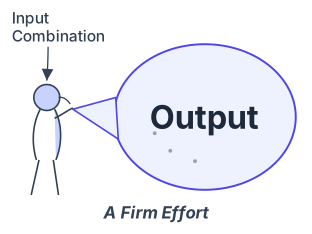
Drawn by us to help you understand the concept clearly, and verified to make sure it's accurate. For exams, practice from your NCERT textbook's own diagram.
A firm's task is to turn an input combination — labour, machines, land and raw materials — into output. The chapter first studies how inputs relate to output and then the cost of acquiring those inputs, so the firm can find the output level at which its profit is highest.
To keep the analysis manageable, this chapter makes a few simplifying assumptions. Production is treated as instantaneous -- no time elapses between combining the inputs and obtaining the output -- and the terms 'production' and 'supply' are used interchangeably. Acquiring inputs costs the firm money; this is the cost of production. Once the output is sold in the market, the firm earns revenue, and the difference between revenue and cost is the firm's profit. Every firm in this analysis is assumed to have a single objective: to earn the maximum profit it can.
This chapter first examines the relationship between the inputs a firm uses and the output it produces, and then turns to the firm's cost structure -- together, these let us identify the output level at which the firm's profit is highest.