Physical Education · Ch 8 — Biomechanics and Sports
Types of Levers
Types of Levers
There are three classes of lever, distinguished by which component — fulcrum, effort or load — lies in the middle.
First-class lever
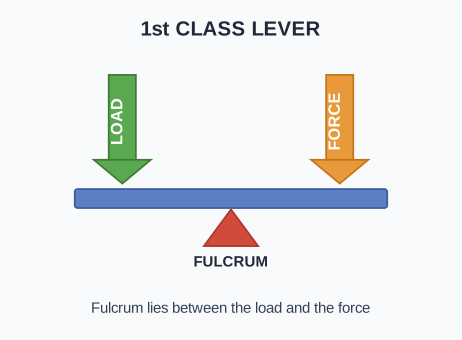
In a first-class lever the fulcrum lies between the effort (force) and the resistance (load). The fulcrum can be moved along the bar, changing the relative lengths of the force arm and the resistance arm. Placing the fulcrum close to the resistance makes the force arm longer, so less force is needed — but the force must travel a longer distance to move the resistance a short way. A shorter force arm needs more force but gives greater speed and range of motion at the resistance end.
Drawn by us to help you understand the concept clearly, and verified to make sure it's accurate. For exams, practice from your NCERT textbook's own diagram.
A simple schematic of a first-class lever: the fulcrum (red triangle) sits directly under the centre of the bar, with the load pressing down at the left end and the effort/force pressing down at the right end. Because the fulcrum lies between the load and the force, this is the defining layout of a first-class lever -- moving the fulcrum closer to either end changes the balance between the force …
Drawn by us to help you understand the concept clearly, and verified to make sure it's accurate. For exams, practice from your NCERT textbook's own diagram.
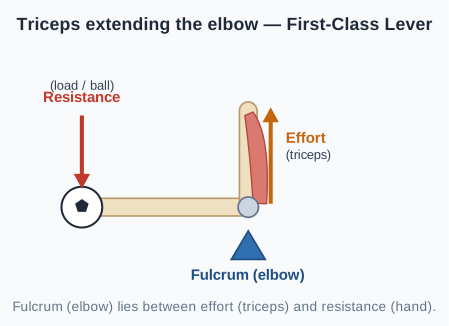
The arm acting as a real first-class lever during a throw: the elbow joint is the fulcrum, the triceps supplies the effort by contracting to straighten the arm, and the hand/ball is the resistance (load) being moved, with the fulcrum sitting between the effort and the resistance -- the same arrangement as the generic first-class lever shown above. This is why forcefully extending the elbow, as in a throw …
Examples in the body:
| Example | Fulcrum | Effort | Load |
|---|---|---|---|
| Triceps extending the elbow (throwing a ball) | Elbow | Triceps | Arm / ball |
| V-sit-up | Hip joint | Abdomen | Leg / lower body |
Second-class lever
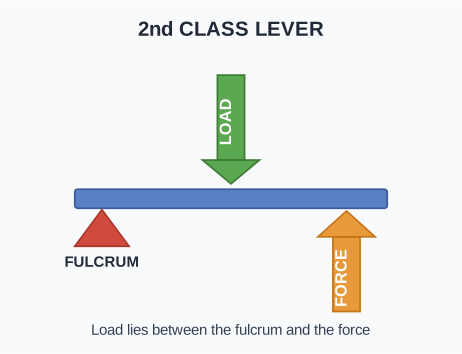
In a second-class lever the load (resistance) lies between the fulcrum and the effort. Here the force arm is always longer than the resistance arm, so the force needed to lift the load is always less than the load itself — this class gives a mechanical advantage.
Drawn by us to help you understand the concept clearly, and verified to make sure it's accurate. For exams, practice from your NCERT textbook's own diagram.
A simple schematic of a second-class lever: the fulcrum (red triangle) sits at the left end of the bar, the load presses down in the middle, and the effort/force pushes up at the right end -- so the load sits between the fulcrum and the force. Because the force arm (fulcrum to effort) is always longer than the resistance arm (fulcrum to load) in this layout, a second-class lever always needs less force than the we …
Drawn by us to help you understand the concept clearly, and verified to make sure it's accurate. For exams, practice from your NCERT textbook's own diagram.
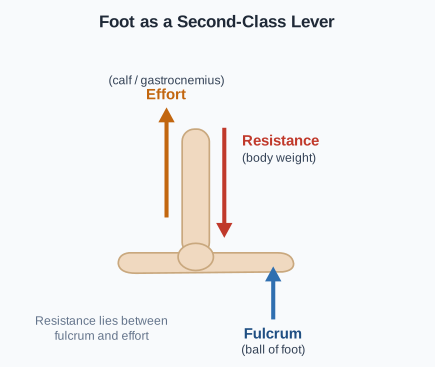
The foot shown acting as a real second-class lever while rising onto the toes, known as plantar flexion, as in a jump take-off or a calf raise: the ball of the foot is the fulcrum, the body weight acting at the ankle is the resistance (load), and the calf muscle (gastrocnemius) pulling up at the heel supplies the effort -- placing the load between the fulcrum and the effort, exactly the second-class arrangement. This lever layout is why the calf can li …
Examples in the body:
| Example | Fulcrum | Effort | Load |
|---|---|---|---|
| Foot rising onto the toes (plantar flexion) | Ball of the foot | Gastrocnemius (calf) | Ankle / body weight |
| Straight push-up | Ball of the foot | Arm-muscle contraction | Body weight |
Third-class lever …
Drawn by us to help you understand the concept clearly, and verified to make sure it's accurate. For exams, practice from your NCERT textbook's own diagram.
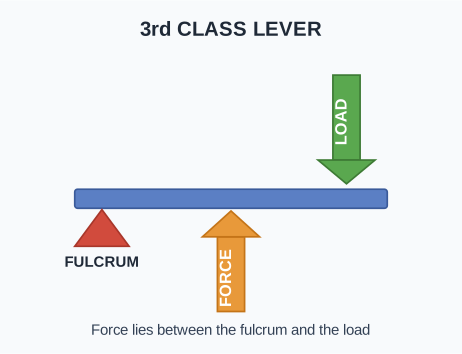
A simple schematic of a third-class lever: the fulcrum (red triangle) sits at the left end of the bar, the effort/force pushes up in the middle, and the load presses down at the right end -- so the effort sits between the fulcrum and the load. Because the force arm here is always shorter than the resistance arm, more muscular force is needed than the weight of the load itself, but in exchange the load end moves through a much greater range of motion and spe …
Drawn by us to help you understand the concept clearly, and verified to make sure it's accurate. For exams, practice from your NCERT textbook's own diagram.
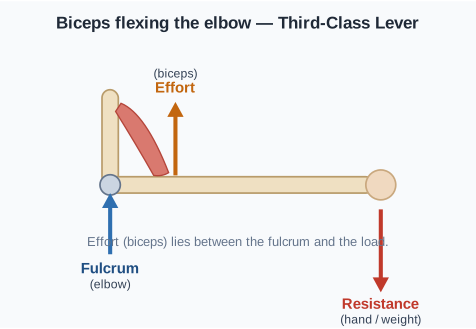
The arm acting as a real third-class lever during elbow flexion, as in a bicep curl or pulling a ball towards the body: the elbow joint is the fulcrum, the biceps supplies the effort by contracting between the fulcrum and the hand, and the hand/weight is the resistance (load) at the far end. Because the biceps' force arm is so much shorter than the full length of the forearm, lifting even a light weight demands significant muscular force -- but the hand moves fast and throug …