Physical Education · Ch 3 — Yoga as Preventive Measure for Lifestyle Disease
Makarasana
Makarasana
Makarasana (Crocodile Pose)
In Sanskrit, Makar means crocodile and Asana means posture, so the English name of this pose is the Crocodile Pose. Here the CBSE Class 12 Physical Education course gives a fuller account of Makarasana as a deeply relaxing asana for back pain and arthritis (a shorter description also appears under hypertension in section 3.4.10).
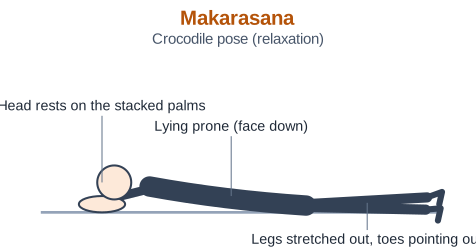
Drawn by us to help you understand the concept clearly, and verified to make sure it's accurate. For exams, practice from your NCERT textbook's own diagram.
A line drawing of a person lying prone (face down) with the legs stretched out and toes pointing outward, the arms folded in front and the head resting on the stacked palms in deep …
Technique
- Lie down on the floor on your stomach with your hands folded under the head.
- Place the right palm over the left palm on the ground, and rest the head over the right palm in a relaxed way, closing your eyes.
- Stretch the legs as far as possible, with the toes pointing outwards.
- Relax the whole body. Breathe normally and slowly, feeling the whole body touching the ground and a deep relaxation in all your muscles.
- Relax in this posture for a few minutes.
- While returning from the posture, slowly bring the feet together, unfold the arms and come back to the prone position.
Benefits
- Gives deep relaxation to the shoulders and the spine.
- Reduces waist pain.
- Helps in cases of slipped disc.
- Beneficial for asthmatic patients and those with lung disorders.
- Provides relief for arthritis patients.
Contraindications
- Practitioners in their second or third trimester of pregnancy should avoid the practice of Makarasana in the prone posture.
Breathing Awareness
- Let the breath settle into its own slow, natural rhythm once in the final relaxed position, without controlling it consciously.
- Notice the breath moving the back gently as it rises and falls, using this as a point of calm attention while the body rests.
- Breathe out fully and slowly when releasing the posture and coming back to a seated position.
Why this fuller account of Makarasana matters for back pain and arthritis
Unlike an active stretch, Makarasana removes all muscular effort from the spine and lets gravity alone gently decompress the vertebrae while the supported head and relaxed shoulders release accumulated tension, valuable for arthritis and back pain because it allows a sore back to rest completely without the complete inactivity of ordinary lying down, which can itself stiffen a joint further. It is often used as a recovery posture between the more active back-bends and twists elsewhere in this unit.
Common mistakes
- Treating this as a brief pause rather than holding it for several full minutes undersells its benefit; the relaxation effect builds with sustained, unhurried time in the posture. …