Biology · Ch 9 — Biotechnology: Principles and Processes
Amplification of Gene of Interest using PCR
Amplification of Gene of Interest using PCR
PCR is the technique used to make millions to billions of copies of a specific DNA segment in a test tube. The full form is Polymerase Chain Reaction. It is an in vitro (outside the body) method of DNA replication.
The reaction requires two sets of primers. These are short, chemically synthesised oligonucleotides — each is complementary to one of the two strands of the target DNA region. The other key requirement is the enzyme DNA polymerase, which extends the primers using the nucleotides provided in the reaction mixture and the genomic DNA as the template.
The PCR cycle has three steps:
- Denaturation: The double-stranded DNA is heated to a high temperature so that the two strands separate.
- Primer annealing: The temperature is lowered to allow the primers to bind (anneal) to their complementary sequences on the single-stranded DNA.
- Extension of primers: DNA polymerase adds nucleotides to the 3' end of each primer, using the genomic DNA as a template, to synthesise a new complementary strand.
If this cycle of replication is repeated many times, the segment of DNA can be amplified to approximately one billion copies. …
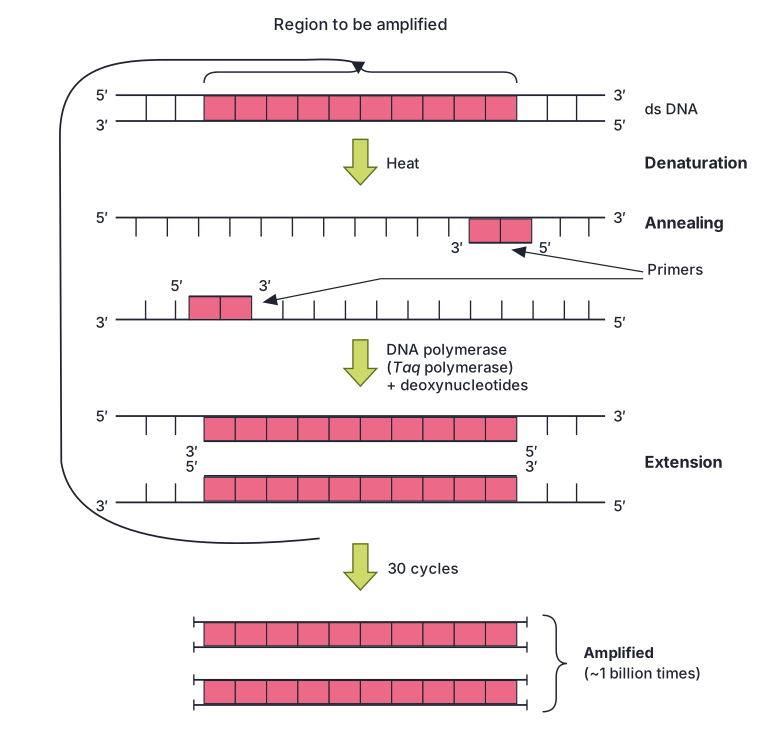
Drawn by us to help you understand the concept clearly, and verified to make sure it's accurate. For exams, practice from your NCERT textbook's own diagram.
Figure 9.6 is a cyclic diagram that walks through one complete round of PCR. It is drawn as a closed loop, because the process repeats. The cycle has three labelled steps, arranged in order around the loop: Denaturation, Primer annealing, and Extension of primers.
At the top of the cycle, the starting material is shown as a double-stranded DNA molecule — the template that contains the target sequence to be amplified. The two strands are drawn as separate, antiparallel lines, with the target region marked somewhere in the middle.
Step (i): Denaturation. The diagram shows the double-stranded DNA being heated to a high temperature (the real figure gives no exact number). The two strands separate completely, yielding two single-stranded templates. The labels indicate that the hydrogen bonds between base pairs break, and the strands unwind.
Step (ii): Primer annealing. The temperature is lowered so the primers can bind. Two short, chemically synthesised oligonucleotides — the forward primer and reverse primer — are shown binding to their complementary sequences on the two separated strands. Each primer is drawn as a short, labelled block that attaches to one strand, flanking the target region. The primers are positioned so that their 3′ ends point toward each other, defining the boundaries of the segment to be amplified.
Step (iii): Extension of primers. The temperature is raised to whatever is optimum for Taq DNA polymerase. The enzyme is depicted as a shape (often a rounded blob) bound to each primer-template complex. It is shown extending the primers by adding nucleotides (dNTPs) in the 5′→3′ direction, using the single-stranded template as a guide. The newly synthesised strands are drawn as dashed or differently coloured lines, extending from each primer until the end of the template is reached.
After extension, the diagram shows that the original double-stranded DNA has been doubled: two identical double-stranded molecules now exist, each containing one original strand and one newly made strand. An arrow loops back to the top of the diagram, indicating that the cycle repeats — denaturation, annealing, extension — over and over. A note or label near the loop states that after about 30 cycles, the target DNA is amplified roughly a billion-fold. …