Biology · Ch 3 — Reproductive Health
Population Stabilisation and Birth Control
Population Stabilisation and Birth Control
The Core Idea
A population explosion is not just about large numbers — it is about the rate at which numbers grow. When the birth rate stays high and the death rate falls sharply, the population surges. India crossed the one billion mark in the year 2000, and the sheer scale of this growth puts enormous pressure on resources like food, water, housing, education, and healthcare. The only sustainable way to manage this is through population stabilisation — which means bringing the birth rate down to match the death rate, so the population stops growing.
Why the Explosion Happened
The main reason is a dramatic drop in the death rate, especially infant and maternal mortality, thanks to better medical facilities, improved sanitation, and widespread immunisation. The birth rate, however, did not fall as quickly. This gap — high births, low deaths — is what caused the population to double in a short span. India’s population, which was about 350 million at independence, crossed 1 billion by 2000. Such rapid growth is called a population explosion.
The Need for Birth Control
To stabilise the population, we must reduce the birth rate. This is where birth control — also called contraception — becomes essential. Contraception refers to all methods that prevent pregnancy. But the goal is not just to stop pregnancy; it is to do so safely, effectively, and without harming the health of the user. A good contraceptive method must be:
- Highly effective — it should reliably prevent pregnancy.
- User-friendly — easy to obtain, use, and afford.
- Reversible — it should not permanently affect the ability to have children later.
- Free from side-effects — it must not cause long-term health problems.
No single method is perfect for everyone. The choice depends on the couple’s age, health, number of children they already have, and their future plans.
Classification of Contraceptive Methods
Contraceptive methods are broadly grouped into four categories:
- Natural / Traditional Methods
- Barrier Methods
- Intrauterine Devices (IUDs)
- Hormonal / Surgical Methods
Each works through a different principle — some prevent the meeting of sperm and egg, some alter the uterine environment, and some stop ovulation or fertilisation entirely.
1. Natural / Traditional Methods
These rely on awareness of the menstrual cycle and do not use any device or chemical. They are less reliable but have no side-effects.
- Rhythm method / Periodic abstinence: Couples avoid intercourse from day 10 to day 17 of the menstrual cycle (the fertile window), when ovulation is most likely. The problem is that cycles vary, making this method unreliable.
- Withdrawal / Coitus interruptus: The male withdraws his penis from the vagina before ejaculation. This is risky because pre-ejaculate fluid may contain sperm, and it requires great self-control.
- Lactational amenorrhea method (LAM): After childbirth, as long as the mother is fully breastfeeding and has not had a menstrual period, ovulation is suppressed. This is effective only for up to six months after delivery.
Natural methods have high failure rates because they depend on perfect timing or self-control. They are not recommended as the sole method for couples who want reliable protection.
2. Barrier Methods
These physically block sperm from reaching the egg.
- Condoms: A thin rubber or latex sheath worn over the penis (male condom) or inserted into the vagina (female condom). They are the most popular barrier method because they are:
- Easily available over the counter.
- Inexpensive.
- Effective when used correctly.
- The only contraceptive that also protects against sexually transmitted infections (STIs), including HIV.
- Diaphragms, cervical caps, and vaults: Rubber or silicone barriers that are inserted into the female reproductive tract to cover the cervix. They must be fitted by a doctor and are used along with a spermicidal cream or jelly.
Condoms are often called "nirodh" in India and are distributed free of cost through government family planning programmes.
3. Intrauterine Devices (IUDs)
These are small, T-shaped devices inserted by a doctor into the uterus. They are one of the most widely used methods in India because they are long-acting and highly effective.
IUDs are classified into three types based on how they work:
| Type | Example | Mechanism of Action |
|---|---|---|
| Non-medicated IUD | Lippes loop | Increases phagocytosis of sperm inside the uterus — white blood cells engulf and destroy sperm. |
| Copper-releasing IUDs | CuT 380A, CuT 200B, Multiload 375 | Copper ions released into the uterus suppress sperm motility and fertilising capacity. |
| Hormone-releasing IUDs | LNG-20 (Progestasert) | Releases the hormone progestogen, which makes the uterus lining unsuitable for implantation and thickens cervical mucus to block sperm. |
IUDs are ideal for spacing children. They are effective for 3 to 10 years depending on the type. The hormone-releasing IUD (LNG-20) is also used to treat heavy menstrual bleeding.
4. Hormonal Contraceptives
These use synthetic hormones to prevent ovulation or alter the uterine environment.
- Oral pills: Taken daily for 21 days, starting within the first five days of the menstrual cycle. They contain a combination of oestrogen and progestogen, or progestogen alone. They inhibit ovulation and also thicken cervical mucus.
- Progestogen-only pills (mini-pills): Safer for breastfeeding mothers because they do not affect milk production.
- Injectables and implants: Progestogen is injected or placed under the skin. They provide protection for several months to years.
- Emergency contraceptives: High-dose progestogen pills (like levonorgestrel) taken within 72 hours of unprotected intercourse. They prevent ovulation or fertilisation. They are not for regular use.
Oral pills must be taken strictly on time. Missing a dose reduces effectiveness. They do not protect against STIs.
5. Surgical Methods (Sterilisation)
These are permanent methods and are meant for couples who have completed their family size.
- Vasectomy (male): A small part of the vas deferens (the tube that carries sperm) is cut and tied. Sperm are still produced but cannot reach the semen. …
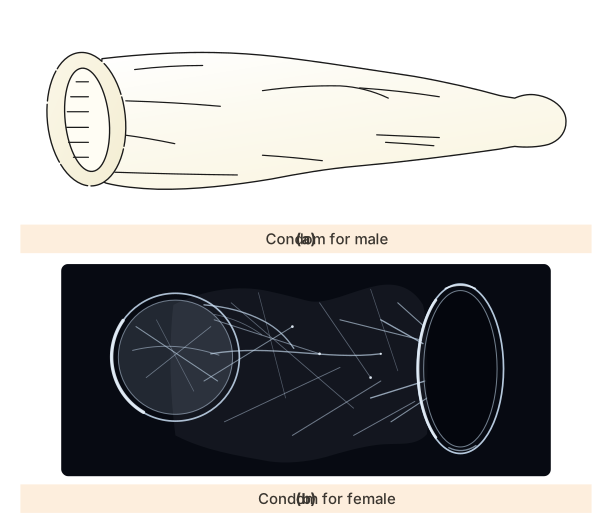
Drawn by us to help you understand the concept clearly, and verified to make sure it's accurate. For exams, practice from your NCERT textbook's own diagram.
This is a simple two-panel comparison of the male and female condom, both barrier contraceptives.
- Male condom — drawn as a thin sheath with two labelled parts: the reservoir tip, a small pouch at the closed end that collects semen after ejaculation, and the rolled rim at the open end, which unrolls down the shaft of the erect penis before intercourse.
- Female condom — drawn as a looser sheath with a ring at each end: the inner ring (closed end), which sits inside the vagina, and the outer ring (open end), which stays outside covering the external genitalia. …
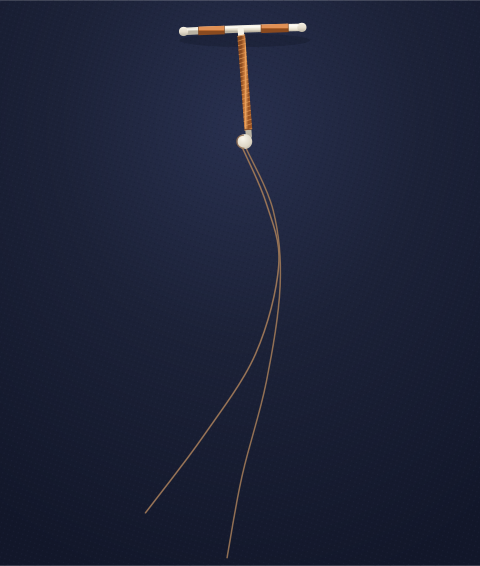
Drawn by us to help you understand the concept clearly, and verified to make sure it's accurate. For exams, practice from your NCERT textbook's own diagram.
Figure 3.2 shows a Copper T (CuT) — a specific type of intrauterine device (IUD) used for contraception. The drawing depicts a small, T-shaped plastic frame. Wound tightly around the vertical stem of this T is a coil of copper wire. The entire device is shown positioned inside the uterus, with the top arms of the T resting near the openings of the fallopian tubes and the stem extending downward toward the cervix.
The key teaching point is how the copper works. The copper wire continuously releases copper ions into the uterine fluid. These ions are toxic to sperm — they directly suppress sperm motility (movement) and reduce their ability to fertilise an egg. Additionally, the presence of the IUD itself triggers a mild inflammatory response in the uterus, which increases phagocytosis (engulfing and destruction) of sperm by white blood cells. The result is that very few sperm ever reach the fallopian tubes, and those that do are too damaged to fertilise an ovum.
The CuT is a non-hormonal IUD. Unlike hormonal IUDs, it does not release progesterone or prevent ovulation. Its entire contraceptive effect is local — inside the uterus — and reversible upon removal. …
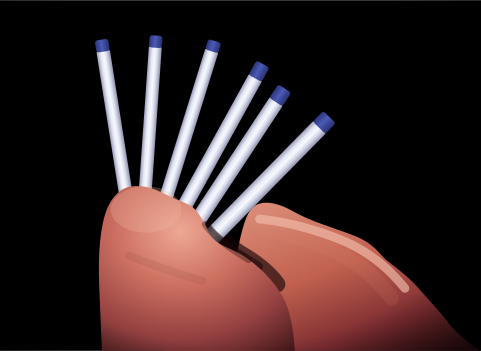
Drawn by us to help you understand the concept clearly, and verified to make sure it's accurate. For exams, practice from your NCERT textbook's own diagram.
This is a two-panel diagram of a hormonal contraceptive implant.
The left panel, "Implant rods", shows the device itself before insertion: a small set of thin, flexible progestogen rods.
The right panel, "Subdermal placement", shows a cross-section of the upper arm with those rods lying just beneath the skin surface — this is what "subdermal" means. This location is easy to access for both insertion and removal. …
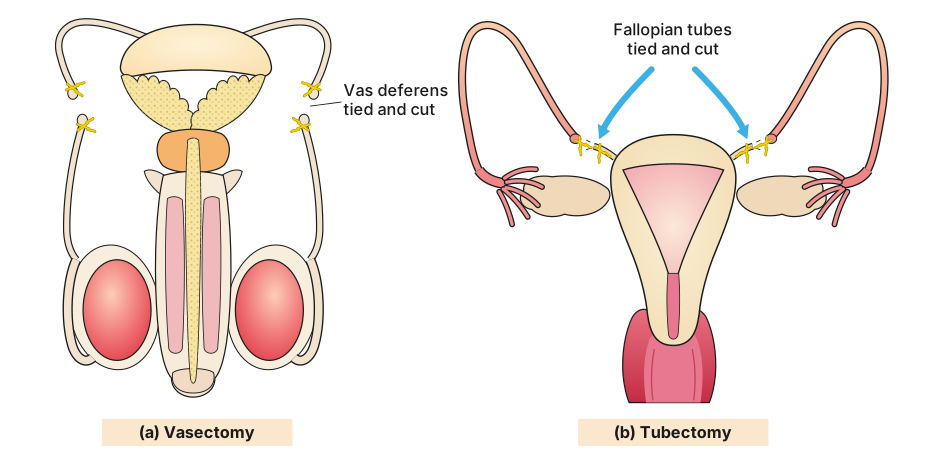
Drawn by us to help you understand the concept clearly, and verified to make sure it's accurate. For exams, practice from your NCERT textbook's own diagram.
This two-panel diagram contrasts the two permanent surgical sterilisation methods.
- Vasectomy — a small segment of the vas deferens (the duct carrying sperm away from the testis) is cut and tied off on one side, shown near the testis. This blocks sperm from reaching the urethra, so the ejaculate contains no sperm.
- Tubectomy — a small segment of each fallopian tube is cut and tied off, shown on both sides of the uterus. This blocks the egg from travelling down to meet sperm, and blocks sperm from travelling up to meet the egg. …