Biology · Ch 1 — Sexual Reproduction in Flowering Plants
Seed
Seed
The seed is the final product of sexual reproduction in angiosperms. It is a fertilised ovule, and seeds are always formed inside fruits. A typical seed consists of three parts: the seed coat (or coats), one or more cotyledons, and the embryo axis.
Structure and Types of Seeds
The cotyledons of the embryo are simple, generally thick and swollen because they store food reserves — this is especially visible in legumes like peas and groundnuts.
Mature seeds are classified based on whether they retain endosperm:
- Non-albuminous (ex-albuminous) seeds have no residual endosperm. The endosperm is completely consumed during embryo development. Examples: pea, groundnut.
- Albuminous seeds retain a part of the endosperm because it is not completely used up during embryo development. Examples: wheat, maize, barley, castor.
Occasionally, in some seeds such as black pepper and beet, remnants of the nucellus persist. This residual, persistent nucellus is called the perisperm.
Seed Coat and Micropyle
The integuments of the ovule harden to form the tough, protective seed coat. The micropyle remains as a small pore in the seed coat. This pore is essential because it allows oxygen and water to enter the seed during germination.
Maturation and Dormancy
As the seed matures, its water content drops, and seeds become relatively dry — about 10–15 per cent moisture by mass. The general metabolic activity of the embryo slows down. The embryo may enter a state of inactivity called dormancy. If favourable conditions are available (adequate moisture, oxygen, and suitable temperature), the seed germinates.
(See the in-text question on the relationship between ovule count and seed count, below.)
From Ovary to Fruit
As ovules mature into seeds, the ovary develops into a fruit. These two transformations happen simultaneously. The wall of the ovary develops into the wall of the fruit, called the pericarp.
Fruits may be:
- Fleshy — e.g., guava, orange, mango.
- Dry — e.g., groundnut, mustard.
Many fruits have evolved mechanisms for seed dispersal.
In most plants, by the time the fruit develops from the ovary, the other floral parts degenerate and fall off. However, in a few species such as apple, strawberry, and cashew, the thalamus also contributes to fruit formation. Such fruits are called false fruits. Most fruits, which develop only from the ovary, are called true fruits.
Parthenocarpy
Although most fruits are the result of fertilisation, a few species develop fruits without fertilisation. Such fruits are called parthenocarpic fruits. Banana is a classic example. Parthenocarpy can be induced through the application of growth hormones, and such fruits are seedless.
Advantages of Seeds
Seeds offer several key advantages to angiosperms:
- Since pollination and fertilisation are independent of water, seed formation is more dependable.
- Seeds have better adaptive strategies for dispersal to new habitats, helping the species colonise other areas.
- They contain sufficient food reserves, so young seedlings are nourished until they can photosynthesise on their own.
- The hard seed coat provides protection to the young embryo.
- Being products of sexual reproduction, seeds generate new genetic combinations, leading to variations.
- Seed is the basis of our agriculture.
- Dehydration and dormancy of mature seeds are crucial for storage. Seeds can be used as food throughout the year and to raise crops in the next season.
Seed Viability
How long do seeds remain alive after dispersal? This period varies greatly:
- In a few species, seeds lose viability within a few months.
- Seeds of a large number of species live for several years.
- Some seeds can remain alive for hundreds of years. …
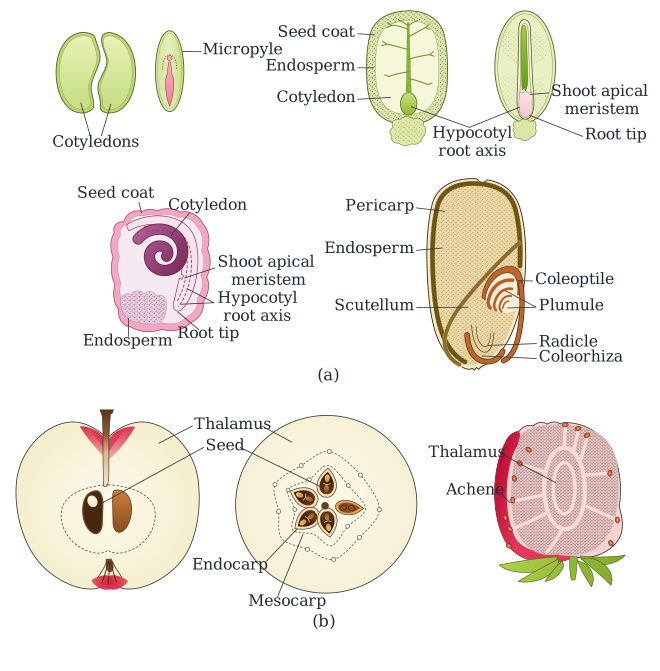
Drawn by us to help you understand the concept clearly, and verified to make sure it's accurate. For exams, practice from your NCERT textbook's own diagram.
Figure 1.15 has two panels, (a) and (b), placed side by side. Panel (a) shows the internal structure of seeds, and panel (b) shows two examples of false fruits.
Panel (a): Structure of some seeds
This panel is a labelled diagram of a seed in longitudinal section. It is meant to represent a typical dicot seed (like a bean or pea) on one side and a monocot seed (like maize or wheat) on the other, though the textbook figure usually combines both features into one generalised drawing or shows them separately. The key parts labelled are:
- Seed coat: The outer protective layer, derived from the integuments of the ovule. It is often shown as two layers: the outer testa and the inner tegmen.
- Embryo: The miniature plant inside the seed. It consists of:
- Cotyledon(s): In dicots, two fleshy, food-storing cotyledons are shown. In monocots, a single shield-shaped cotyledon (scutellum) is shown.
- Embryo axis: The central axis connecting the cotyledons. It has two ends: the plumule (the shoot tip, which will give rise to the first leaves and stem) and the radicle (the root tip, which will form the primary root).
- Endosperm: This is shown only in albuminous seeds (like castor or maize). It appears as a separate, often granular, tissue surrounding the embryo. In non-albuminous seeds (like pea or groundnut), the endosperm is absent because it was completely consumed during embryo development.
- Perisperm: In some seeds (like black pepper or beet), a persistent remnant of the nucellus is labelled as perisperm, lying outside the endosperm or embryo.
- Micropyle: A small pore in the seed coat, visible as a tiny opening near the radicle. It allows water and oxygen to enter during germination.
The diagram uses arrows or labels to point to each of these structures, making clear the spatial relationship between the seed coat, the embryo, and any residual nutritive tissue (endosperm or perisperm).
Panel (b): False fruits of apple and strawberry
This panel shows two fruits in cross-section or with a portion cut away to reveal their origin. The key teaching point is that the fleshy, edible part does not develop from the ovary wall (pericarp) but from the thalamus (the swollen receptacle of the flower).
- Apple (a pome): The diagram shows a longitudinal section of an apple. The central, papery core containing the seeds is the true fruit — it develops from the ovary. The thick, juicy, edible part surrounding the core is labelled as the thalamus (or receptacle). The outer skin is the exocarp of the thalamus. So the apple is a false fruit because the bulk of it comes from the thalamus, not the ovary.
- Strawberry (an aggregate accessory fruit): The diagram shows a strawberry in section. The small, hard, yellow-brown specks on the surface are the achenes — these are the true fruits, each a tiny, one-seeded dry fruit developed from a separate ovary of the flower. The large, fleshy, red, edible part is the thalamus (receptacle), which has swollen and become succulent. Again, the edible part is not derived from the ovary.
What the figure teaches …