Chemistry · Ch 9 — Amines
Basicity of Amines
Basicity of Amines
Amines as Bases
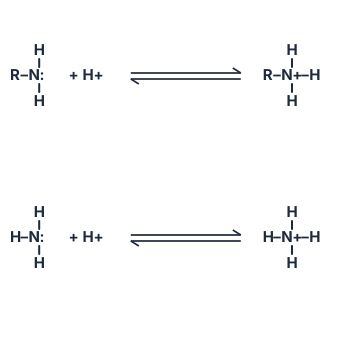
Because nitrogen holds an unshared electron pair, amines readily accept a proton from an acid and are therefore classified as Lewis bases. In the presence of a mineral acid, an amine is converted into the corresponding ammonium salt:
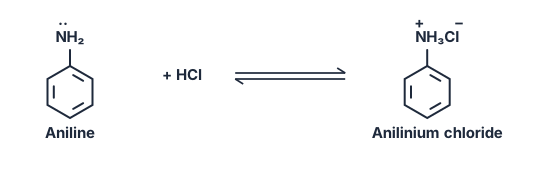
Aniline reacts with hydrochloric acid in the same way, giving anilinium chloride:
Drawn by us to help you understand the concept clearly, and verified to make sure it's accurate. For exams, practice from your NCERT textbook's own diagram.
Redrawn from the NCERT page with the structures, printed labels (NH2, ··, Aniline, + HCl, NH3Cl, Anilinium chloride) and reagent placement exactly as the textbook prints them. Every element of this display was checked against the printed page during the sweep's blind-judge verification pass, s …
These ammonium salts are water-soluble but insoluble in non-polar organic solvents such as ether — a solubility switch that is exploited to separate amines from non-basic organic compounds. The salts are not permanent: treating them with a strong base such as NaOH regenerates the free amine,
and this reversible salt-formation/regeneration cycle is itself the clearest evidence that amines are basic in nature.
Quantifying Basicity: and p
The basicity of an amine can be put on a numerical footing by treating its reaction with water as an equilibrium and writing a base-dissociation constant for it:
A larger (equivalently, a smaller p) signals a stronger base, since it means the equilibrium lies further towards the protonated ammonium ion. Table 9.3 below tabulates measured p values for a representative set of aliphatic and aromatic amines in aqueous solution — it is worth studying alongside the discussion that follows rather than memorised in isolation, since the pattern across the table is the real exam-relevant content.
| Name of amine | pKb |
|---|---|
| Methanamine | 3.38 |
| N-Methylmethanamine | 3.27 |
| N,N-Dimethylmethanamine | 4.22 |
| Ethanamine | 3.29 |
| N-Ethylethanamine | 3.00 |
| N,N-Diethylethanamine | 3.25 |
| Benzenamine | 9.38 |
| Phenylmethanamine | 4.70 |
Ammonia itself has p. Aliphatic amines, as a class, are distinctly stronger bases than ammonia, with p values typically falling in the 3–4.22 range, because the alkyl group(s) attached to nitrogen push electron density onto it (the +I, electron-releasing effect), making the lone pair more available for protonation. Aromatic amines behave in the opposite direction — they are markedly weaker bases than ammonia — because the aryl ring pulls electron density away from nitrogen. The reasoning behind each of these two broad trends, and the subtlety that appears once you try to rank amines finely within the aliphatic class, is explored below.
Why the Simple +I Picture Isn't Enough: Structure–Basicity Relationship
The basic strength of an amine is really a statement about how readily it forms its conjugate-acid cation, and more precisely, about how stable that cation is relative to the neutral amine. The more stabilised the ammonium cation, the more favourably the equilibrium sits towards protonation, and the stronger a base the amine is. Comparing basicities is therefore always, at heart, a comparison of cation stability.
(a) Alkanamines versus Ammonia
Drawn by us to help you understand the concept clearly, and verified to make sure it's accurate. For exams, practice from your NCERT textbook's own diagram.
Redrawn from the NCERT page with the structures, printed labels (–N:, + H+, –N+, –H) and reagent placement exactly as the textbook prints them. Every element of this display was checked against the printed page during the sweep's blind-judge verification pass, so wh …
When an alkanamine such as accepts a proton, the resulting substituted ammonium ion, , benefits in two related ways from the presence of the alkyl group: the alkyl group's electron-releasing (+I) character makes the nitrogen lone pair more available for bonding to the incoming proton in the first place, and once the cation has formed, that same +I effect helps disperse the positive charge over a larger volume, stabilising the ion. On this reasoning alone, basicity should rise steadily as more alkyl groups are added to nitrogen, giving the order
and this is, in fact, exactly the order observed in the gas phase, where no solvent is present to complicate matters.
In aqueous solution the order is NOT simply 3° > 2° > 1° — and no single effect explains why. Three factors act together, and all three must be weighed simultaneously to predict basicity correctly in water:
- Inductive (+I) effect — more/bulkier alkyl groups push more electron density onto nitrogen, favouring protonation and dispersing the resulting positive charge (favours 3° > 2° > 1°).
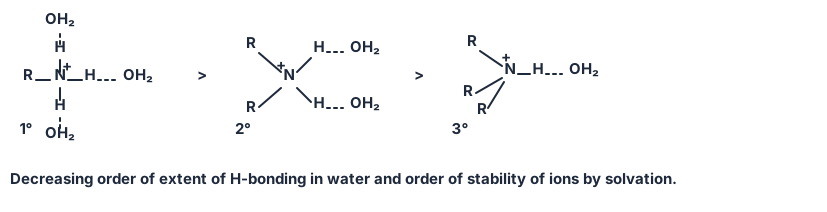
- Solvation of the cation — the ammonium cation is stabilised further by hydrogen-bonding with surrounding water molecules, which requires N–H bonds on the cation to act as hydrogen-bond donors to water. A primary ammonium cation has three such N–H bonds available, a secondary has two, and a tertiary has only one, so solvation stabilisation falls as substitution rises (favours 1° > 2° > 3°).
- Steric hindrance — bulkier or more numerous alkyl groups physically crowd the nitrogen and the water molecules trying to approach and hydrogen-bond to the cation, further weakening solvation as the alkyl groups get bigger, not just more numerous. Because (1) pulls one way while (2) and (3) pull the other, the aqueous-phase order for a given family of amines is a genuine trade-off, not a rule you can read off from the number of alkyl groups alone.
Weighing the +I effect against solvation for the aqueous phase, the expected order for basicity of aliphatic amines works out to
— the reverse of the gas-phase, inductive-only order — because in water, better-solvated (that is, less hindered, more N–H-rich) cations are stabilised more than the +I effect alone would predict. The extent of hydrogen bonding, and hence the stability gained through solvation, decreases in the sequence
Drawn by us to help you understand the concept clearly, and verified to make sure it's accurate. For exams, practice from your NCERT textbook's own diagram.
Redrawn from the NCERT page with the structures, printed labels (OH2, 1°, 2°, 3°, Decreasing order of extent of H-bonding in water and order of stability of ions by solvation.) and reagent placement exactly as the textbook prints them. Every element of this display was checked against the printed page during the sweep's blind-judge verificati …
as the crowding around nitrogen increases and fewer N–H bonds remain to hydrogen-bond to water.
However, this reversed order is itself only a first approximation, since steric hindrance depends on the actual size of the alkyl group, not merely its count. When the alkyl group is small — a methyl group, say — there is essentially no steric hindrance to hydrogen bonding, so solvation stabilisation behaves close to ideally. But once the alkyl group is bulkier than methyl (an ethyl group, for instance), steric hindrance to hydrogen bonding becomes significant even for a mono- or di-substituted amine. This is why the observed aqueous order is different for methyl-substituted and ethyl-substituted amines:
In both series the secondary amine comes out on top — striking the best balance between electron release and solvation/steric cost — while the position of the tertiary amine changes depending on how bulky the alkyl substituent is (ethyl's greater bulk hinders the tertiary amine's solvation more severely than methyl's does). The overall lesson is that no single effect — inductive, solvation, or steric — determines basic strength in water on its own; the observed order emerges only when all three are considered together, and this is exactly the kind of "discrepancy" you would run into if you tried to rank amines from the +I effect alone.
(b) Arylamines versus Ammonia
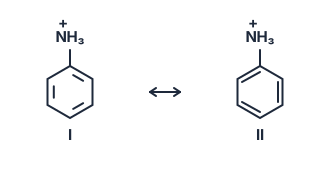
Aromatic amines such as aniline show a p that is far higher (i.e., far weaker basicity) than either ammonia or any aliphatic amine. The reason lies in where the nitrogen lone pair actually is. Because the group in aniline is attached directly to the benzene ring, the lone pair on nitrogen is not localised on nitrogen alone — it is delocalised into the ring through resonance, conjugating with the system of the aromatic ring. Writing out the resonance contributors of aniline shows that it is a hybrid of five structures: one with the lone pair localised on nitrogen and the ring in its normal Kekulé form, and three further structures in which the lone pair has moved into the ring, placing a negative-type contribution at the ortho/para carbons and a positive charge on nitrogen.

Drawn by us to help you understand the concept clearly, and verified to make sure it's accurate. For exams, practice from your NCERT textbook's own diagram.
Redrawn from the NCERT page with the structures, printed labels (:NH2, NH2, II, III, IV, ··) and reagent placement exactly as the textbook prints them. Every element of this display was checked against the printed page during the sweep's blind-judge verification pass, so w …
…
Drawn by us to help you understand the concept clearly, and verified to make sure it's accurate. For exams, practice from your NCERT textbook's own diagram.
Redrawn from the NCERT page with the structures, printed labels (NH3, II) and reagent placement exactly as the textbook prints them. Every element of this display was checked against the printed page during the sweep's blind-judge verification pass, so what …