Chemistry · Ch 10 — Biomolecules
Disaccharides
Disaccharides
Disaccharides
When a disaccharide is hydrolysed — using dilute acid or an appropriate enzyme — it splits into two monosaccharide units, which may be identical or different. The two monosaccharide units are not simply mixed together; they are joined covalently through an oxygen atom, in a bond formed by the loss of one water molecule between an group on one sugar and an group on the other. This oxygen bridge between two monosaccharide units is called a glycosidic linkage.
Reducing and non-reducing disaccharides
Whether a disaccharide behaves as a reducing sugar or not depends on exactly which groups are used to form that glycosidic linkage.
- If the glycosidic linkage forms using the reducing group (the aldehydic or ketonic carbon) of both monosaccharide units, neither free carbonyl remains available, and the disaccharide is a non-reducing sugar — sucrose is the example.
- If the linkage uses the reducing group of only one of the two units, the other unit's carbonyl group stays free (it can be regenerated in solution) and the disaccharide is a reducing sugar — maltose and lactose are the examples.
(i) Sucrose
Sucrose is one of the most familiar disaccharides. On hydrolysis it yields an equimolar mixture of D-(+)-glucose and D-(–)-fructose:
The two rings are joined by a glycosidic linkage running from C1 of -D-glucose to C2 of -D-fructose. Notice that C1 of glucose is glucose's own anomeric (reducing) carbon, and C2 of fructose is fructose's own anomeric (reducing) carbon — so this linkage consumes the reducing group of both component sugars at once. With no free aldehyde or ketone left on either ring, sucrose is a non-reducing sugar.
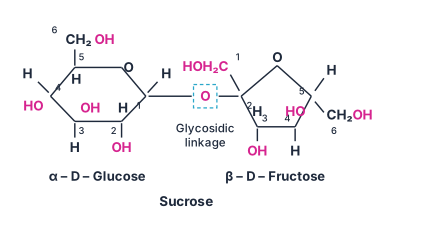
Drawn by us to help you understand the concept clearly, and verified to make sure it's accurate. For exams, practice from your NCERT textbook's own diagram.
Redrawn from the NCERT page with the structures, printed labels (Glycosidic, linkage) and reagent placement exactly as the textbook prints them. Every element of this display was checked against the printed page during the sweep's blind-judge verification pass, so wh …
Inversion on hydrolysis. Sucrose itself is dextrorotatory. But hydrolysing it produces dextrorotatory glucose together with laevorotatory fructose, and fructose's laevorotation () is numerically larger than glucose's dextrorotation (). The net effect is that the product mixture is laevorotatory overall. So the act of hydrolysing sucrose actually flips the sign of optical rotation, from dextro (+) in the starting sugar to laevo (–) in the product mixture — which is why the resulting glucose–fructose mixture is given the special name invert sugar.
(ii) Maltose …
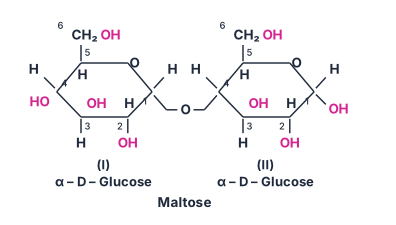
Drawn by us to help you understand the concept clearly, and verified to make sure it's accurate. For exams, practice from your NCERT textbook's own diagram.
Redrawn from the NCERT page with the structures and reagent placement exactly as the textbook prints them. Every element of this display was checked against the printed page during the sweep's blind-judge verification pass, so what you …
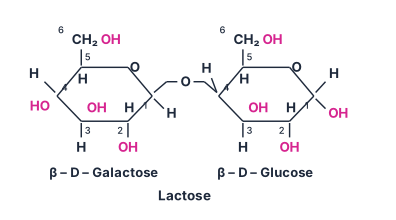
Drawn by us to help you understand the concept clearly, and verified to make sure it's accurate. For exams, practice from your NCERT textbook's own diagram.
Redrawn from the NCERT page with the structures and reagent placement exactly as the textbook prints them. Every element of this display was checked against the printed page during the sweep's blind-judge verification pass, so what you …