Chemistry · Ch 5 — Coordination Compounds
Bonding in Metal Carbonyls
Bonding in Metal Carbonyls
Metal Carbonyls: Homoleptic Complexes of CO
A metal carbonyl is a coordination compound in which the ligand is carbon monoxide. When every ligand attached to the metal is CO, the compound is called homoleptic. Most of the transition metals form such homoleptic carbonyls, and they turn out to have simple, well-defined geometries that follow directly from the metal's coordination number.
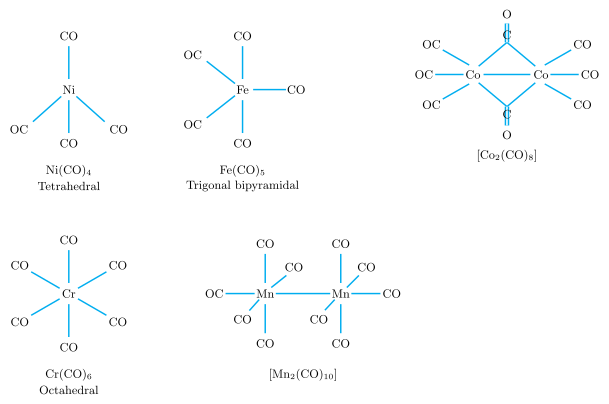
- — tetracarbonylnickel(0) — is tetrahedral.
- — pentacarbonyliron(0) — is trigonal bipyramidal.
- — hexacarbonylchromium(0) — is octahedral.
Notice the metal is written with an oxidation state of zero in each case — the metal atom is neutral, and CO is a neutral ligand, so the whole complex carries no charge.
Two carbonyls involve a direct metal–metal bond rather than a single central metal atom:
- — decacarbonyldimanganese(0) — consists of two square-pyramidal units joined to each other by a Mn–Mn bond.
- — octacarbonyldicobalt(0) — has a Co–Co bond that is additionally bridged by two CO groups sitting between the two cobalt centres.
(See fig-5-13 for the drawn structures of these representative homoleptic carbonyls.)
Drawn by us to help you understand the concept clearly, and verified to make sure it's accurate. For exams, practice from your NCERT textbook's own diagram.
The figure presents the structures of five representative homoleptic metal carbonyls—complexes in which a metal is bonded only to carbon monoxide ligands. Each structure illustrates a distinct geometry and bonding pattern, all following the rule that the carbon atom of each CO coordinates to the metal.
- Ni(CO)₄: Tetrahedral geometry. Nickel is at the centre, with four terminal CO ligands (each bound through carbon) at the vertices of a tetrahedron.
- Fe(CO)₅: Trigonal bipyramidal geometry. Iron is at the centre, with five terminal CO ligands—three in the equatorial plane and two axial.
- Cr(CO)₆: Octahedral geometry. Chromium is at the centre, with six terminal CO ligands at the vertices of an octahedron.
- [Mn₂(CO)₁₀]: A dimer with a direct Mn–Mn bond. Each manganese atom is surrounded by five terminal CO ligands, giving a coordination number of six per metal (five CO + one metal–metal bond). The overall geometry around each Mn is approximately octahedral.
- [Co₂(CO)₈]: A dimer with a Co–Co bond. Two CO ligands bridge the two cobalt atoms (each carbon bonded to both metals), and each cobalt also has three terminal CO ligands. This gives each cobalt a coordination number of six (three terminal CO + two bridging CO + one Co–Co bond).
The physical idea taught is that metal carbonyls adopt geometries that satisfy the 18-electron rule (also called the effective atomic number rule). For a metal in a low oxidation state, the total number of valence electrons around the metal (from the metal itself plus donated electrons from ligands) tends to equal 18, the electron count of the next noble gas. Each terminal CO donates 2 electrons, each bridging CO donates 2 electrons (shared between two metals), and a metal–metal bond contributes 1 electron to each metal's count.
The key formula the textbook develops with this figure is the 18-electron rule:
For example, in Ni(CO)₄:
- Ni(0) has 10 valence electrons.
- Each CO donates 2 electrons → electrons.
- Total = .
In [Mn₂(CO)₁₀]:
- Each Mn(0) has 7 valence electrons.
- Five terminal CO donate electrons.
- One Mn–Mn bond contributes 1 electron to each Mn.
- Total per Mn = .
In [Co₂(CO)₈]:
- Each Co(0) has 9 valence electrons. …
Synergic Bonding: How the M–CO Bond Forms
The bond between a metal and a carbonyl carbon is not a simple single bond — it has both σ and π character, and the two components reinforce each other. This combined, mutually strengthening bonding scheme is called synergic bonding.
1. The σ-bond ().
The carbon atom of CO carries a lone pair. This lone pair is donated into an empty (vacant) orbital on the metal, forming a normal coordinate σ-bond. Here CO acts purely as a Lewis base (electron-pair donor) and the metal as a Lewis acid (electron-pair acceptor).
2. The π-bond, i.e. back-donation ().
CO also has an empty antibonding orbital, , associated with its triple bond. A filled d-orbital on the metal donates electron density into this empty orbital of CO. This flow of electrons is in the opposite direction to the σ-donation — from metal to ligand — and is called back-bonding or back-donation.
The σ-donation (ligand → metal) makes the metal centre more electron-rich than it would otherwise be. Back-donation (metal → ligand) then relieves this build-up by pushing electron density back onto CO. Each half of the interaction supports the other — donation encourages back-donation, and this mutual reinforcement is exactly what "synergic" means.
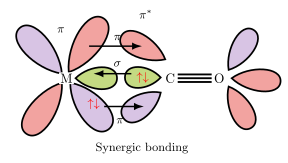
(See fig-5-14, which shows the σ lobe donating into the metal and the two π lobes back-donating from filled metal d-orbitals into the CO orbital.)
Drawn by us to help you understand the concept clearly, and verified to make sure it's accurate. For exams, practice from your NCERT textbook's own diagram.
The figure illustrates the synergic bonding between a metal (M) and carbon monoxide (CO) in a metal carbonyl complex. It shows two simultaneous electron-transfer processes:
- σ donation: A lone pair of electrons on the carbon atom of CO is donated into an empty orbital on the metal. This is labelled as C → M.
- π back-donation: Electrons from a filled orbital on the metal are donated into the empty (antibonding) orbital of CO. This is labelled as M → .
The two arrows in the sketch point in opposite directions, indicating the two flows. The key physical idea is that these processes are mutually reinforcing — the σ donation makes the metal more electron-rich, which enhances π back-donation; the π back-donation removes electron density from the metal, which further encourages σ donation. This cooperative effect is the synergic effect.
The consequence of this bonding is captured by two key trends:
- Strengthening of the M–C bond: The σ donation and π back-donation both contribute to a strong metal–carbon bond.
- Weakening of the C≡O bond: The back-donation places electron density into the orbital of CO, which is antibonding with respect to the C–O bond. This reduces the bond order of CO, weakening the triple bond.
The textbook develops the formula for the bond order of CO in the complex, which is derived from the molecular orbital diagram of CO. In free CO, the bond order is 3 (triple bond). After back-donation into , the bond order decreases. The general expression is:
where:
- = number of electrons in bonding molecular orbitals
- = number of electrons in antibonding molecular orbitals …