Chemistry · Ch 6 — Haloalkanes and Haloarenes
Preparation of Haloarenes
Preparation of Haloarenes
Haloarenes are prepared by two principal routes: direct halogenation of an arene ring, and diazotization of an aromatic amine followed by displacement of the diazonium group.
(i) Electrophilic Substitution on the Arene Ring
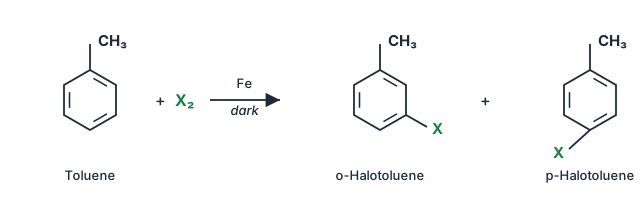
Aryl chlorides and aryl bromides can be obtained directly by treating an arene with chlorine or bromine in the presence of a Lewis acid catalyst such as iron or iron(III) chloride, with the reaction carried out in the dark. The halogen acts as an electrophile toward the aromatic ring, and substitution occurs at positions activated by any existing substituent.
For toluene, the methyl group directs the incoming halogen mainly to the ortho and para positions, so the reaction gives a mixture of -halotoluene and -halotoluene:
Drawn by us to help you understand the concept clearly, and verified to make sure it's accurate. For exams, practice from your NCERT textbook's own diagram.
Aryl chlorides and bromides can be made directly from an arene by electrophilic substitution: toluene reacts with in the presence of a Lewis acid catalyst (Fe) in the dark, and the methyl group directs the incoming halogen mainly to the ortho and para ring positions. The diagram shows the actual substitution pattern: lands on the ring carbon adjacent to in o-halotoluene, and on the carbon directly opposite it in p-halotoluene, the mor …
Because the para isomer is more symmetric and packs more efficiently in the solid state, it has a distinctly different (higher) melting point than the ortho isomer, which makes the two easy to separate.
Three points worth noting about this route:
- Reactions with iodine are reversible and only proceed usefully in the presence of an oxidising agent — such as or — that consumes the HI formed as a by-product and pulls the equilibrium toward the aryl iodide.
- Fluoroarenes are not made this way, because elemental fluorine is far too reactive to control safely in a direct substitution.
- The catalyst (Fe or FeCl) generates the electrophilic halogen species; without it the ring is not reactive enough toward .
(ii) From Aromatic Amines: Diazotization and Sandmeyer's Reaction
A second, more versatile route starts from a primary aromatic amine rather than the hydrocarbon itself.
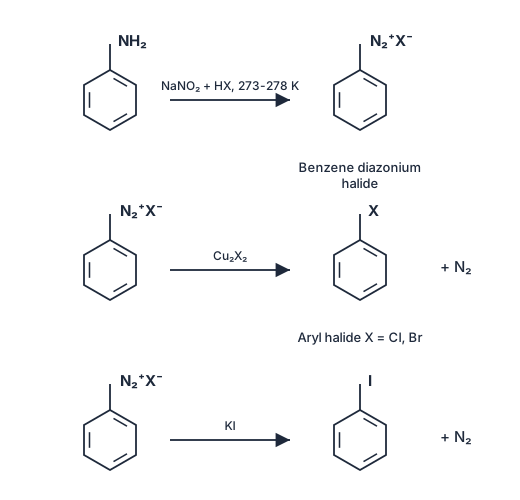
Step 1 — Diazotization. When a primary aromatic amine, dissolved or suspended in a cold aqueous mineral acid, is treated with sodium nitrite at a low temperature (273–278 K), it is converted into a diazonium salt:
This benzene diazonium halide is unstable and is generated fresh, immediately before it is used in the next step.
Step 2 — Displacement of the diazonium group. Mixing the freshly prepared diazonium salt solution with cuprous chloride or cuprous bromide replaces the group with or , releasing nitrogen gas:
This substitution of the diazonium group using a cuprous halide is known as Sandmeyer's reaction, and it is a reliable way to place chlorine or bromine at a specific ring position — namely, wherever the amino group originally was.
Drawn by us to help you understand the concept clearly, and verified to make sure it's accurate. For exams, practice from your NCERT textbook's own diagram.
The second route to a haloarene starts from a primary aromatic amine, not the hydrocarbon itself. Treating the amine with and a mineral acid at 273-278 K converts into the diazonium group, giving benzene diazonium halide. Mixing this freshly prepared salt with cuprous chloride or cuprous bromide () displaces with or -- this substitution is Sandmeyer's reaction, and it places the halogen exactly where the amino group used to be. Replacing the diazonium group with iodine needs no …
…